Archive for April, 2024|Monthly archive page
chouette Number One, Spring 2024 is live!
Filed under: The Brouillon | Tags: Canadian poetry, Carla Frey, chouette, literary periodicals
 Leave a comment
chouette, a new, online literary periodical based in Montreal has published its first number. It includes, among much else, two poems of mine, “Simulacra” and “A lot of poets…” along with a poem by a student of mine, Carla Frey. You can read chouette, Number One, here.
As well, I’ve recorded “A lot of poets…” for your listening pleasure, hearable, here.
An Old Man’s Eagle Mind: on Peter Dale Scott’s Dreamcraft
Filed under: notices and reviews | Tags: Canadian poetry, Czeslaw Milosz, Dreamcraft, ethogeny, Peter Dale Scott, poetry, poetry reviews
Leave a comment 
The publication of Peter Dale Scott‘s latest volume of poetry is bookended by last year’s appearance of his study of Czeslaw Milosz, Ecstatic Pessimist, and this year’s release of Reading the Dream: A Post-Secular History of Enmindment, quite the trifecta for a man who turned ninety-five in January of this year (2024).
The poems collected in Dreamcraft, on might say, have vista. This latest volume’s being published in the poet’s ninety-sixth year, it comes as no surprise to find poems on old age. “Eros at Ninety” is both humbly, humorously self-deprecating and wise. “A Ninety-Year-Old Rereads the Vita Nuova” and “After Sixty-Four Years” ruminate over the changing experience of art, here, that of Dante and Grieg, within a lifetime’s perspective. The longer one lives, the more acquaintances one loses to death: elegies for lost friends—Robert Silvers and Scott’s lifelong friend Daniel Ellsberg, among them—take up nearly a third of the book. Four poems are addressed to Scott’s friend, Leonard Cohen, the book’s title track, “Dreamcraft,” the explicit elegy “For Leonard Cohen (1934-2016),” “Commissar and Yogi,” and a poetic back-and-forth the two shared just before Cohen’s death, “Leonard and Peter” (included, as well, in the last collection of Cohen’s work, The Flame). The volume’s perspective, from within “the long curve of life” (words from the book’s first poem, “Presence”) is evident in the poems that embed the poet in larger processes, whether “the bicameral brain that makes // obsfucation of mere fact / so much more beautiful” (“The Condition of Water”), our genetic character (“Dreaming My DNA”), the Earth itself (“Deep Movement”), “cosmic space / …knowable / by those specks of light // at great distance from each other,” or History’s ethogeny, which Scott glosses as “cultural evolution” (“Moreness”). Loss and the long view bring the poet’s closest relations into focus in more intimate poems, those for his daughter, Cassie (“To My Daughter in Winnipeg” and “Missing Cassie”) and wife, Ronna Kabatznick (“Enlightenment” and “Red Rose”).
Last year’s publication of Ecstatic Pessimist: Czeslaw Milosz, Poet of Catastrophe and Hope reveals Milosz as a kind of éminence grise in Dreamcraft (and, indeed, throughout Scott’s poetry). Though their friendship at the University of California, Berkely, was short-lived (roughly from 1961-1967), Milosz’s notions of the function of poetry and the poet, as one whose “poetic act both anticipates [an emancipated] future and speeds its coming,” are determinative: anyone at all familiar with Scott’s poetry and prose will hear the echo of Milsoz’s Nobel Prize acceptance speech: “In a room where people unanimously maintain a conspiracy of silence, one word of truth sounds like a pistol shot.” Scott’s lifelong relationship to Milosz’s poetry and thought, if not with the man, finds expression in the five-part sequence “To Czeslaw Milosz,” wherein Scott reflects on that relationship, one Polish word or one poem or idea at a time. This sequence is balanced, as it were, by “The Forest of Wishing,” originally published in 1965, which addresses (among other things) Milosz’s reaction to the American Counterculture of the 1960s in an earlier style of Scott’s, remarkable for a more elusive density of suggestion than is found in his poetry from Coming to Jakarta (1988) to the present volume.
Scott’s mature style might be said to take its cue from Milosz’s admonition (also from his Nobel Prize acceptance speech) that the poet need “liberate [themselves] from borrowed styles in search for reality.” The result, in Scott’s case, is sure to irritate those readers who need their poetry to “tell it slant” (whether that spring from a post-Eliotean prejudice for “metaphor” or a post-Language demand that the linguistic medium be estranged, if the aesthetic inclination is even so self-aware). A case in point might be the poem “Pig”:
Aside from the poem’s being a recognizably generic “lyric” (a first-person anecdote climaxing in an epiphany), I can well imagine readers with a taste for the mimetic virtues of, say, Seamus Heaney, Eric Ormsby, or (more recently) Kayla Czaga, or the verbal deftness of Michael Ondaatje at his best, dissatisfied with the description of the pig’s butchering (in the second, third, and fourth tercets), desiring in place of, for example, the words ‘slaughtered’, ‘cutting’, and ‘squealing’ at least a more sensuously robust diction if not a vividly inventive image to present rather than refer to the action. Such readers would be even more scandalized by the poem “Mythogenesis” with its opening “The OED defines / both mythopoeia and mythogenesis / as the same: the creation of myths,” lines which set the tone for the explicatory prosaicness of the poem that follows (a prosaicness, however, that slyly reproduces, line for line, the original email sent to the editors of the Oxford English Dictionary). I, too, have struggled for my own reasons with this tendency in Scott’s style over the years, and, were this notice a “review,” I’d be obliged to indulge in the workshop nit-pickery that would find fault with (“criticize”) a certain word choice here, a syntax that might be made more mimetic there, or even the collection’s title, but such an approach too often merely brings into view the reviewer’s prejudices or limitations (let alone the hatchet they might have to grind) than serving to illuminate the work under consideration (a problematic addressed, in fact, by the book’s penultimate poem “A Quinkling Manifesto”). Scott, himself, has responded to critics who find his poetry too prosaic, reminding them the same accusation was levelled at the prosody of Williams Carlos Williams a century ago. One could point to that other compositional sensibility (with which Williams was briefly associated) present in the “Objectivist” poets (notable for their engagement), among them, Lorine Niedecker, Carl Rakosi, or Charles Reznikoff. But more to the point, it is precisely this clinamen of Scott’s style, the way it swerves from any such obvious borrowings or influence, that is an index of that essential drive in his entire oeuvre, a “search for reality,” the telos of his work that is the principle measure of its success or failure, if a critical judgement is indeed called for.
As I’ve observed, the poems in this latest (if not last) volume take the perspective of “an old man’s eagle mind” (as Yeats called it), wherein “the long curve of life” becomes visible, the horizon for whatever else might come into view. This perspective is, perhaps, no more evident than in the book’s final, thought-provoking poem with its explicitly ethogenic theme, “Esprit de l’Escalier“:
The poem, in post-secular fashion, has as its epigraph a verse from the Book of Zechariah (4:6) (Scott the first to my knowledge to articulate a post-secular sensibility, in advance of Habermas’ developing the concept in its present form in 2008), a verse with tonal implications for what follows. We are admonished to “not just talk about politics // which let’s face it / we can do nothing about” (at least those of “us here / at this Chanukah table”) but “about culture // preparing people’s minds / for tomorrow’s revolution” (words which, again, echo Milosz’s “The poetic act both anticipates the future and speeds its coming”). Curiously, the poem speaks of a “black windshield” (likely the image that, in part, inspires the book’s cover art) “smeared… // with the grime of facts,” a brow-furrowing sentiment to flow from the pen of so assiduous a researcher, whose work, prose and poetry, has laboured to uncover that “conspiracy of silence” and scatter it with a resounding “word of truth.” (That is, perplexing as long as we remain insensitive to the potential tonal complexity of ‘facts’ and the even more important and profound distinction to be made between “facts” and truth…). This grime is to be cleaned “with hope,” a hope that waits for “the great poet // on whose shoulder / that eagle flying / above and ahead of us // in the darkness / will come down briefly to rest.” These lines are richly suggestive. On the one hand, they mark Scott, I think, as one of those increasingly rare poets who demand poetry play an orienting if not guiding role in culture and society. On the other, that “eagle flying / above and ahead of us” is at first elusive as allusive. Is it a mere—if complex—metonymy, invoking the eagle’s powers of sight? Does it allude to the eagle formed by the just souls in the heaven of Jupiter in Paradiso XIX? Is it a symbol of God, via the bird often associated with Zeus (‘Z-eus’, ‘d-eus’ (which, regrettably, only rime with ‘th-eo’…))? More tentatively, it brings to this mind, anyway, the idea of the kommende Gott, the “coming god” in Hölderlin’s “Bread and Wine” (however much that god is, in fact, Dionysius…), perhaps that god who is the only one “who can save us” in Heidegger’s late, portentous phrase. This interpretive question is resolved, however, by turning to Reading the Dream, where we discover Scott’s eagle alludes to the spirit of Rousseau in Hölderlin’s ode to the French thinker, that “flies as the eagles do / Ahead of thunder-storms, preceding / Gods, his own gods, to announce their coming” (“wie Adler den / Gewittern, weissagend seinen / Kommenden Göttern voraus“). The rich figurative resonance of these lines that demands such learned, interpretive labour marks them, too, as belonging to a past, if not passed, poetic, one rarely practiced today, if at all.
For many, I think, Scott’s vatic stance in this poem (however domesticated in its opening scene) and the faith in poetry it expresses will place him beyond a certain pale. The present, at least North American, mood is more skeptical. Those with some historical sense will too easily remember those poets who aspired to influence, cultural, social, and political, and went “wrong, / thinking of rightness.” Auden’s words, “poetry makes nothing happen,” still express a common sentiment, and, for those who do engage the question of the relation of poetry and politics seriously, it remains an open-ended, complexly recalcitrant problem. In his defense, Scott, in Ecstatic Pessimist, invokes Virgil, Dante, Blake, Shelley, and Eliot (6). More forcefully, Scott’s study of Milosz is a sustained argument for the potential social force of poetry, exemplified by his subject, notably “his contributions in the 1950s and 1960s to what became the intellectual culture of Solidarność” (5). What is striking is how this last poem in Dreamcraft departs from Scott’s characteristic poetry-of-truths that ring out like “a pistol shot.” It might be argued that its prophetic vision, of that mysterious justice-to-come and its poet, draws on poetry’s power to posit the counterfactual (how matters could or should be, to paraphrase Aristotle), to imagine a non-place (u-topos), a place that is not because it is only yet-to-be, and only potentially so. In contrast to the probing of uncomfortable truths (facts) characteristic of so much of Scott’s poetry, the fictionality of the poem’s vision (its being (only) imagined) invites, demands, a suspension of disbelief (the condition of imagining what is not as if it were), evoking our Negative Capability, that ability to live “in uncertainties, Mysteries, doubts, without any irritable reaching after fact and reason.” By its very unreality, then, the poem evokes that resolve that poetry—and social action—require….
That Scott’s oeuvre in this way, from his Seculum trilogy to Dreamcraft, demands the engaged reader to consider and wrestle with the art of poetry, poetry and politics, investigative fact and visionary fiction is evidence of its sophisticated achievement. Such reflection, it has long seemed to me, is the condition for any understanding of poetry, worthy of the name, an understanding that needs precede any critical appraisal. This resistance to a ready assimilation to existing literary-aesthetic canons—despite the surface, apparently-prosaic transparency of the poetry—testifies to Scott’s poetry’s being poetry, making, creating works possessed of a novel uncanniness that adds something new, not merely accomplished, to the world of letters, if not the world-at-large.
(If so moved, you can purchase a copy of Dreamcraft by clicking on the book’s cover, above.)
“Statements, terms, and jargon”: Tuesday 9 April 2024
Filed under: "statements, terms, and jargon" | Tags: Marxist literary criticism, Marxist poetics, poetics, quantum theory, social media, the lyric
Leave a comment 
Time constraints and temperament restrict many of my thoughts to remarks. Thus, what follows are emphatically fragments, metonymies (parts) of potentially more-extended discourses and drafts (essays) holding the promise of future elaboration…
These posts take their title from Jeffrey C. Robinson’s description of his work-in-progress Romantic Manifestoes Manifest, an anthology of “statements, terms, and jargon from the ‘Romantic mother-lode’ (Anne Waldman).”
RE: “incommensurability”—Art which resists immediate comprehension, “consumption,” and “the commodity form”—BUT all poetry, even the most banal, possesses an aesthetic reserve, infinite in principle, i.e., every textual artefact de jure and de facto possesses an infinity of significance or meaning (not that all of that in every instance is necessarily “interesting,” but even something’s being interesting is always relative in many ways…).—The language of every poem must possess an aesthetic minim even to appear at all: “absolute transparency” = invisibility. And every poem, especially a poetry book, in its materiality is caught up inescapably in the means of production and the market and liquidated in exchange…
Poem as “economy”; poem as “magic” or spel…
The detonation of the A-bomb not as an extension of a Promethean process sparked by the discovery/domestication of fire but as rupture, as a quantum leap, underwritten itself by quantum theory, which, itself, radically, breaks with and transcends the Atomism that governed physics since at least Democritus, marking the mind’s reaching a limit (indicated by the contradiction between the undeniable efficacy of quantum mechanics but our inability to understand or grasp the logic of the reality underlying quantum mechanics), along with Gödel’s Incompleteness Theorem, all a piece, perhaps, with the advent of industrial capitalism and its exploitation of fossil fuels, which, in turn, push the biosphere to and beyond the Holocene which nurtured agriculture and the consequent division of labour that set some human societies, fatefully, in the direction of the present…
Within the horizon of social media, the “selfie,” what consequences for the poetic genre that puts the self on display, the “lyric”?…
Hell’s Printing House: Luffere & Oþere: Amoretti from Marchend Prill (2003)
Filed under: Hell's Printing House | Tags: amoretti, Canadian poetry, Ilona Martonfi, love poetry, March End Prill, poetry, poetry chapbooks, poetry recordings
Leave a comment 
Aside from the pages of little magazines and those of certain, indulgent anthologies, by poems really first made their way in the world in the form of chapbooks. I hadn’t yet published a full-length trade edition, when I went on a “European tour” in 1996, reading in Munich (twice), Heidelberg, and Amsterdam, two self-published chapbooks, Gloze (1995) and On the Phantom Air Ship Mystery (1995), my calling cards.
Joachim Utz, the sponsor of my reading at Heidelberg University’s Anglistiches Seminar, observed that my chapbooks reminded him of William Blake’s. This new category of post takes its inspiration from his remark. “Hell’s Printing House” will showcase my chapbooks, describing them, detailing their contents, linking poems that have already been published at Poeta Doctus, and presenting a new recording of one of their poems.
It is hoped these posts fill the lacunae between full-length collections, assuring those (apparently) few (and valued) readers who follow my production with interest that I am hard at work, going my own direction, at my own pace, trusting those intrigued might be charmed enough to tarry along….
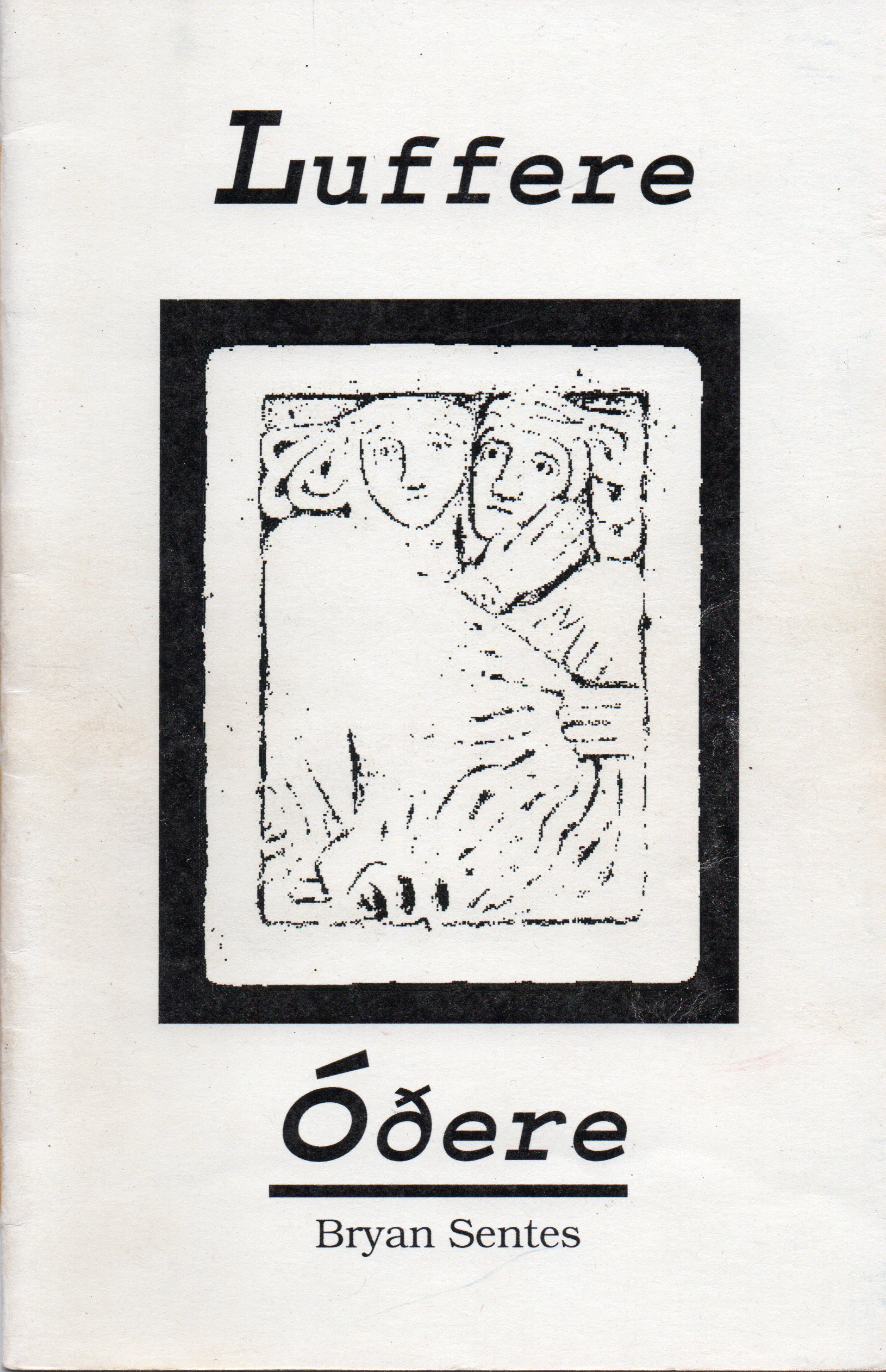
The first five chapbooks I’d bound were made to collect and “publish” work otherwise unpublished in periodical or book form. Luffere & Oþere marked a departure, as it was the first chapbook that collated the poems I was to perform at a reading. At the time, Ilona Martonfi organized (among many other events) an annual Valentine’s Day reading, “Lovers and Others,” and kindly invited me to read. I don’t remember exactly what reasons I gave myself at the time, but it seemed somehow appropriate to have the poems I would read ready in print-form for interested parties, a good opportunity to issue a new chapbook, a practice I was to maintain for many years. Luffere & Oþere are the oldest forms of the words ‘lovers’ and ‘others’ in English.
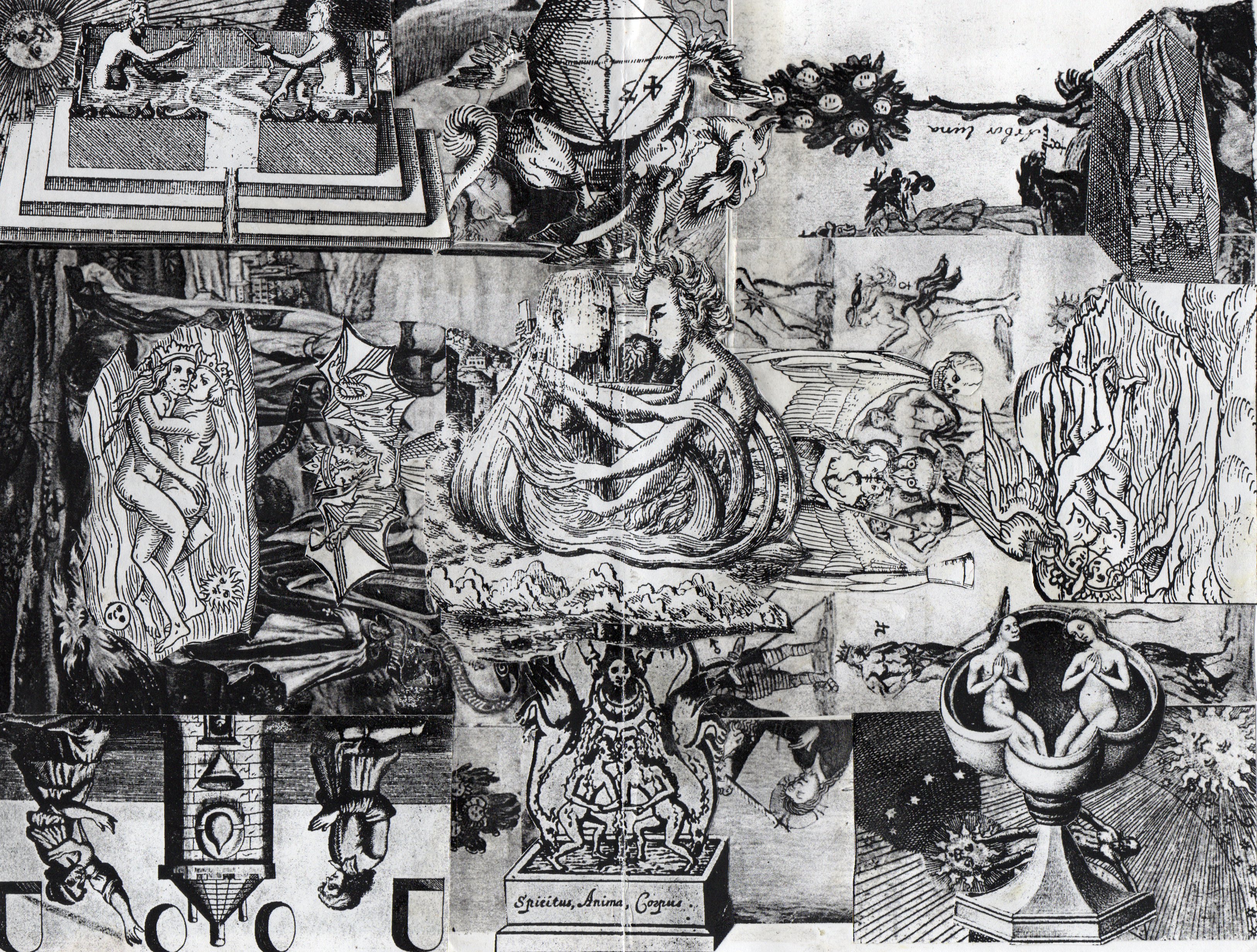
Not only was this chapbook the first made for a reading, but it is also the first with original artwork (in this case, two collages) for the flyleaf, outer and inner:

However much amor is one of the great poetic themes, it’s not one I have often dared (except for one poem, known only to my closest friends). However, at the time, I had written a poetic sequence, an extension of the concerns motivating X Ore Assays and Seventh Column, that was to be published years later in 2011 by Book*hug, March End Prill. This sequence, compositionally, adhered to a resolutely Surrealist poetic (“the dictation of thought in the absence of all control exercised by reason and outside all moral or aesthetic concerns”), informed as much by Breton as by ethnopoetics:
Songs are thoughts, sung out with the breath when people are moved by great forces & ordinary speech no longer suffices. Man is moved just like the ice floe sailing here and there in the current. His thoughts are driven by a flowing force when he feels joy, when he feels fear, when he feels sorry. Thoughts can wash over him like a flood, making his breath come gasps & his heart throb. Something like an abatement in the weather will keep him thawed up. And then it will happen that we, who always think we are small, will feel smaller still. And we will fear to use words. But it will happen that the words we need will come of themselves. When the words we want to use shoot up of themselves—we get a new song.—Orpingalik
At any rate, I combed through March End Prill and abstracted a sample of, if not all, the poems defensibly “erotic.” The titles are their first lines or the first words thereof:
Contents
- falling asleep
- she was coming for supper
- durée
- dear Wife
- we must really be out of touch
- Can’t wait for you
- mornings spooned
- When I get the chance
- my old friend dumped his
- Godammit! Love’s
- Bedrock
Here’s a new recording of these poems, for those who missed the reading!
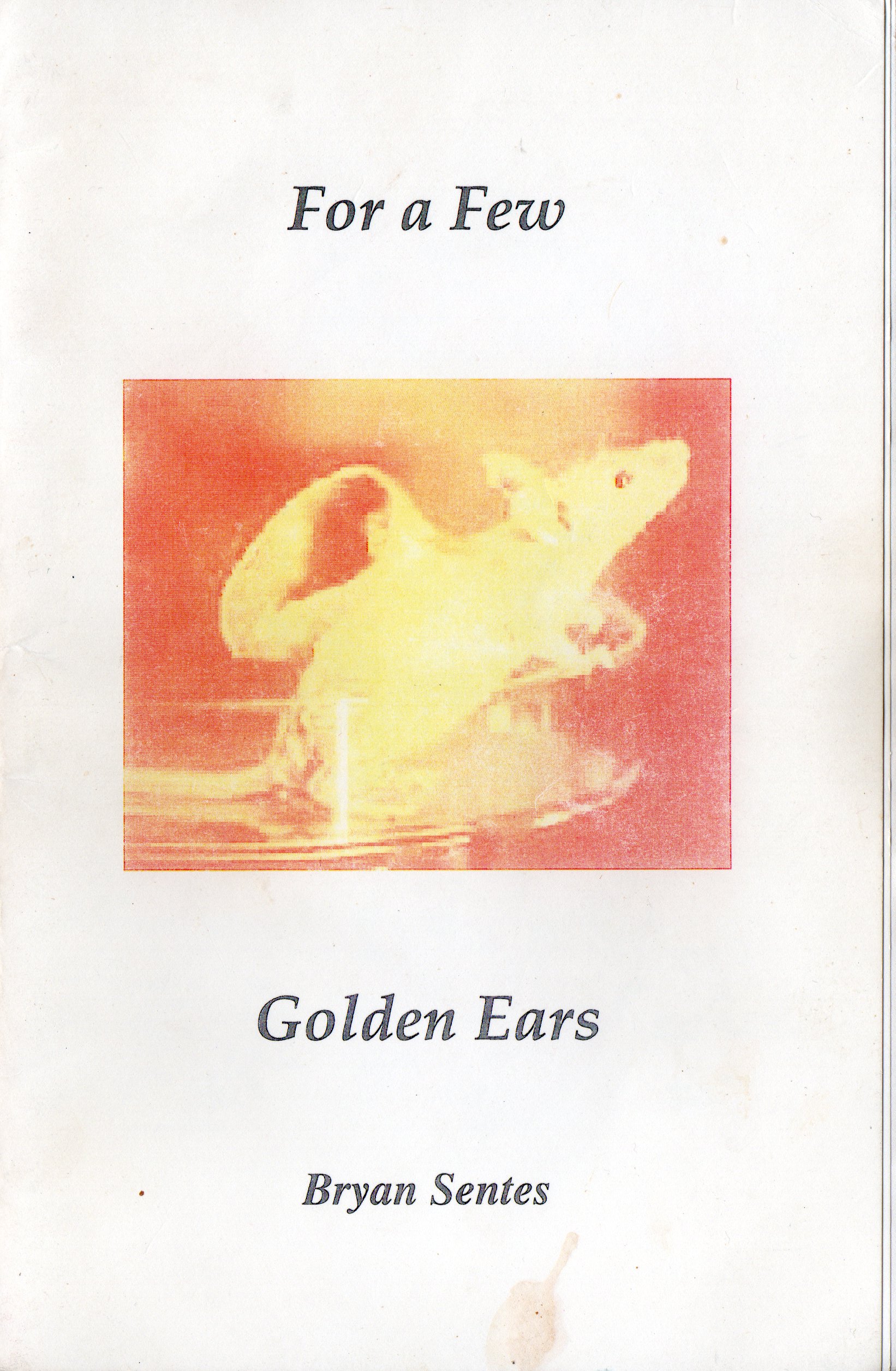
Next month: For a Few Golden Ears (2004).

 Poeta Doctus