Archive for the ‘The Brouillon’ Category
A source study of Charles Reznikoff’s “Amelia”
Filed under: The Brouillon | Tags: Charles Reznikoff, Objectivism, poetry, poetry criticism, Richard Hyland
 Leave a comment
 A source study of Charles Reznikoff’s “Amelia”
The late, great Objectivist poet Charles Reznikoff has long been a favorite and model of mine. Jacket 2 does us all the favor of publishing a study of Reznikoff’s poem “Amelia” from his multi-volume work Testimony, criminally out of print. Charles Bernstein summarizes the virtues and import of this excellent piece of literary scholarship:
Richard Hyland, Distinguished Professor, Rutgers Law School, Camden, New Jersey, has compiled the fullest account of the sources of a Reznikoff poem, together with a detailed commentary on theAmelia Kirwan case and the poem Reznikoff wrote based on this case. Many of Reznikoff’s poems, especially those in Testimony, are based on legal records. But there has been little research on the exact relationship between the legal record and the poem, with the general assumption that Reznikoff used only language from the legal records, cutting away but not adding any of his own words. The key to Reznikoff’s aesthetic is his selection and condensation of the source materials.
Surely Reznikoff is a paradigmatic poet for all documentary and source-based poetry of the 20th century and exemplary for many of us who use appropriated or found material in our work. By looking at the 1910 court records, we can now see the source of the language that Reznikoff incorporated into his poem, at least in this one instance. Hyland goes much further. By contrasting the aesthetic pitch of Reznikoff’s slim poem with the social efficacy of Judge Edward Bartlett’s magisterial decision, Hyland gets to the core issue of the office of poetry. Reznikoff’s poem, he notes, perhaps wryly, is “weak.”
New for the new year, the New Gnosticism in poetry!
New for the new year, the New Gnosticism in poetry!
Why not start this new year off with something new, a primer on the New Gnosticism in poetry at the journal Talisman? The New Gnosticism got up Barrett Watten’s nose, so there must be something to it!
(And not to chew on any sour grapes, here (more like raisins, at this point), but apparently Grand Gnostic Central was or is just too Canadian for inclusion…)
Grand Gnostic Central
That’s not typing, that’s écriture
Filed under: The Brouillon | Tags: écriture, Clark Coolidge, Jack Kerouac, literary criticism, Ron Silliman, the novel, Truman Capote, Visions of Cody
Leave a comment Truman Capote famously quipped regarding Kerouac’s writing, “That’s not writing, that’s typing!” Happily, thanks to the heightened serendipitous dimensions of cyberspace, I happened on a closer reader of Kerouac, Clark Coolidge. One can mouse around the links from the original Jacket2 posting, but what caught my attention was Ron Silliman’s remark that
One test of Coolidge as a critic – you can find some other non-Kerouac samples as well on his EPC web page – is that he gets the importance of Visions of Cody, not just as a central work in the Kerouac canon, but quite possibly the Great Novel of the past century, right up on a par with Ulysses & Gravity’s Rainbow & the best of Faulkner (who is not unlike Kerouac in that his best work often comes in passages, rather than entire books).
I’ve long admired Kerouac’s achievement in The Legend of Dulouz, his novels taken as one multivolume work, but I can’t recall having encountered anyone else who appreciated what happens when the novel taps into its original energies as the genre that is by definition novel, as “the genre that contains all other genres,” when the narrative becomes écriture and one doesn’t know what one is reading anymore, only that one is reading. I’m glad to have chanced on someone else who gets it.
What’s the ideogram for ‘sheer inertia’?
Filed under: The Brouillon | Tags: Ideogram, Modernism, poetics, Revelator, Romanticism, Ron Silliman, the New Sentence
Leave a comment Normally, I’m given to giving more thought to what I post here and developing that thought at greater length and depth, but, sometimes, maybe, a blog is a place to allow oneself to think out loud, to essay some positions, without the explication and footnoting a more rigorously writ out thesis would demand. To wit:
 Reading a random piece of praise from Charles Bernstein for Ron Silliman’s latest addition to what amounts to his lifelong long poem, Revelator, I can’t help but think that the paratactic poetic of Silliman’s New Sentence is in a way the afterlife of Pound’s Ideogram, so trenchantly studied in what should be widely-known as the classic study by Laszlo Gefin. This insight, however true, helps articulate a growing discomfort and dissatisfaction with what passes for the contemporary avant garde in English-language poetry, which seems increasingly, to me, at any rate, as a dead end of that literary High Modernism that flourished in the first quarter of the Twentieth Century as that ghost of Romanticism that haunted the end of the Nineteenth Century was a faint echo of the Spirit of the first and second generations of British Romanticism about a century before it.
  However much our practice must be (never mind can’t help but be) “absolutely modern” (a modernity whose horizon, arguably, includes what is academically termed Romanticism, Modernism, and Postmodernism), said modernity is also always relative to its precursors, demanding, at times, a gesture for the sake of sheer differentiation, precisely what inspired Pound’s return to meter and rhyme in Hugh Selwyn Mauberly (1915!). That is to say, however pertinent parataxis might be said to be to our moment, as a poetic practice it has become, if not merely reflexive, at least de rigueur, which is to say as dogmatic as any compositional value in any school of poetry, another hollow idol for the hammer to sound.
Psychomagically Beyond Appropriation
Filed under: The Brouillon | Tags: conceptual poetics, conceptual poetry, Gilvan Samico, Lucas de Lima, Montevidayo blog, poetics
Comments (2) Psychomagically Beyond Appropriation
Over at the Montevidayo blog, Lucas de Lima calls our attention to the example of Gilvan Samico, an artist whose work links up with certain heretical dimensions of contemporary poetry and poetics.
Does the imagination have limits? Are we actually in the time of “uncreative writing”? In the age of information overload, is appropriation–the resampling of other texts–the last reservoir of our creativity? Is there really nothing new under the sun to be said or done?
When I look at the engravings of Gilvan Samico, the Brazilian artist who died yesterday at the age of 85, the answer to all these questions turns out to be a resounding no.
Translation & Biocultural diversity
Filed under: The Brouillon | Tags: ecolinguistics, ecopoetics, Monica Mody, Montevidayo blog
Leave a comment Monica Mody at the Montevidayo blog has posted some thought-provoking remarks and links concerning “ecolinguistic issues in translation studies.” As she writes: “These are some beginning thoughts about strategies for translation in the midst of ecological crises, shedding of old stories, eco-awakenings.” Surely worth following up!

Learn how to type at ACAD
Iffn ya’ll got an ol’d manual typewriter hangin’ about, here’s a worthy project to retire it to!

 ACAD Liberal Studies Instructor Derek Beaulieu is planning to teach his students how to type.
Starting in January, every student in Beaulieu’s Creative Writing course will be required to create all of their notes, their assignments and their final projects on portable manual typewriters.
Students will be required to write in class, in coffee houses and on public transit in order to make traditional poetry and prose, but also to use the typewriters to create portraits and music — all in order to explore the artistic possibilities of these sadly neglected machines.
In order to bring these ideas to his students, Beaulieu is seeking the donation of 35 portable, manual typewriters in working condition.
“Typewriters epitomize the romance of being a writer. Every typewriter harkens back to a golden age: the clack of the keys, the ding of the carriage, the rachetting of the roller. This is an opportunity for students…
View original post 216 more words
Rhyme: imagine that happening in poetry again
Filed under: The Brouillon | Tags: Michael Robbins, poetry, rhyme, Robert Archambeau, Samizdat blog
Leave a comment http://samizdatblog.blogspot.ca/2013/11/imagine-that-happening-again-in-poetry.html
Robert Archambeau at Samizdat blog presents some chewy gists on rhyme served up at a recent mini-conference.
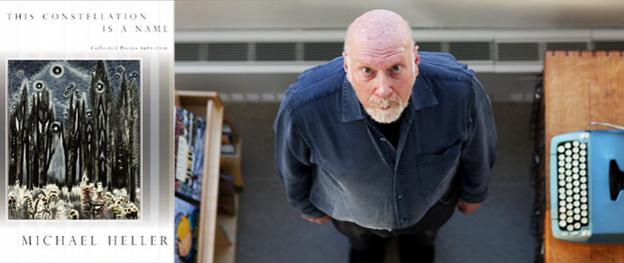
Review of Michael Heller’s collected poems @Jacket2
Review of This Constellation Is a Name @ Jacket2
As Ezra Pound wrote Louis Dudek: “C/vn not a one man job.” Happily, readers other than my lone self appreciate the writing of Michael Heller, and Eric Hoffman has reviewed Heller’s collected poems, which review is readable at the link!
On not disputing taste
Filed under: The Brouillon | Tags: Adam Plunkett, criticism, poetry criticism, Stephen Burt, taste
Leave a comment The teapot in the tearoom of the North American poetry milieu is all aripple again and cups aclatter in their saucers. Boston Review publishes a conversation with poet, critic, and scholar Stephen Burt and (via the Véhicule Press blog via Evan Jones) one can read Adam Plunkett in the The New Republic take Burt to task—on the matter of taste. Taste? In 2013?!
I quote a supposedly well-known poet-critic: “Consider the way of the scientists rather than the way of an advertising agent for a new soap.”
This serious artist has more important things to attend before Time’s wingéd chariot kindly stops for him. Or, to quote again that well-known poet-critic:
I would much rather lie on what is left of Catullus’ parlour floor and speculate the azure beneath it and the hills off Salo and Riva with their forgotten gods moving unhindered amongst them, than discuss any…theories of [taste] whatsoever….I shall not argue.

 Poeta Doctus