Archive for the ‘The Brouillon’ Category
“Swallowed Repulsion”: Johan Jönson’s Soiled Conceptualism – Montevidayo
“Why in all this discussion about Conceptualism has there been no mention of this incredibly famous [Swedish] poet?”
“Swallowed Repulsion”: Johan Jönson’s Soiled Conceptualism – Montevidayo.
We have to talk: Poetry on the Brink at Boston Review
This forum now on-line at Boston Review, though a little overwhelming with its nineteen participants, is exemplary of just what we could use more of, the more varied the participants, the better! Poetry on the Brink | Boston Review.
Peter Dale Scott reads the whole of Coming to Jakarta
Filed under: The Brouillon | Tags: Coming to Jakarta, Peter Dale Scott
 Leave a comment
 Peter Dale Scott reads the whole of Coming to Jakarta
Freeman Ng has done a great service by filming Peter Dale Scott read through and comment on the first volume of Seculum, Coming to Jakarta (1988): here’s the latest instalment.
Un inclassable: Bryan Sentes
A very perceptive and much appreciated French-language notice of my work to date. Merci M. Malette!
a review of “Please No More Poetry”
Filed under: The Brouillon | Tags: conceptual poetry, derek beaulieu
Leave a comment Frank Davey provides some valuable context to and for our contemporary avant-garde. His observations re nichol’s Martyrology demand constant reiteration…

 Frank Davey has reviewed Please, No More Poetry at London Open Mic Poetry Night.
from the Rhein-Neckar-Zeitung 13 June 2013
Filed under: The Brouillon | Tags: George Slobodzian, poetry reviews
Leave a comment 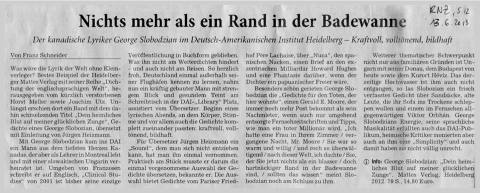
When was the last time you read a review of a poetry READING in a Canadian newspaper? Well, they do it in Germany! Here, of George Slobodzian launching a German-language selection of his poetry in Heidelberg.
Prière pour Zoë (Prayer for Zoë) – George Slobodzian
Filed under: The Brouillon | Tags: Clinical Studies, George Slobodzian, poetry
Leave a comment Prière pour Zoë (Prayer for Zoë) – George Slobodzian
Antoine Malette provides a French-language version of a striking poem from George Slobodzian’s Clinical Studies.
You can read Malette’s appreciation (in French) of Slobodzian’s poetry here.
My appreciation of Slobodzian’s poetry is here.
Reflecting on “Romanticism” we see ourselves
Filed under: The Brouillon | Tags: Frühromantik, literary criticism, Romanticism, The Literary Absolute
Leave a comment 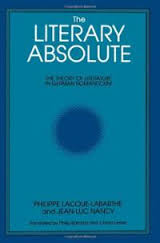 I post below two passages from the Preface to Lacoue-Labarthe’s and Nancy’s The Literary Absolute, a study of twelve texts from the Athenaeum (Jena: 1798-1800).
The original French version L’Absolu littéraire appeared in 1978, the English-language translation in 1988, i.e., a solid generation ago. The francophobic likely to reject the volume out of hand might be more circumspect did they know the investigation carried out by Lacoue-Labarthe and Nancy parallels the equally generally unacknowledged thinking of the German-language scholars Dieter Henrich and Manfred Frank and England’s Andrew Bowie. Those who find such matters too philosophical or overly-intellectual were already answered in the Athenaeum: “If some mystical art lovers who think of every criticism as a dissection and every dissection as a destruction of pleasure were to think logically, then ‘wow!’ would be the best criticism of the greatest works of art….”—Friedrich Schlegel, Critical Fragments, 57.
A veritable romantic unconscious is discernible today, in most of the central motifs of our “modernity” [or “postmodernity”]. Not the least result of romanticism’s indefinable character is the way it has allowed this so-called modernity [or postmodernity] to use romanticism as a foil, without ever recognizing–or in order not to recognize–that it has done little more than rehash romanticism’s discoveries.
…it is not difficult to arrive at the derivatives of these romantic texts, which still delimit our horizon. From the idea of a possible formalization of literature (or of cultural production in general) to the use of linguistic models (and a model based on the principle of auto-structuration of language); from an analytic approach to works based on the hypothesis of auto-engendering to the aggravation of the problematic of a subject permanently rejecting subjectivism (that of inspiration, for example, or the ineffable, or the function of the author, etc.); from this problematic of the (speaking or writing) subject to a general theory of the historical or social subject; from a belief that the work’s conditions of production or fabrication are inscribed within it to the thesis of a dissolution of all processes of production in the abyss of the subject. In short, we ourselves are implicated in all that determines both literature as auto-critique and criticism as literature. Our own image comes back to us from the mirror of the literary absolute. And the massive truth flung back at us is that we have not left the era of the Subject.
A French-language notice of the German translation of George Slobodzian’s poetry!
A French-language notice of the German translation of George Slobodzian’s poetry!
credit: Antoine Malette
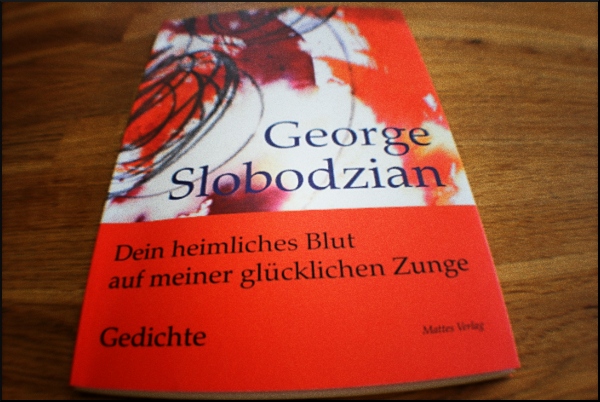
Antoine Malette has posted some illuminating and appreciative words concerning the poetry of George Slobodzian and the just published German-language translation of his poems Dein heimliches Blut auf meiner glücklichen Zunge (trans. Jürgen Heizmann).
Good to see Slobodzian get some well-deserved polyglot appreciation!

 Poeta Doctus