Archive for the ‘The Brouillon’ Category
Concerning the late Ernesto Cardenal, the Communist Hypothesis, and related matters…
Filed under: Ecology, The Brouillon | Tags: ecosocialism, Ernesto Cardenal, Herbert Marcuse, Liberation Theology, poetics, poetry, Saint Francis of Assisi, the Communist Hypothesis
 Comments (2)
 Social media (in this case, Facebook) for everything disturbingly evil about it can provide gist for no little cogitation.
The Nicaraguan poet Ernesto Cardenal died Sunday 1 March 2020 at 95. His work (which  I first read in that brick of an anthology Poems for the Millennium, Volume II (UCP, 1998)) is exemplary for me, because of its development of an “objectist” sensibility (a poetry of bald statement shorn of metaphor or ornament) wedded to a (religiously!) profound social sensibility that extends to all living creatures.
Understandably, when I learned of his passing (on Facebook), I shared the news with my vast friends list of 374. Things got interesting, however, when I followed a link to the news of his death at one of my favourite poetry sites, Dispatches from the Poetry Wars, which quoted a passage from The New York Times obituary it had shared, which passage I shared in turn:
“Christ led me to Marx,” Father Cardenal said in an interview in 1984. “I don’t think the pope understands Marxism. For me, the four gospels are all equally communist. I’m a Marxist who believes in God, follows Christ, and is a revolutionary for the sake of his kingdom.”
The identification of socialist tendencies in Christianity (unsurprising for those not unacquainted with Liberation Theology, the German Peasant Rebellions during the Reformation, or radical social movements from around the time of the English Civil War, let alone jokes about a certain socialist Jew…) and the very evocation of “communism” elicited rapid responses happy to affirm Cardenal’s artistic gifts but quick to condemn (as “nuts” in the first case and in the second as an example of “some crazy idea of ‘sharing’ that millennials, with a social media-fed knowledge of history, may lean towards”) his embracing what French philosopher Alain Badiou and others have called The Communist Hypothesis.
Now as interesting as it would be to take up the twin topics of Liberation Theology or the Communist Hypothesis (regarding the latter, a good read is this article by the inimitable Slavoj Zizek from 2009) what’s more curious is how those critical of Cardenal’s politics can at the same time respect his poetry whose nearly every line is imbued with his own “communist” perspective. On the one hand, I am the first to maintain a distinction can be made and maintained between a poet’s poetry and their politics, even when that politics rears an ugly head in the work; an even earlier and more important influence on my poetry is the figure of Ezra Pound, a poet who famously went very “wrong / thinking of rightness”. But in Pound’s Cantos, for instance, the author’s “fascism” (arguably as idiosyncratic as Cardenal’s Christian Marxism) and suburban anti-semitism appear only sporadically, while Cardenal’s socialist sympathies are ambient throughout.
Ironically, the critical commenters, above, react to neither the specific synthesis of Christ and Marx and the related, resulting “communism” nor Cardenal’s poetry, for the former finds its sustained and complex articulation in the latter. Cardenal’s “liberation theology” is an ecosocialism avant le lettre, concerned not only with class struggle and the metabolic rift that underwrites it, but with the relations, oppression and liberation of all organisms and the environment that sustains them. Cardenal’s sensibility opposes to the Abrahamic legacy that believes God bestowed dominion over the earth and its creatures to Man a vision more akin to the animistic, Hindu, or Buddhist, or, in the Christian tradition, to that of Saint Francis of Assisi, for whom all Creation forms a family, composed of all the children of God. Likewise, Cardenal’s politics finds echoes and support in the thought of Herbert Marcuse, for whom the liberation of human beings is inextricably bound up with the liberation of nature from human exploitation.
Cardenal, being the poet he was, can speak for himself. As he writes in his poem “New Ecology” (a portion of which in English translation can be read, here):
Not only humans longed for liberation.
All ecology groaned for it also. The revolution
is also one of lakes, rivers, trees, animals.
With him, we can only imagine, long for, and work toward the day when “The armadillos are very happy with this government.”
A Timely Re-release: Peter Dale Scott reading from Minding the Darkness
Filed under: The Brouillon | Tags: Minding the Darkness, Peter Dale Scott, poetry, poetry readings
Leave a comment Twenty years ago I got wind that Peter Dale Scott would be reading in the McGill University Library’s Rare Books Room. I had only recently discovered his work, in an excerpt from Minding the Darkness in Conjunctions, a poetry whose engagement with history and politics by means of an unabashedly citational poetics harmonized with my concerns and practice at the time, so I went.
When Scott solicited questions after his reading, I asked something like: “You have three books: the first [Coming to Jakarta] that begins by invoking three desks, at one Virgil’s Nekyia, an Inferno; then Listening to the Candle, a Purgatorio; now an old man’s Paradiso: all weaving historical, luminous details, personages modern and historical, autobiography, taking up the Tradition, all written in tercets: is there a Dantescan intertext?” to which he answered, “You, don’t go anywhere!”, an invitation to speak once all the other questions had been asked and answered. That was a fateful meeting, as Scott, the man and his work, have maintained an important place in my life and work, happily, since.
John Bertucci has now done us all the favour of uploading a video of Scott reading from that ultimate volume of his Seculum trilogy only a year after the one I attended. You can recapture an experience of Scott reading in the wake of the release of Minding the Darkness, here:
James Dunnigan: new chapbook & interview
Filed under: The Brouillon | Tags: Cactus Press, James Dunnigan, poetry, Wine and Fire
Leave a comment 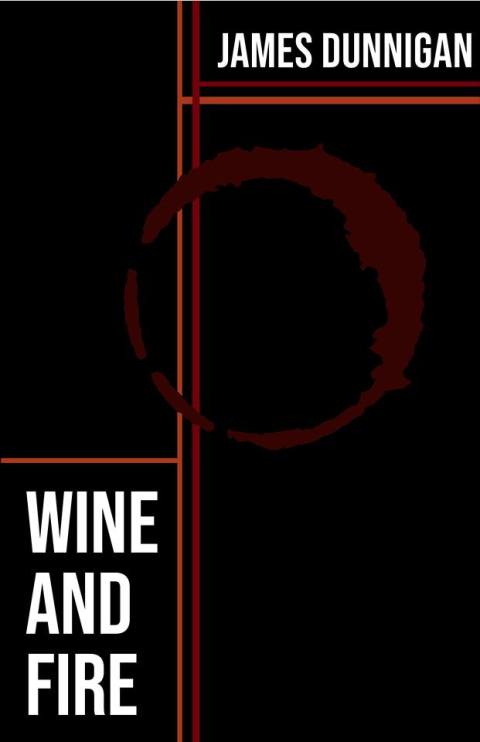
Design: Bianca Cuffaro
James Dunnigan launches his second chapbook Wine and Fire (Cactus Press, 2020) Tuesday 18 February 2020, 20h00 at the Accent Open Mic Vol. 25—Cactus Press launch, La Marche à côté, 5043 St-Denis, Montreal, Quebec. (Facebook Event page, here).
Dunnigan is also the author of The Stained Glass Sequence (Frog Hollow Chapbook Award, 2019) and was shortlisted for the Gwendolyn MacEwen Poetry Prize in 2018. His work has also appeared in CV2, Maisonneuve Magazine, and Montreal Writes. He writes in English and French, reads Latin and sells fish for a living.

You can read a series of five mini-interviews with him, here.
You can see and hear a recent reading, here.
Dunnigan is a singularly gifted young poet. If you’re in Montreal, this launch and this chapbook are not to be missed.
Critical Fragment
Filed under: The Brouillon | Tags: critical fragments, literary criticism
Leave a comment 
If we judge a writer’s worth in the first instance on their identity or character, we avoid, evade, or void the work (and, arguably, reward) of reading (which is trouble enough) and engaging the work, which is to short circuit the critical task.
Writing on and conversations with Bruce Andrews and Amiri Baraka
Filed under: The Brouillon | Tags: American poetry, Amiri Baraka, Bruce Andrews, Dennis Büscher-Ulbrich, literary criticism, poetics
Leave a comment 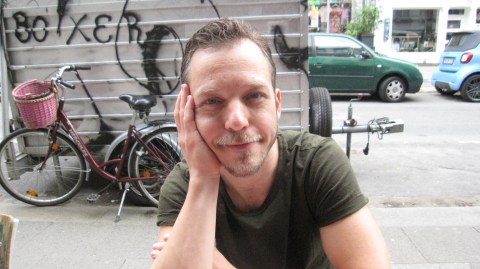 Back in 2008 (!), I had the good fortune to meet (among others) a then-younger scholar of Amerikanistik, Dennis Büscher-Ulbrich.
Now, the rest of us are lucky enough to get to know his work: the Electronic Poetry Center has made available as a PDF download his dissertation on American post-avant poet Bruce Andrews, Dissensual Operations: Bruce Andrews and the Problem of Political Subjectivity in Post-Avant-Garde Aesthetic Politics and Praxis, you can download and read, here.
Admittedly, reading through a theoretically state-of-the-art dissertation on a notoriously difficult poet can be a challenge. Interested readers can jump straight to a wide-ranging and penetrating interview that is appended to the dissertation, here.
Büscher-Ulbrich also conducted one the last interviews with Amiri Baraka, one no less lively, you can read, here.
“Apology for Absence”
Filed under: The Brouillon | Tags: creative writing, the writing life
Comments (20) 
At a reading I attended at the end of last year, a poet friend (very supportive of my work) asked if I’d retired.
I understood her to be referring to my not having worked the past three years. I was in chemotherapy the last half of 2016, and I’ve been recovering ever since. My vitality and acuity are presently too volatile for me to commit to teaching fifteen weeks at a go. I tried in the fall of 2018, but had to surrender the single class I was teaching mid-November…
I was more than a little disturbed when through my mental fog it appeared to me she hadn’t been asking about my job status but my writing and publication record. (That it took me so long to pick up on her meaning is an index of my state). My last trade publication was March End Prill (Book*Hug, 2011), a long poem that, itself, had been composed almost a decade before it appeared in print.
Lately, I’ve taken to joking I have the creative metabolism of a pop star: about twelve poems a year, which, were I pop singer, would be enough for a new album. Given that many poetry presses prefer manuscripts of over eighty pages or so, that pace of production would ideally result in a new book every seven years or so. Were it only so simple.
Even for someone with three trade editions under his belt, every new manuscript is a new challenge to get published. Indeed, the last two collections I’ve collated have failed to find a publisher. On the one hand, I’m no networker. On another, the work has always been against the grain. Tellingly, the last editor to turn down my latest manuscript did so on the basis of an understanding of its poetics the opposite of my own.
Moreover, I eschew a practice increasingly common, to compose “a book”. Often a poet will pick up and follow the thread of a theme or as often crank a generative device. Sometimes such efforts are successful, and I can appreciate the urge and sentiment that goes into this approach, when it’s not the result of the pressures of reigning expectations. However, as my earliest mentor once quipped concerning the composition of a collection: “A book is a box.”
Which brings me to the title of this post. Apology for Absence is the title of John Newlove’s 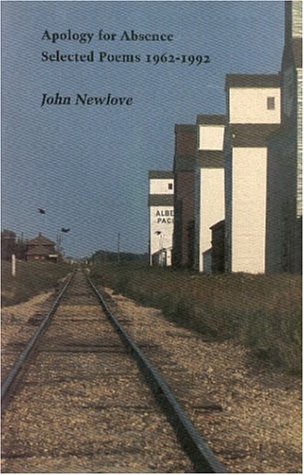 selected poems (Porcupine’s Quill, 1993), a famously laconic poet, known, among other things, for his diminishing productivity over the years. But Newlove holds a more profound importance for me, personally. As I write in a poem from Ladonian Magnitudes:
Because John Newlove the Regina Public Library’s writer-in-residence gave me his Fatman and reading it in the shade on the white picnic table on the patio in our backyard thought “I can do that!” and wrote my first three poems
I like to think that happened when I was fourteen, but a little research proves I must have been a year or two older. At any rate, however much I admire and envy the productivity of a D. H. Lawrence or Thomas Bernhard, I seem to have followed Newlove’s example in this regard. (It’s a long story). Poetically, there are worse models.
No, I haven’t retired. Nor am I absent, MIA. I’m hard at work, at my own work, going my own direction at my own pace, trusting some will be intrigued if not charmed enough to tarry along.
Action Books action
Filed under: The Brouillon | Tags: Action Books, poetry, poetry in translation
Leave a comment As an English-language Canadian poet, I’ve always starved and thirsted for almost anything foreign to most of what officially passes for my native poetic tradition. Action Books has been introducing some of the wildest, weirdest, far-outest poetry into English for years, and now their list is half price (with the checkout code ‘TRANSLATE’).
Do yourself and them and North American English-language poetry and line your shelves and blow your poetic mind now!

Manifesto
Action Books is transnational.
Action Books is interlingual.
Action Books is Futurist.
Action Books is No Future.
Action Books is feminist.
Action Books is political.
Action Books is for noisies.
Action Books believes in historical avant-gardes.
& unknowable dys-contemporary discontinuous occultly continuous anachronistic avant-gardes.
Art, Genre, Voice, Prophecy, Theatricality, Materials, the Bodies, Foreign Tongues, and Other Foreign Objects and Substances, if taken internally, may break apart societal forms.
“In an Emergency, Break Forms.”
Action Books: Art and Other Fluids
Synchronicitious Critique
Filed under: The Brouillon | Tags: Bookninja, Insta-poets, Instagram poetry, literariness, poetry criticism, Seth Perlow, social network, William Blake
Comments (1) Bookninja‘s back, and worth keeping an eye on.
Yesterday, George Murray posted an article on Instagram poetry, with the commentary, “I work hard to be progressive. I work hard to be forward-thinking. I work hard to find joy and worth in as much of life’s silliness as possible.” As much as I share Murray’s estimation of the literary-media (media-literary?) phenomenon, the article, by scholar Seth Perlow, teaches an important lesson by example.
In the article’s introduction, Perlow sets out his purpose:
In what follows, I’ll nonetheless try to learn something from the Insta-poets, something about the technological scene of contemporary poetry, without advancing a judgment about their work. The complex intersections of Insta-poetry’s political, commercial, and literary significance have frustrated literary critics’ efforts to evaluate it. So for now, I want to suspend questions of value in order to ask how Instagram structures poetic forms and participatory reading practices.
By suspending “questions of value” what comes into view are not only otherwise overlooked aspects of the verbal art of poetry in general, but no less pressing questions concerning media, composition, reception, and various blindnesses that inevitably accompany whatever insights poets and critics might otherwise have. Canonical figures, such as Emily Dickinson and Charles Olson, come into play; the no less urgent and perspicacious studies of Byung-Chul Han on digital media and society might as well have been included. The point is that the critical (judgemental) sensibility all-too-often obscures the reality of what it judges. And however much I agree with Murray’s and Perlow’s low estimation of Insta-poetry, Perlow’s example is instructive as to what resolute, clear-eyed, and informed study can reveal, revelations of no little pertinence or consequence to “serious” poetry.
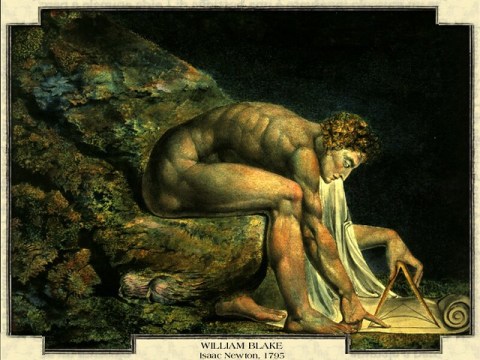
By lucky happenstance, just this morning, a review of the William Blake show at the Tate Gallery came up in the newsfeed. What struck me about this chance juxtaposition is what Blake, weirdly, shares with the Insta-poetry Perlow investigates. Both are, in a sense, cottage industries; in both, text and image are inseparable (regardless of Blake’s stripping the text from some paintings and engravings to sell them independently), and both present themselves via the handwritten as opposed to schematized typography. And who, reading the Songs of Innocence for the first time, has not been initially perplexed by the high critical regard they now receive?
The theme, as Whitman (that other great self-published self-promoter) wrote, has vista, even when what is scrutinized is silly.
Why the title, “Bread & Pearls”?
Filed under: The Brouillon | Tags: poetics, poetry, poetry criticism
Leave a comment It has some pleasant affinities with the title of Roland Barthes’ magisterial study S/Z.
The conjoined substantives are, first, singular and plural. The initial phonemes of each are in opposition: /b/ voiced, /p/ unvoiced. Orthographically, the consonant-vowel pattern ‘r-ea’ in ‘bread’ is reversed in ‘pearls’, ‘ea-r’. Like the initial consonants, the more-or-less terminal consonants of the pair seem to me again in phonological opposition: both /d/ and /l/ are formed by placing the tongue-tip to the palate, but the former releases the flow of breath, removing the tongue from the palate, while the latter does not.
Semantically, in one regard, the first substantive denotes something edible, while the latter does not; bread is artificial, while pearls are natural (if susceptible to being cultured); however, one sense of ‘bread’ (money) makes both terms media of exchange. The substantives allude, too, to two bible verses not without a certain rhetorical significance.
Much more, of course, could be said….
New on the Video Page: Accent Poetry series 29 July 2019
Filed under: The Brouillon | Tags: Accent poetry series, poems, poetry, poetry readings
Leave a comment New on the Video Page!
Thanks to Devon Gallant for the invite; and a pleasure to have read with that evening’s other featured reader, Derek Webster.
As I have the creative metabolism of a pop star (i.e., roughly a dozen new poems a year), new volumes of work are slow to appear. Four of the seven poems I perform here are therefore “new”.
Play list:
1. Budapest Suites I (from Grand Gnostic Central)
2.”European Decadence in medias res” (from Ladonian Magnitudes)
3. Hamburg & Kassel sections from “Made in Germany”
4. Toronto Suite
5. “By Mullet River”
6. “Flying Saucers” (from Grand Gnostic Central)
7. “A sonnet is a moment’s &c.”

 Poeta Doctus