OULIPO now and then
Filed under: poems | Tags: Christian Bök, Ernst Robert Curtius, Eunoia, Joseph Conte, Ladonian Magnitudes, OULIPO, poetics, poetry, postmodern poetry
 Leave a Comment
“Oulipo turns 60, but given how much we hear about it these days, it feels more like 150″ says George Murray at Bookninja. To some of us, it seems much older.
For my part, I learned about the OULIPO and composition by means of a generative device in the early nineties, thanks to Joseph Conte’s goldmine of a study, Infinite Design: The Forms of Postmodern Poetry. Not that long after (or so it seems this morning), Christian Bök’s Eunoia appeared to equal acclaim and, well, annoyance (a book, for those who don’t know, is composed by means of a generative device, after the OULIPO).
For me, the controversy was tiresome, having read Conte’s work and, more importantly, Ernst Robert Curtius’s classic oeuvre, European Literature and the Latin Middle Ages, which details ancient and medieval modes of composition which quickly dispel any illusions the OULIPO and its epigones are avant garde. (Though I do know that matter is more complex than I allow for here).
I expressed my impatience with the whole matter, boiling Curtius’ excurses into the following poem from Ladonian Magnitudes, one among several that got up the nose of that book’s most notorious reviewer. The poem is four quatrains and a concluding line, despite WordPress’ formatting constraints…
Liposuction & Related Procedures in Antiquity
Lasus Pindar’s master made a poem sans σ and a millennium later
Nestor of Laranda in Lycia wrote an Iliad each book less a letter Tryphrodorus Aegyptus did the Odyssey
So from Baroque Spain via Peter Rega
From Fabius Planciades Fulgentius’ De aetatibus mundi et hominis λειπoγραμματoς
Hucbald’s Charles the Bald eclogue beginning every word with C one-hundred and forty six lines
Late Roman grammarians’ παρόμoιoν
O Tite, tute, Tati, tibi tanta, tyranne, tulisti a scolia for a Caracalla’s Banquet
where as Aelius Spartianus has it from his brother Geta every dish alliterated
The so-called “figure poems” τεχνoπαίγνια in the Greek Anthology
Porfyrius Optatianus rendered in Constantine’s Latin
Alcuin, Raban Maur, Sixteenth Century Hellenism followed
Pre-Alexandrian Persian lines in trees and parasols
Eusonius follows Plato’s for the Sophists logodaedalia in his Technopaegnion
Each line of one poem starting and finishing with one syllable and the last word’s the next’s first
Catalogues of single syllable limbs, gods, foods, questions “yes” or “no”
A myth crib every line turning on one syllable
Grammatomastix’s monosyllables amputated prefixes lifted from Ennius and Virgil
The “versos de cabo roto” Urganda chants before “…a certain village in La Mancha…”
James Dunnigan: new chapbook & interview
Filed under: The Brouillon | Tags: Cactus Press, James Dunnigan, poetry, Wine and Fire
Leave a Comment 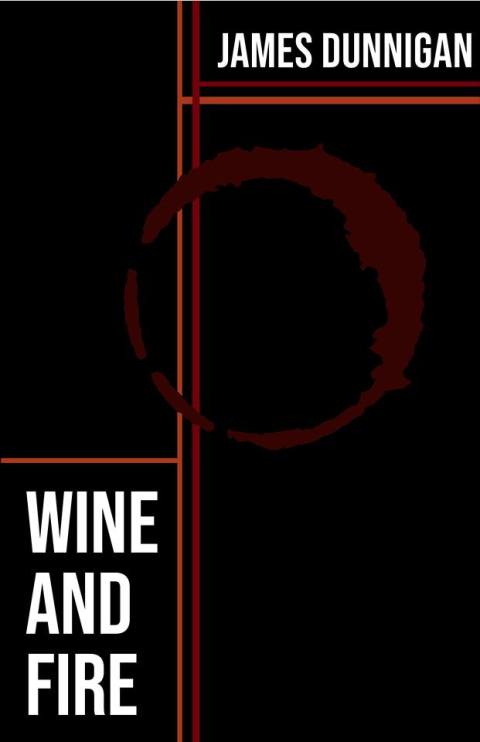
Design: Bianca Cuffaro
James Dunnigan launches his second chapbook Wine and Fire (Cactus Press, 2020) Tuesday 18 February 2020, 20h00 at the Accent Open Mic Vol. 25—Cactus Press launch, La Marche à côté, 5043 St-Denis, Montreal, Quebec. (Facebook Event page, here).
Dunnigan is also the author of The Stained Glass Sequence (Frog Hollow Chapbook Award, 2019) and was shortlisted for the Gwendolyn MacEwen Poetry Prize in 2018. His work has also appeared in CV2, Maisonneuve Magazine, and Montreal Writes. He writes in English and French, reads Latin and sells fish for a living.

You can read a series of five mini-interviews with him, here.
You can see and hear a recent reading, here.
Dunnigan is a singularly gifted young poet. If you’re in Montreal, this launch and this chapbook are not to be missed.
Critical Fragment
Filed under: The Brouillon | Tags: critical fragments, literary criticism
Leave a Comment 
If we judge a writer’s worth in the first instance on their identity or character, we avoid, evade, or void the work (and, arguably, reward) of reading (which is trouble enough) and engaging the work, which is to short circuit the critical task.
Writing on and conversations with Bruce Andrews and Amiri Baraka
Filed under: The Brouillon | Tags: American poetry, Amiri Baraka, Bruce Andrews, Dennis Büscher-Ulbrich, literary criticism, poetics
Leave a Comment  Back in 2008 (!), I had the good fortune to meet (among others) a then-younger scholar of Amerikanistik, Dennis Büscher-Ulbrich.
Now, the rest of us are lucky enough to get to know his work: the Electronic Poetry Center has made available as a PDF download his dissertation on American post-avant poet Bruce Andrews, Dissensual Operations: Bruce Andrews and the Problem of Political Subjectivity in Post-Avant-Garde Aesthetic Politics and Praxis, you can download and read, here.
Admittedly, reading through a theoretically state-of-the-art dissertation on a notoriously difficult poet can be a challenge. Interested readers can jump straight to a wide-ranging and penetrating interview that is appended to the dissertation, here.
Büscher-Ulbrich also conducted one the last interviews with Amiri Baraka, one no less lively, you can read, here.
“Apology for Absence”
Filed under: The Brouillon | Tags: creative writing, the writing life
Comments (20) 
At a reading I attended at the end of last year, a poet friend (very supportive of my work) asked if I’d retired.
I understood her to be referring to my not having worked the past three years. I was in chemotherapy the last half of 2016, and I’ve been recovering ever since. My vitality and acuity are presently too volatile for me to commit to teaching fifteen weeks at a go. I tried in the fall of 2018, but had to surrender the single class I was teaching mid-November…
I was more than a little disturbed when through my mental fog it appeared to me she hadn’t been asking about my job status but my writing and publication record. (That it took me so long to pick up on her meaning is an index of my state). My last trade publication was March End Prill (Book*Hug, 2011), a long poem that, itself, had been composed almost a decade before it appeared in print.
Lately, I’ve taken to joking I have the creative metabolism of a pop star: about twelve poems a year, which, were I pop singer, would be enough for a new album. Given that many poetry presses prefer manuscripts of over eighty pages or so, that pace of production would ideally result in a new book every seven years or so. Were it only so simple.
Even for someone with three trade editions under his belt, every new manuscript is a new challenge to get published. Indeed, the last two collections I’ve collated have failed to find a publisher. On the one hand, I’m no networker. On another, the work has always been against the grain. Tellingly, the last editor to turn down my latest manuscript did so on the basis of an understanding of its poetics the opposite of my own.
Moreover, I eschew a practice increasingly common, to compose “a book”. Often a poet will pick up and follow the thread of a theme or as often crank a generative device. Sometimes such efforts are successful, and I can appreciate the urge and sentiment that goes into this approach, when it’s not the result of the pressures of reigning expectations. However, as my earliest mentor once quipped concerning the composition of a collection: “A book is a box.”
Which brings me to the title of this post. Apology for Absence is the title of John Newlove’s 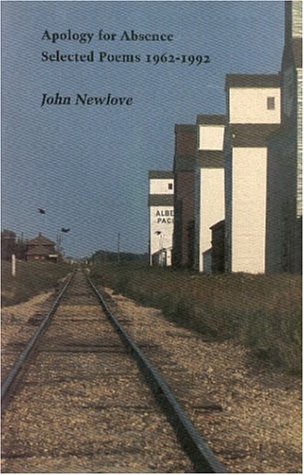 selected poems (Porcupine’s Quill, 1993), a famously laconic poet, known, among other things, for his diminishing productivity over the years. But Newlove holds a more profound importance for me, personally. As I write in a poem from Ladonian Magnitudes:
Because John Newlove the Regina Public Library’s writer-in-residence gave me his Fatman and reading it in the shade on the white picnic table on the patio in our backyard thought “I can do that!” and wrote my first three poems
I like to think that happened when I was fourteen, but a little research proves I must have been a year or two older. At any rate, however much I admire and envy the productivity of a D. H. Lawrence or Thomas Bernhard, I seem to have followed Newlove’s example in this regard. (It’s a long story). Poetically, there are worse models.
No, I haven’t retired. Nor am I absent, MIA. I’m hard at work, at my own work, going my own direction at my own pace, trusting some will be intrigued if not charmed enough to tarry along.
To praise, that’s the thing! Geoffrey Nilson on Lynn Crosbie’s influence
Over at many gendered mothers, Geoffrey Nilson gives some well-deserved praise to Lynn Crosbie.
Nilson begins his laudation with reference to Crosbie’s infamous, bête noire of a book, 1997’s Paul’s Case (which I would still energetically maintain is a tour de force). Where Nilson goes on to describe Crosbie’s influence on his own work and self-understanding, I would point to her exemplary 2006 poetry book Liar as another index of her singular, independent talent: at a time when only the most mannered poetry was de rigeur, Liar stood out alone as a work of fierce, fearless confession.
Read Nilson at the link above, and get and read something by Lynn Crosbie!
Corpus Sample: the poetic Wittgenstein
Filed under: poems | Tags: Grand Gnostic Central, philosophy, poems, poetry, Wittgenstein
Comments (10) A friend recently got a hold of the first and only book published during philosopher Ludwig Wittgenstein’s lifetime, the Tractatus Logico-Philosophicus. I don’t know what prompted my friend to order in a copy, but he was understandably perplexed; even Bertrand Russell famously failed to understand his student’s work. Philosophically, despite its immediate fame among the Logical Positivists, the Tractatus is, today, a “dead dog”, repudiated most famously by the author’s own reflections, published posthumously as the Philosophical Investigations. Nevertheless, a friend of my friend sought to console him, assuring him “the Tractatus is pure poetry.” Creative writers have tended to agree: Jerome Rothenberg and John Bloomberg-Rissman included sections from Philosophical Investigations in their assemblage of outsider poetry, Barbaric Vast & Wild, dramatist and novelist Thomas Bernhard published Wittgenstein’s Nephew in 1982, and Canadian poet-philosopher Jan Zwicky’s first book Wittgenstein Elegies appeared in 1986.
I don’t remember when I first encountered Wittgenstein, but it was surely before beginning my undergraduate studies. Those (eventually) were devoted to philosophy, and I wrote my honours paper on the private language argument in the Philosophical Investigations. To pass the time (four days) driving from Regina to Montreal, where we were going to study, a friend and I read through the Tractatus, doing our damnedest to make what sense of it we could. And my graduate studies resulted in a number of poetic texts, all engaging in various ways with the early and late Wittgenstein. Even more recently, a compositional method shared here takes an ironic inspiration from his remark that “meaning is use”.
I post below, then, two poems now included in my first trade edition Grand Gnostic Central. The first is a prose poem, borrowing liberally from Norman Malcolm’s memoir; the second is a poem that tries to come to terms with the Tractatus.

[from “Grand Gnostic Central”]
The walls are bare and the floor scrupulously clean. In the living-room, two canvas chairs and a plain wooden one around an iron heating-stove. In the other room, a cot and card-table, books, papers and pen. A man sits at the card table. His face is lean and tanned. He wears a flannel shirt and light grey flannel trousers. His shoes are highly polished. He looks concentrated and severe, striking out as if arguing. He stops, sits still. He remembers swimming—a small boy, the ease of floating, the sun and water in his eyes, closing them tight. He remembers how hard it was forcing himself down, down deep to the mud at the bottom, the water always pushing him back to the surface, his needing air pushing him back to the surface. He has written a treatise on logic. He knows those who do not know him think him an old man, irritable and obscure. He remembers writing his thoughts for the book in small notebooks he carried around. He remembers writing “If `the watch is shiny’ has sense…” He remembers the flash on the watch-face that gave him the example. It had rained and only now the sun cut through red clouds. The field’s mud is soupy and slick. He crouches down in the water at trench-bottom, once almost standing to keep his balance in the muck. He hears the sharp tiny ticking at his wrist. He dates the entry 16.6.15.
Holy Crow Channels LW
We know no sensations
give these propositions sense. Questions
that exact innocence free from naivete
demand a rigorous ignorance of the evident
apparent given as the one condition
for their initial
stuttered utterance.
The long tautology that bends say
the blade of a jet engine
to just the angle of most force
turns on this
when the need for further thrust
draws inertia from the potential
for doubt, unbinding concepts and arguments
and baffling mathematicians
just this side of mathematics.
We need our end to be
the final determination
of the rule that keeps stasis
appearing repeatedly, that blesses with some semblance
of regularity frequently enough
to let us see this
and hear that
completely unsurprised. These things we know
are hardly thought, for the common
is the category entered most
easily. We can count, yet,
to ask what numbers are
reveals the path that eases
the passage everywhere but where
the answer you expect to desire lies
and leads you to question
again the writings that made you
conclude the first proposition
that defined one doubtfully. For them
a mere analysis, for you
something more that flails you
to what is truly necessary. The clear thought
expressed as clearly as the fabric of language
will strain it
fascinates you with its immaculate muteness
that finally becomes a song so mythic
you are bound from it, fast,
and your hearing is filled
with what is spoken
in innocence, naively.
Action Books action
Filed under: The Brouillon | Tags: Action Books, poetry, poetry in translation
Leave a Comment As an English-language Canadian poet, I’ve always starved and thirsted for almost anything foreign to most of what officially passes for my native poetic tradition. Action Books has been introducing some of the wildest, weirdest, far-outest poetry into English for years, and now their list is half price (with the checkout code ‘TRANSLATE’).
Do yourself and them and North American English-language poetry and line your shelves and blow your poetic mind now!
Manifesto
Action Books is transnational.
Action Books is interlingual.
Action Books is Futurist.
Action Books is No Future.
Action Books is feminist.
Action Books is political.
Action Books is for noisies.
Action Books believes in historical avant-gardes.
& unknowable dys-contemporary discontinuous occultly continuous anachronistic avant-gardes.
Art, Genre, Voice, Prophecy, Theatricality, Materials, the Bodies, Foreign Tongues, and Other Foreign Objects and Substances, if taken internally, may break apart societal forms.
“In an Emergency, Break Forms.”
Action Books: Art and Other Fluids
Praise the algorithm! Plunging into the silliness: Andrew Lloyd’s career as an Instagram poet
Filed under: Praise and Polemics | Tags: Instagram poetry, poetics, poetry, poetry criticism
Leave a Comment Thanks to real poet Michael Boughn for sharing Andrew Lloyd’s article from Vice “I Faked My Way as an Instagram Poet, and It Went Bizarrely Well”—a fortuitous addendum to my last post, “Synchronicitious Critique”.
Synchronicitious Critique
Filed under: The Brouillon | Tags: Bookninja, Insta-poets, Instagram poetry, literariness, poetry criticism, Seth Perlow, social network, William Blake
Comments (1) Bookninja‘s back, and worth keeping an eye on.
Yesterday, George Murray posted an article on Instagram poetry, with the commentary, “I work hard to be progressive. I work hard to be forward-thinking. I work hard to find joy and worth in as much of life’s silliness as possible.” As much as I share Murray’s estimation of the literary-media (media-literary?) phenomenon, the article, by scholar Seth Perlow, teaches an important lesson by example.
In the article’s introduction, Perlow sets out his purpose:
In what follows, I’ll nonetheless try to learn something from the Insta-poets, something about the technological scene of contemporary poetry, without advancing a judgment about their work. The complex intersections of Insta-poetry’s political, commercial, and literary significance have frustrated literary critics’ efforts to evaluate it. So for now, I want to suspend questions of value in order to ask how Instagram structures poetic forms and participatory reading practices.
By suspending “questions of value” what comes into view are not only otherwise overlooked aspects of the verbal art of poetry in general, but no less pressing questions concerning media, composition, reception, and various blindnesses that inevitably accompany whatever insights poets and critics might otherwise have. Canonical figures, such as Emily Dickinson and Charles Olson, come into play; the no less urgent and perspicacious studies of Byung-Chul Han on digital media and society might as well have been included. The point is that the critical (judgemental) sensibility all-too-often obscures the reality of what it judges. And however much I agree with Murray’s and Perlow’s low estimation of Insta-poetry, Perlow’s example is instructive as to what resolute, clear-eyed, and informed study can reveal, revelations of no little pertinence or consequence to “serious” poetry.
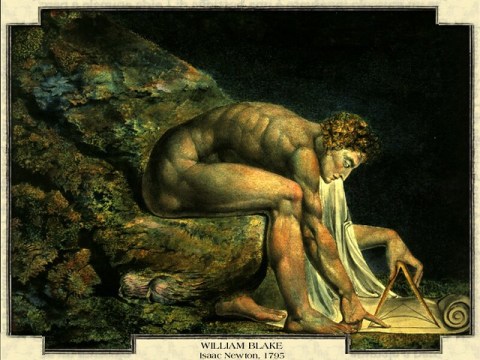
By lucky happenstance, just this morning, a review of the William Blake show at the Tate Gallery came up in the newsfeed. What struck me about this chance juxtaposition is what Blake, weirdly, shares with the Insta-poetry Perlow investigates. Both are, in a sense, cottage industries; in both, text and image are inseparable (regardless of Blake’s stripping the text from some paintings and engravings to sell them independently), and both present themselves via the handwritten as opposed to schematized typography. And who, reading the Songs of Innocence for the first time, has not been initially perplexed by the high critical regard they now receive?
The theme, as Whitman (that other great self-published self-promoter) wrote, has vista, even when what is scrutinized is silly.

 Poeta Doctus