We have to talk: Poetry on the Brink at Boston Review
This forum now on-line at Boston Review, though a little overwhelming with its nineteen participants, is exemplary of just what we could use more of, the more varied the participants, the better! Poetry on the Brink | Boston Review.
Peter Dale Scott reads the whole of Coming to Jakarta
Filed under: The Brouillon | Tags: Coming to Jakarta, Peter Dale Scott
 Leave a Comment
 Peter Dale Scott reads the whole of Coming to Jakarta
Freeman Ng has done a great service by filming Peter Dale Scott read through and comment on the first volume of Seculum, Coming to Jakarta (1988): here’s the latest instalment.
Un inclassable: Bryan Sentes
A very perceptive and much appreciated French-language notice of my work to date. Merci M. Malette!
a review of “Please No More Poetry”
Filed under: The Brouillon | Tags: conceptual poetry, derek beaulieu
Leave a Comment Frank Davey provides some valuable context to and for our contemporary avant-garde. His observations re nichol’s Martyrology demand constant reiteration…

 Frank Davey has reviewed Please, No More Poetry at London Open Mic Poetry Night.
from the Rhein-Neckar-Zeitung 13 June 2013
Filed under: The Brouillon | Tags: George Slobodzian, poetry reviews
Leave a Comment 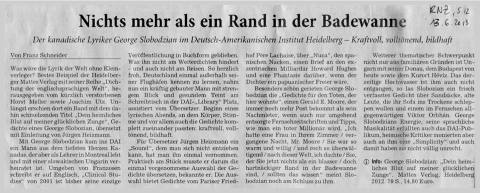
When was the last time you read a review of a poetry READING in a Canadian newspaper? Well, they do it in Germany! Here, of George Slobodzian launching a German-language selection of his poetry in Heidelberg.
“Does [writing] need to be an act composed by a human entity?”
Filed under: Ecology | Tags: a rawlings, ecopoetics, gibber, Robert Bringhurst, semiotics
Leave a Comment Gary Barwin quotes this question from a rawlings’ recent online work Gibber to open his recent post at Jacket2 on her complex, proliferatively ludic project that examines language and landscape with an ecopoetical eye. As rawlings puts it “Gibber hinges on exploring notions that humans read their environments and/or that humans are in conversation with landscapes and the inhabiting non-human species.”
Gibber, then, participates in an important eco-poetical, -logical, or -sophical task, attempting to transcend “the urge to identify, name, possess” by culturing an eye and ear for the “ecosystem (or any ecosystem components) as a text, or…as a writer of its own text[,]… as a collaborator”. Hence, the question Barwin via rawlings raises.
The project to dethrone Homo Sapiens as the sole linguistic animal is shared widely across the ecopoetical spectrum. Robert Bringhurst, a poet whose work couldn’t be more unlike rawlings’, dilates language in two ways. In The Solid Form of Language, consistent with archaic wisdom and contemporary zoosemiotics, he first reminds us of those other, nonhuman languages, “the calls of leopard frogs and whales, the rituals of mating sandhill cranes” (11). Then, in A Story as Sharp as a Knife, he expands the linguistic beyond the communicative circuit, writing
We read the tracks and scat of animals, the depth and lustre of their coats, the set of their ears and the gait of their limbs. We read the horns of sheep, the teeth of horses. We read the weights and measures of the wind, the flight of birds, the surface of the sea, snow, fossils, broken rocks, the growth of shrubs and trees and lichens…We read the speech of jays, ravens, hawks, frogs, wolves, and in infinite detail, the voices, faces, gestures, coughs and postures of other human beings. (14)
To which we might add (as Bringhurst does) that language includes even “the chemical messages coming and going day and night within the brain” and all that is “chemically written into our genes.”
Unsurprisingly, rawlings and Bringhurst are hardly the first to be inspired by the compelling charm of this vision of universal semiosis. Hölderlin famously writes “Ein Zeichen sind wir” (we are a sign) in harmony with Novalis’ thoughts on the hieroglyphs of The Book of Nature, a metaphor that itself originates in the Latin Middle Ages. What, then, could be more ecologically sane and poetically sweet (“poethical” as rawlings puts it) than to savour this fruit plucked from the semiotic tree that opens our ears and eyes to not only the languages of nonhuman Others but to what perception itself spells out?
However imaginatively appealing this Book of Nature, the inflation of the linguistic that underwrites it also conflates certain conceptual distinctions whose erasure is fateful. Among others, what is lost is the genus-species distinction between understanding in general and understanding language. Whenever I perceive something as something, I understand, I interpret, as would happen whenever I “read” an ecosystem or “the tracks and scats of animals”. However, specifically linguistic understanding necessarily involves an address, a conversation.
What happens when I take a non-linguistic (albeit interpretable) phenomenon as a linguistic address? I must posit a speaker, an interlocutor. In the world order that originally imagined the Book of Nature, that speaker or writer is God. But who, in the absence of God, writes what is “chemically written into our genes” for instance? The metaphor of the genetic code was criticized at the moment of its inception precisely on these grounds, that it was an inappropriate application of linguistic or information theoretical concepts . Lily E. Kay sums up these criticisms nicely in her Who Wrote the Book of Life?
Information theorists, cryptologists, linguists, and life scientists criticized the difficulties (some would say inappropriateness) of these borrowings in molecular biology, arguing that the genome’s information content cannot be assessed since the key parameters (e.g., signal, noise, message channel) cannot be properly quantified. DNA is not a natural language: it lacks phonemic features, semantics, punctuation marks, and intersymbol restrictions. So unlike any language, “letter” frequency analyses of amino acids yield only random statistical distributions. Furthermore, no natural language consists solely of three-letter words. Finally, if it were purely a formal language, then it would possess syntax only but no semantics. Thus the informational representations of the genome do not stand up to rigorous scrutiny. (2)
However much “reading” natural phenomena does “not stand up to rigorous scrutiny,” it enables a grasp of what is read that empowers the reader, as present-day genetic technology undeniably demonstrates. Attributing a message or intentionality to non-linguistic, spontaneous things is an extension of the Platonic metaphysics that conceived of all things as if they were products made according to a plan or Form. This productionist metaphysics is the first chapter of the story that leads to our present technological society. The presupposition that Nature possesses a plan, whether written out in hieroglyphs or mathematics, enables us to articulate that plan and thereby order Nature to our own ends. The disastrous consequences of this instrumentalization of Nature are too-well known.
Thus the understandable desire to transcend the Adamic monologue that imperiously names natural things, to imagine instead what it would mean to hear, understand, and converse with Nature, gets caught up in a dialectic that reveals the character such well-intentioned listening shares with the worst excesses of scientific-technological interrogation.
Does writing, what is read, demand a human writer? Who’s asking?
Everything you already know about poetry
Filed under: Praise and Polemics | Tags: literary criticism, poetry criticism, slam poetry, slam poetry explained, spoken word
Leave a Comment A Canadian poet, whose disdain for Slam Poetry and Spoken Word is well-known, recently posted this clip on his blog under the title “‘Slam Poetry’ explained”:
Regardless whether you agree or disagree with the “pointlessness” of Slam Poetry, the clip does express a truth, but one more general, I think, than what the blogger or the clip’s writers had in mind. For what, exactly, is the clip mocking? One way of putting it would be that Spoken Word is a generic manner, one so stereotypical it is of no more importance to what is said than an accent.
However, it doesn’t take too much familiarity with contemporary poetry to realize that the same holds true for wide swaths of every school of poetic composition, whether “Official Verse Culture”, the present-day institutionalized Avant Garde, Neoformalism, or what have you. Indeed, it is precisely these characteristic, generic mannerisms around which their respective appreciative readers, reviewers, editors, publishers, and practitioners hover.
The problem is not any one empty manner but schematized production—and consumption—as such, whether of poems or Big Macs. What is rightly slammed in the clip is the vapidity cultured by the need to ingratiate oneself or one’s product, cultural or otherwise.
Maybe that’s why I HATE POETRY.
Prière pour Zoë (Prayer for Zoë) – George Slobodzian
Filed under: The Brouillon | Tags: Clinical Studies, George Slobodzian, poetry
Leave a Comment Prière pour Zoë (Prayer for Zoë) – George Slobodzian
Antoine Malette provides a French-language version of a striking poem from George Slobodzian’s Clinical Studies.
You can read Malette’s appreciation (in French) of Slobodzian’s poetry here.
My appreciation of Slobodzian’s poetry is here.
Reflecting on “Romanticism” we see ourselves
Filed under: The Brouillon | Tags: Frühromantik, literary criticism, Romanticism, The Literary Absolute
Leave a Comment 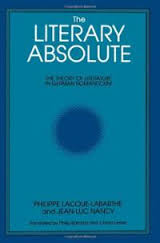 I post below two passages from the Preface to Lacoue-Labarthe’s and Nancy’s The Literary Absolute, a study of twelve texts from the Athenaeum (Jena: 1798-1800).
The original French version L’Absolu littéraire appeared in 1978, the English-language translation in 1988, i.e., a solid generation ago. The francophobic likely to reject the volume out of hand might be more circumspect did they know the investigation carried out by Lacoue-Labarthe and Nancy parallels the equally generally unacknowledged thinking of the German-language scholars Dieter Henrich and Manfred Frank and England’s Andrew Bowie. Those who find such matters too philosophical or overly-intellectual were already answered in the Athenaeum: “If some mystical art lovers who think of every criticism as a dissection and every dissection as a destruction of pleasure were to think logically, then ‘wow!’ would be the best criticism of the greatest works of art….”—Friedrich Schlegel, Critical Fragments, 57.
A veritable romantic unconscious is discernible today, in most of the central motifs of our “modernity” [or “postmodernity”]. Not the least result of romanticism’s indefinable character is the way it has allowed this so-called modernity [or postmodernity] to use romanticism as a foil, without ever recognizing–or in order not to recognize–that it has done little more than rehash romanticism’s discoveries.
…it is not difficult to arrive at the derivatives of these romantic texts, which still delimit our horizon. From the idea of a possible formalization of literature (or of cultural production in general) to the use of linguistic models (and a model based on the principle of auto-structuration of language); from an analytic approach to works based on the hypothesis of auto-engendering to the aggravation of the problematic of a subject permanently rejecting subjectivism (that of inspiration, for example, or the ineffable, or the function of the author, etc.); from this problematic of the (speaking or writing) subject to a general theory of the historical or social subject; from a belief that the work’s conditions of production or fabrication are inscribed within it to the thesis of a dissolution of all processes of production in the abyss of the subject. In short, we ourselves are implicated in all that determines both literature as auto-critique and criticism as literature. Our own image comes back to us from the mirror of the literary absolute. And the massive truth flung back at us is that we have not left the era of the Subject.
Poem newly up at the BookThug blog for Poetry Month
Filed under: poems | Tags: March End Prill, National Poetry Month, poetry
Comments (2) 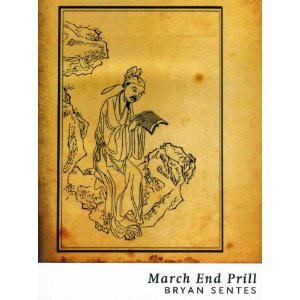 Ever wondered who the guy on the cover of March End Prill is and what he’s got to do with the book? BookThug has posted “What the Hell…” that might help clarify the issue, here.

 Poeta Doctus