Thatcher’s Ghost, Bill 85, and a Poetical Rejoinder
Filed under: poems | Tags: Bill 85, current-events, poetry, Saskatchewan, Saskatchewan Employment Act
 Comments (5)
 Though Margaret Thatcher may have been struck down, her mean-spirited spectre still haunts the so-called developed world: to wit, the socially retrograde Bill 85 about to be passed in Saskatchewan. As a true-born son, I can’t bear to bite my tongue while my erstwhile homeland goes against everything that made it a social beacon in Canada for decades. I therefore append the poem “Reasons Why” from Ladonian Magnitudes (DC Books, 1996) as reminder of different, arguably better, times. Allusive obscurities can be clarified via Google…
Et illud transit…
Reasons Why
for Laszlo Gefin, ‘56er
“He’s some kinda Universal Welfare Tommy Douglasite!”
Because in the early Seventies National Geographic called Saskatchewan the only communist province in North America
Because Saskatchewan is not Alberta, settled by a dispossessed deported peasantry, not American ranchers
Because Sask Student Loans helped me study philosophy and poetry at home and whose flexibility kept me from defaulting so I could pay them back no problem
Because I had and have to pay for my glasses and dentist
Because in the Great Depression just a boy Tommy Douglas broke his arm—The doctor set it for free
Because in the Dirty Thirties everybody was literally dirt poor plagued by drought and locusts
Because hobos went door to door asking for water, onion, potato, and carrot to make themselves some Nail Soup
Because their Volkswagen was the Bennett Buggy
Because at the Regina Riot the police gunned down the workless on their cross-country way to complain at the capital
Because of old Ukrainian collective farmers way out in the country
Because my friends drove red Ladas
Because my Uncle’s antique cars are in Who Has Seen the Wind? we saw at its premiere—he took us to a threshing bee where old cars were raced to see which was slowest
Because I prefer Russian vodka over all
Because my grandmother melted brown sugar and caraway into moonshine and we toasted each other “God bless you!” in Hungarian
Because my dad got beat up at school not because he didn’t speak English but because he didn’t speak Ukrainian
Because the only Hungarian I learned was curses
Because my Great Uncle Peter and Aunt Julia are DPs from Bukovina
Because he rode the rails walked the dusty grid roads and slept on hay in barns
Because Tommy Douglas told a parable about Country Mice electing Fat Cats
Because they told me You know the Truth! You should go into politics!
Because the British Arts Council and the National Endowment for the Arts are modelled after the Saskatchewan Arts Board
Because over two dozen of Canada’s social programs originate in Saskatchewan
Because we have a China Town with street signs in Chinese in Regina (but no signs in Cree for half the population)
Because fibre optics was invented there a necessary condition for the Global Village
Because the first television broadcast was made from Saskatoon
Because of Saskatoon Berries and Saskatoon pie, syrup, jam, chocolates, and spirits
Because I sat on a bench in Victoria Park one spring Saturday morning reading Kiekegaard and Pound’s ABC of Reading and Selected Poems understanding nothing
Because lying out on the sunny lawn fifteen I read “Not how the world is is the mystical but that it is” and understood
Because John Newlove the Regina Public Library’s writer-in-residence gave me his Fatman and reading it in the shade on the white picnic table on the patio in our backyard thought “I can do that!” and wrote my first three poems
Because John Cage conducted a workshop at Emma Lake July 1965
Because Saskatchewan is the bed of a shallow prehistoric sea
Because weather systems of bison thundered over the land turned only by prairie dog villages of millions
Because my brother the doctor is walling his house in the capital with stones picked from farmers’ fields
Because I grew up on Coldwell Road named after a signee of the Regina Manifesto
Because the Regina Manifesto calls for the downfall of capitalism
Because of T the anarchist with guns in his walls, washing machine cleaned with Spic ‘n Span between each load, locked up every Royal Visit
Because another signee was named Wordsworth
Because at the Summer School of the Arts on Echo Lake in an old sanitarium we were taught to write as we talk in our idiom as we phrase it
Because my first love’s name’s etymology is Dionysius’ Mark and I asked her out once for every line in a sonnet
Because Modern poetry starts when the winter night sky over the prairies makes plain no single theory can encompass them
Because the tornado’s vortex is an ideogram for inspiration
Because the province’s borders are absolutely arbitrarily geometrical
Because verse’s root is Latin for a farmer’s ploughing
Because of winters 8 months long and in their middle rising in the dark and coming home in the dark for six weeks down to -70 with the windchill and snow banks white dunes up to the eaves
Because on cold black January dawns, hours reading Hegel over a mug of coffee, cream and sugar, and a sticky steaming cinnamon bun, in a violet pink and gold yellow aurora the sun broke
Because Tommy Douglas’ rhetoric flowed inspired by unconscious Liberation Theology Christianity and peasant poverty
Because my grandmother had her poppies rooted up by the RCMP
Because you didn’t go to the Indian parts of town
Because everyone laughs when I say “I’m from Regina”
Because everyone’s been through Regina
Because of the natural genius of friends who renovated their home and own furniture and keep two dogs, four cats, fish, and birds, and a baby boy and a garden lusher than two square metres of jungle
Because my brother-in-law built his own furniture and grand country house from a hole in the ground up with the relatives beside a Stone Age Saskatoon Berry grove
Because the Saskatoon is the Kiwi of the 21st Century
Because I was adopted and can invent my blood-parents and their lives
Because the Conservatives thought you could run a province like a used-car lot and now most are jailed for their clumsy corruption
Because I left with hundreds of thousands of others needing what home could not supply
Because my grandfather fought at Ypres first gas attack, returned and was wounded three more times and enlisted in the Second War, dead before I was born
Because my parents sat on the steps watching the skies waiting during the Cuban Missile Crisis
Because my father had to choose between staying on the farm or getting a job and never became an engineer
Because the Saskatchewan Arts Board paid for my four years’ studies in Montreal and my first trip to Europe which inspired my Budapest Suites and there I met my dead brother, drank poppy tea, and played surrealist parlour games all night
Because everybody called me the Ambassador from Saskatchewan
Because growing hemp, food and cash crops, we could provide our own food, shelter, housing, clothing, and paper—We should fill all the uranium mines in the north with concrete (two-thirds of the world’s uranium!)—Make greenhouses to grow whatever we can’t above out of all the abandoned potash mines (two thirds of the world’s potash!)—The rivers, the sun, and the wind might light our nights and heat our winterhomes—If a million people can’t get their acts together to supply their basic needs, what’re they doing?
Because rocking chair anarchist Les said smoking a cone of home grown “Better old folks homes in Estevan than swimming pools in Bogota!”
Because when I visited the Louvre with my lousy French I felt like I’d been raised in a hole in the mud under a plastic garbage bag flapping in the wind
Because I was born not in a half savage country but an utterly barbaric one
Because the Lab Building at the U of R is partly a maze for testing LSD subjects
Because one psych prof would join the hands of his class in a circle and try to levitate the Ad Hum Bldg
Because I think I remember the last Mass said in Latin at our church when I was still a babe in arms, the smell of incense
Because ‘Saskatchewan’ can translate Heraclitus on time into Cree
(Montreal March 1998)
A French-language notice of the German translation of George Slobodzian’s poetry!
A French-language notice of the German translation of George Slobodzian’s poetry!

credit: Antoine Malette
Antoine Malette has posted some illuminating and appreciative words concerning the poetry of George Slobodzian and the just published German-language translation of his poems Dein heimliches Blut auf meiner glücklichen Zunge (trans. Jürgen Heizmann).
Good to see Slobodzian get some well-deserved polyglot appreciation!
Scott reads from Tilting Point
Filed under: The Brouillon | Tags: Peter Dale Scott, Tilting Point
Leave a Comment Peter Dale Scott reads from his latest poetry collection Tilting Point and discusses the poems with Freeman Ng. A selection from the volume can be read here.
Peter Dale Scott’s Tilting Point: “tilting at the mills of state / with a lance of paper”
Filed under: notices and reviews | Tags: criticism, Peter Dale Scott, reviews, Tilting Point
Leave a Comment Peter Dale Scott’s first full volume of poetry since Mosaic Orpheus (2009) collects ten new poems that speak from the vantage point of a lifetime and his singular interrogation of the American Empire. The first eight, short poems reflect on the eros of old age, the “drive’s decline”, a shift to “love not as acquisition but as gift”, an eros poignantly in love with living more than with any one beloved, that lifts
…once again
for an instant
into this abiding
awareness
of all there is
Fifty-seven of the volume’s seventy-pages are taken up by two longer works Loving America and Changing North America, the former probing the schizophrenic love-hate relationship Scott has developed over decades’ engagement with his adopted country (“the cradle of the worst and the best” as Leonard Cohen sings), the latter searching for resolutions to the country’s increasingly pathological contradictions.
The profound pertinence of Scott’s message is tuned to a style tempered to communicate it. Tellingly, at least four of the book’s poems, including many of the long poems’ sections, first appeared on “the spreading / leafwork of the Internet,” an index of Scott’s urgent desire to get the word out. His classical manner verges on the prosaic, even the pedestrian at times, guided throughout by a democratic ideal to address the widest possible audience, such as in the startling “To the Tea-Party Patriots: A Berkeley Professor says Hello!”. Often, that audience is an expressed dedicatee or interlocutor, poets or friends, including Daniel Ellsberg, Allen Ginsberg, Denise Levertov, Czeslaw Milosz, and Walt Whitman, among many others.
More ruminative readers, however, will not mistake the clear surface of Scott’s language for a shallowness of thought or knowledge. Already, for example, in the volume’s first piece “Homing: A Winter Poem,” Scott’s simplicity belies a profound complexity of reference, the tracing of which is the richly rewarding work his writing invites: the significance of the dedication to Tomas Tranströmer, the epigraph from Genesis, the allusions to ‘Jubal’ and ‘Urthona’ and the poet speaker’s “dead parents,” among others, coupled with the intratextual references—the “tilt of the earth” nodding to the collection’s title and the “glimpse of odyssey” that winks at the poem dedicated to Milosz “Not for long”—all point to a profound and unending network of meaningfulness, a characteristic virtue of literary art.
For all its accomplished polish Scott’s poetry is no mere aesthetic production. His manner is chosen to address matters of the utmost consequence, the character and fate of America, a topic that has inspired him to produce more than eight volumes of painstaking investigative scholarship into the machinations and abuses of power and a monumental long poem Seculum (in three volumes, Coming to Jakarta (1988), Listening to the Candle (1992), and Minding the Darkness (2000)). It is in the book’s two long poems that Scott most firmly grasps this theme that runs throughout his life’s work, work that rises to his friend Milosz’s question “What is poetry which does not save / Nations or peoples?// A connivance with official lies…” Scott’s answer to Milosz’s demand is, in part,
… to write any poem
encompassing this nation
one must have an awareness
of gratuitous murder
committed by released felons
in uniform for sport
without forgetting the grace
of a doe drinking from a forest stream
Scott’s theme, like Whitman’s before him, has vista. The periplum of this territory his work traces and this latest book continues invites and demands our attentive study.
Tilting Point, Peter Dale Scott, San Luis Obispo: Word Palace Press, 2012
On the end of the Doha Climate Change Conference: a poem and commentary
Filed under: poems | Tags: climate change, Doha Climate Change Conference, ecology, ecopoetics, ecopoetry, global warming, poetry
Leave a Comment Brushfires from Colorado
to Croatia; floodwaters
deeper than memory
drown southern Russia
and Thailand; tornadoes
plough the Midwest;
record hurricanes on
the Eastern Seaboard.
Humanity betrays all
the collective intelligence
of a bacterium
in a petri dish.
Although the poem above was composed in Berlin this past summer, today its sentiment seems prescient of what many of those of us who care about the fate of civilization feel. A lone voice speaks to the issue in Canada’s parliament, and in the face of suicidal official denial and incapacity, it would be barbaric not to lend a poetic voice in support. Posting a poem, of all things, must seem a futile gesture, but its impulse takes inspiration from Luther, who, asked what he would do if he knew the world were to end tomorrow answered, “Plant an apple tree.”
Tilting Point: new poetry from Peter Dale Scott
Filed under: The Brouillon | Tags: Peter Dale Scott, Tilting Point
Leave a Comment 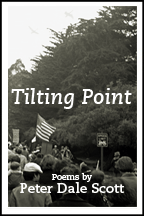 Peter Dale Scott has published a new chapbook of poems Tilting Point. You can read three poems from the volume here.
Poem for Humpday
Filed under: poems | Tags: Argo Books, Ladonian Magnitudes, poetry
Leave a Comment 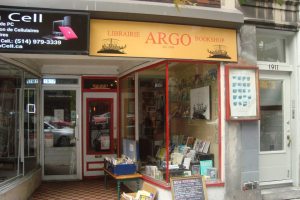 Need a poetic boost to get you on through to the other side of the week? Argo Books in Montreal thinks so, too, so they were kind enough to post a poem from Ladonian Magnitudes on their website!
March End Prill sampler
BookThug has just posted a generous sample from March End Prill, readable here.
Twin Takes on Twin Takes on Canada’s Poetic Renaissance
Filed under: Praise and Polemics | Tags: Carmine Starnino, Michael Lista
Leave a Comment My post on Russell Smith’s article on recent Canadian poetry seems to have a struck a nerve with Michael Lista (see his comment on the original post) and Carmine Starnino, whose remarks can be read here. I leave it to discerning readers to come to their own conclusions.

 Poeta Doctus