Twin Takes on Canada’s Poetic Renaissance
Filed under: Praise and Polemics | Tags: Canadian poetry, Canadian poetry renaissance, Carmine Starnino, literary criticism, Matthew Tierney, Michael Lista, Nobelese, Russell Smith
 Comments (4)
 I’m the first to agree with Rilke, that “Rühmen, das ist’s!” (roughly, “To Praise—that’s the thing!”), but, sometimes, praise isn’t what it seems prima facie, and that is surely the case with Russell Smith’s article on recent poetry in Canada, a thinly-veiled plug for Carmine Starnino’s forthcoming volume of criticism, wherein he lauds Starnino and The Walrus poetry editor Michael Lista for their “tough-minded” editorial and critical efforts, which, Smith maintains, have helped to culture an “unlikely renaissance”. Aside from its disingenuousness, Smith’s article deploys a questionable rhetoric and a squintingly narrow view of contemporary poetry.
First, Smith eulogizes Lista and Starnino for being “tough-minded” and “stern”; The Walrus “bravely publishes poems” under the aegis of “the truculent Michael Lista”; and Starnino, in his role as a “combative tastemaker”, has helped “purge” Canadian poetry of “a certain kind of weepy folksiness” Smith blames on the baleful influence of Al Purdy. One’s unsure whether Smith is writing about editor-critics, austerity hawk finance ministers, or Jean Charest in his late showdown with Quebec’s students. In any case, such Iron Lady bluster is as tiresome as it is empty.
Even more offputting and regressive than the right wing speechifying that echoes through Smith’s prose is the swaggering machismo of his rhetoric. Just a century ago the same words were invoked to banish the effeminate, dreamy sentimentality of Romanticism. The Modernist critics demanded forceful, hard, virile poetry in a bellicose criticism whose apotheosis was their recruiting the expression “avant-garde.” One would have hoped that after the intervening history such displays of cocky braggadocio would be too ridiculous to be indulged.
Ironically, where Modernist criticism might claim salutary effects, the “dense and intellectual”, “difficult”, “highbrow” poetry Smith praises Lista and Starnino for having whipped into shape is merely, in Smith’s own words, “narrow and exclusive”. He mistakes surface gloss for sophistication. How seriously can we take Smith’s judgement when, as his example of “playful, amusing, dazzling, or simply exasperating” poetry, he quotes the rather grammatically straight-forward lines “We leap magpie flat-footed, shriek obsidian / disbelief tidings”? Smith does, it would seem, as he himself admits, “think in a frustratingly direct manner”.
The poetry Smith is so dazzled by is merely the latest version of what August Kleinzahler has dubbed “Nobelese” (an oblique contextualization of which can be read here), a poetry that springs, ultimately, from T. S. Eliot’s canonization of the Metaphysicals and the New Criticism’s consequent lionizing of “texture” and “complexity”. Anyone with the patience to scrutinize the kind of “tough-mindedness” Smith lauds will quickly find it little more than a latter day version of the “narrow and exclusive” crotchetiness of F. R. Leavis.
How refreshing, then, to read another recent article by poet Matthew Tierney whose purpose, like Smith’s, is to share his excitement about the “fierce mojo” his contemporaries are working. Despite the ironically humble persona he adopts, the catholicity of Tierney’s list of poets who make his “head spin” reveals him to be one of those “poets, it seems, who committed themselves early, read widely, and got down to it”. The sixteen poets he names (including Michael Lista) are mindbogglingly various, writing inventively from and out of (i.e. away from) every school of composition I know of that’s active in North American English-language poetry, let alone Canadian.
Where Lista and Starnino, at least according to Smith, are “tough”, “stern”, and “combative”, Tierney proves himself flexible, charitable, and gregarious, qualities of mind not without their precedent praise. As one hero of American postmodern poetry and poetics, John Adams, put it: “The Mind must be loose.” The looseness of mind Tierney exemplifies, the kind of mind I would promote, is not “narrow and exclusive”, but open to the chance community of vital makers it finds itself thrown among, quick to perceive and respect each their characteristic virtues and curious to understand and appreciate them.
Novalis, a poet/critic/thinker who worked his own “fierce mojo”, writing about the “narrow and exclusive” critics of his own day, put it well:
Reviewers are literary policemen. Doctors are policemen also. Hence there ought to be critical journals which treat authors with medical and surgical methods, and not merely find out the ailment and announce it with malicious pleasure. Methods of healing up to now have been barbaric for the most part.
A genuine police force is not merely defensive and polemical toward whatever evil exists—but it seeks to improve the sickly disposition.
—Miscellaneous Fragments, 113 (trans. Margaret Mahony Stoljar); German original here
Gwerful Mechain’s “Ode to the Pubic Hair” and other bawdy poetry
Filed under: The Brouillon | Tags: Binoy Majumdar, Gwerful Mechain, Hiromi Ito
Comments (1) So much, too much, contemporary English-language poetry, especially in Canada, is downright “Pruditanical”. Those interested in work more true to life and the body that sustains it might find of interest, first, this poem from the medieval Welsh, Gwerful Mechain’s “Ode to the Pubic Hair”, then this work by two moderns, Binoy Majumdar (1934-2006), and Hiromi Ito. Or you could just read some unexpurgated Catullus or Juvenal…
Coming to Jakarta: Peter Dale Scott reads and comments on his poem
Filed under: The Brouillon | Tags: Coming to Jakarta, deep politics, Peter Dale Scott, poetry
Leave a Comment Freeman Ng has produced a series of videos, wherein Peter Dale Scott reads and comments on the first volume of his monumental trilogy Seculum, Coming to Jakarta.
Access the videos here
On the Discovery of the Higgs-Boson
Filed under: poems | Tags: God particle, Higgs-Boson, particle accelerator, poetry
Leave a Comment Poetry is news that stays news, as a famous poet-critic observed, and sometimes said news might even be prescient. One of the first texts I wrote on arriving in Montreal, in 1986-7, concerned the manner of experimental device that has just proven so instrumental in the most recent earth (if not cosmos!) shaking discovery in physics. Therefore, as a humble gesture in honour of 4 July 2012, I append said text below, one section of the “title track” from my first book, Grand Gnostic Central (DC Books, 1998).
In recent decades, a radical cell of sculptors and conceptual artists has infiltrated the scientific research community. As “physicists”, they have managed to have governments construct massive installations, dumbfounding in the intricate rigor of their design, to generate experimental data in a manner consistent with the most demanding mathematical scientific method. Some see these “particle accelerators” as communal accomplishments the order of Stonehenge, the Pyramids, or the Great Cathedrals.
Universal Progressive Poesy: Reconfiguring Romanticism
For the too many who sneer contemptuously or sigh knowingly when they read or hear of ‘Romanticism’, here’s not a bad place to start your re-education: Poems and Poetics: Reconfiguring Romanticism (54): Jeffrey C. Robinson, “Occupy Romanticism,” 27 May 2012.
Blast from the past: opening night at States of the Art
Filed under: Poetry | Tags: poetry readings, States of the Art: Considering Poetry Today
Leave a Comment A reading from the States of the Art conference, Saabrücken, Germany, 23-26 October 2008, remastered and ready for listening under the “Audio” tab…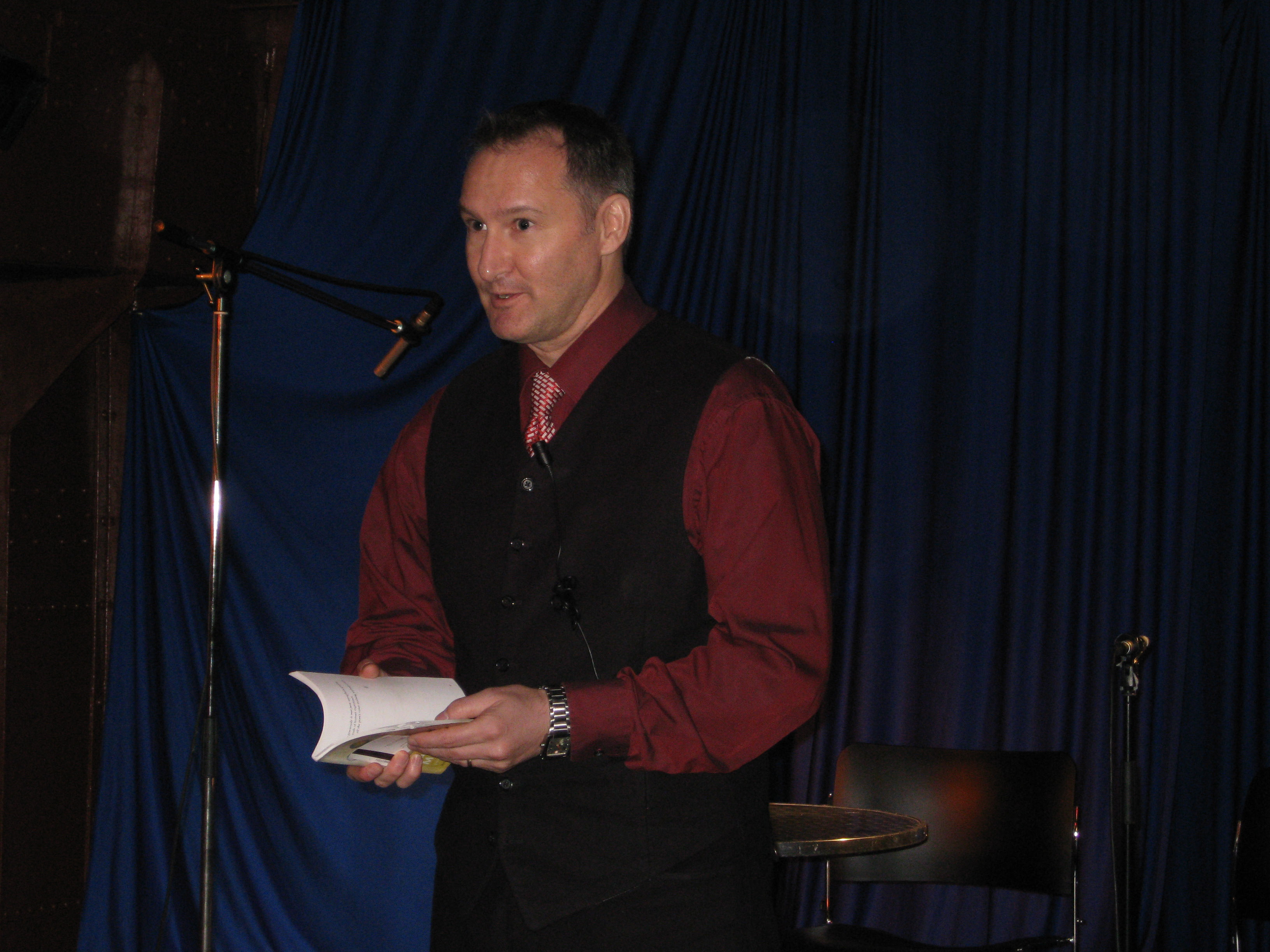
Hear March End Prill, and other poems, live at Argo Books, 28 March 2012
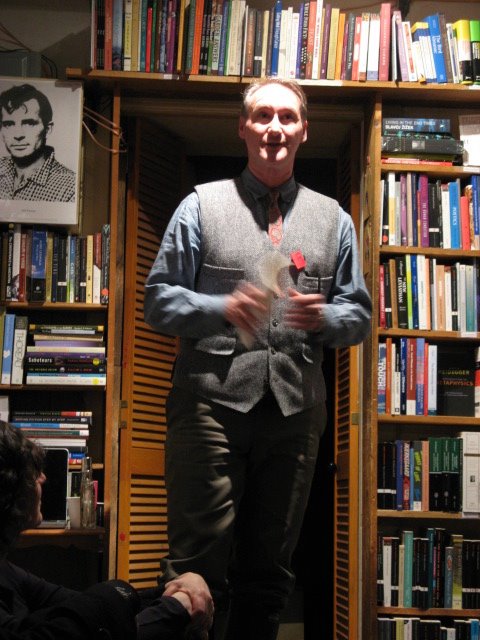 A recording of a recent reading at Argo Books, Montreal, QC, is now hearable under the “audio” tab.
Soughknot: The University
Filed under: poems | Tags: 2012 Quebec student general strike, austerity, Ladonian Magnitudes, poetry
Leave a Comment A nearly twelve-year-old poem reread by chance: plus ça change…
The University,
medieval. Institutions
for hire, earnings.
Management,
archonic,
anarchic
, i.e., colleges and universities to perform
a function for tha plutocracy’s technocracy
, i.e., the formation of technicians in real time.
There won’t be monied enough
to send their kids to prep school?
(16:47 Montreal Tuesday 31 August 2004; Ladonian Magnitudes, 2006)
On the Road to Not-here
Filed under: The Brouillon | Tags: 2012 Quebec student general strike, politics, utopia
Leave a Comment Twice recently concerning the on-going student protests here in Quebec I’ve heard two artists (Baby Boomers both) dismiss the students’ demands for tuition-free education as “utopian!”. Their one-word argument puzzled me, because these are reasonably intelligent, educated men, yet they seem ignorant of just what brow-furrowing complexities these four syllables hold.
I’m sure they know the word was coined by “Syr Thomas More knyght”, who published a book by that title in 1516, which he described as a “fruteful and pleasaunt Worke of the beste state of a publyque weale.” More’s fictional, “beste state” was quickly criticized by his more “realistic” contemporaries, for whom “a place, state, or condition ideally perfect in respect of politics, laws, customs, and conditions” (OED 2.a) could only be “an impossibly ideal scheme” (OED 2.b).
However, if we reflect on More’s own description of his work, one that imagines “the beste state of a publyque weale,” a “condition ideally perfect in respect of politics, laws, customs, and conditions” we might come to realize that all debate about the direction society should take is inescapably utopian. Whenever we question or debate how things—especially that “public thing,” the res publica—should be, we think counterfactually, positing states-of-affairs that in fact do not exist, but might or ought to. In this sense of the word, even the Harper government’s vision for Canada is utopian, since its efforts aim at bringing our present society into line with a merely projected one (Harper’s notion of “the beste state”) that has yet in fact to be realized. All “schemes” for how society should be are ideal in this sense, since they exist as ideas before they are actualized. Indeed, their being conceived in the first place is the necessary condition for their eventual fruition. What is real now was only once imagined.
Such schemes for how society ought to be are ideal not only in the pragmatic sense of their being, in the first place, only imagined plans, but they are “impossibly ideal,” as well, and necessarily so. No plan ever realizes itself perfectly. This blog post, too, falls short of my intentions. Knowing we must fail, however, doesn’t stop us from striving to bring about our vision of how things should be, moving our here and now closer to that u-topos, that place that is not (yet) here.
Of course, the dismissiveness of our two artists isn’t one that will be persuaded by such fine conceptual discriminations. Their hard-nosed point is that the students’ demands are, in practical, fiscal terms, impossible. This thesis is debatable: at least eight different alternatives to the tuition hikes have been proposed, all consistent with the fiscal facts all parties agree on. But even this disagreement defined in these terms assumes that an appeal to facts and reason should be sufficient to decide the matter, an impossible ideal rarely met with in concrete political discourse or social struggle, but still one that underwrites any such debate in the first place, if not the very ideal of a democratic society.
So the artists are right: the students’ demands are utopian, but then, so are the artists’ views of how things should be, and so is the democratic ideal all parties play along with, that the matter can be hammered out, best without recourse to arbitrary fiat or truncheons. In this sense, whenever we take up the question of how things ought to be and take the steps to get there, we’re on the road to utopia.
Notice: Norman Nawrocki’s Nightcap for Nihilists
Filed under: Praise and Polemics | Tags: Nightcap for Nihilists, Norman Nawrocki
Leave a Comment One discouraging struggle of the writing life is getting one’s work noticed. One obstacle is that many of those who do engage in literary journalism hardly have the time for their own lives and writing, never mind wrighting a solid, sensitive review. Those with the time and energy to write intelligent criticism, something else again, have my undying respect. But, what one can do with relatively little effort is give notice of work that has appeared, like recommending a good movie to a friend, getting the word out just to share the pleasure.
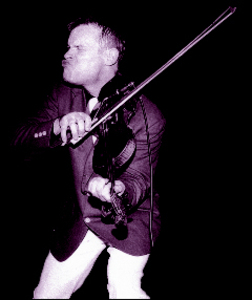 Norman Nawrocki has just published Nightcap for Nihilists (Les Pages Noirs, 2012), the fourth volume in his Brain Food series that includes Breakfast for Anarchists (2007), Lunch for Insurgents (2009), and Dinner for Dissidents (2009). This latest volume and series are just the latest addition to a very long, impressively engaged body of work that includes cabaret, spoken word, musical collaboration, theatre, and even sex education!—just check out his biography. Like the man, the work is on the front line of the struggle for social justice: rants, anecdotes, parables, and songs, all in that long tradition of imaginative, creative, eloquent engaged art that aspires to cheer the downtrodden and horrify despots.
Here’s his contribution to a recent memorial reading held for the late Andy Suknaski: “Homestead, 1914 (SEC. 32. TP4, RGE2, W3RD, SASK.) 1. returning”

 Poeta Doctus