Archive for the ‘aleatoric poetry’ Tag
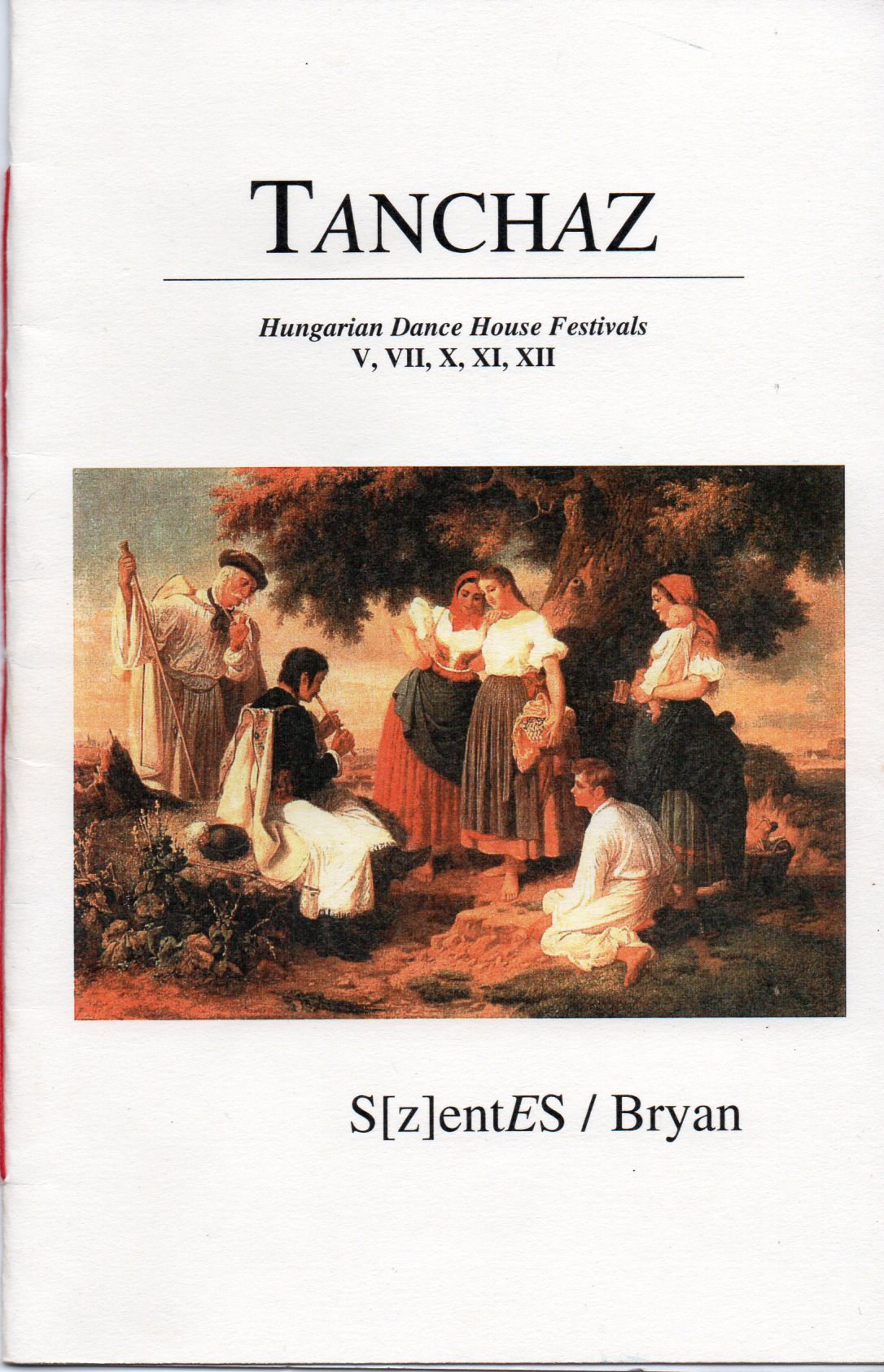
Hell’s Printing House: Táncház: Hungarian Dance House Festivals V, VII, X, XI, XII (2005)
Filed under: Hell's Printing House | Tags: aleatoric poetry, Canadian poetry, Joseph M Conte, poetry, poetry chapbooks, poetry recordings
 Comments (1)
Aside from the pages of little magazines and those of certain, indulgent anthologies, by poems really first made their way in the world in the form of chapbooks. I hadn’t yet published a full-length trade edition, when I went on a “European tour” in 1996, reading in Munich (twice), Heidelberg, and Amsterdam, two self-published chapbooks, Gloze (1995) and On the Phantom Air Ship Mystery (1995), my calling cards.
Joachim Utz, the sponsor of my reading at Heidelberg University’s Anglistiches Seminar, observed that my chapbooks reminded him of William Blake’s. This new category of post takes its inspiration from his remark. “Hell’s Printing House” will showcase my chapbooks, describing them, detailing their contents, linking poems that have already been published at Poeta Doctus, and presenting a new recording of one of their poems.
It is hoped these posts fill the lacunae between full-length collections, assuring those (apparently) few (and valued) readers who follow my production with interest that I am hard at work, going my own direction, at my own pace, trusting those intrigued might be charmed enough to tarry along….
I cannot recall now what prompted me to pick up Joseph M. Conte‘s Unending Design: The Forms of Postmodern Poetry (Cornell University Press, 1991) soon after it was published. The price pencilled in on my copy’s flyleaf indicates mine is a used copy. As I remember it, I was motivated by my having heard him deliver a lecture at Concordia University’s Liberal Arts College; however, he seems not to have spoken there until 1997. Nevertheless, perhaps it was the book’s Table of Contents (even more intriguing, today), with its attention to those poets I was interested in at the time, primarily Robert Duncan and John Cage. I can say with greater certainty that it was the book’s fifth chapter, which examined the use of a “generative device” in the work of William Bronk and John Cage, that motivated the composition (no later than March, 1992) of the poems collected here as Táncház.
After composing five “dance house festivals,” I wrote the following “note on composition”:
Starting in the 1980s a new generation of Hungarian folk musicians and dancers began to gather regularly at what came to be annual Dance House (Táncház) festivals. Song and dance titles recorded at some of these festivals are here the melodic lines to which the words in a sheaf of canonical Hungarian poems in translation sent me by a friend then living in Budapest are set. If “every language is a world” then the world in these festivals is one sung by the Hungarian poetic imagination to a tune and in a syntax both as foreign as non-Indo-European Hungarian traditional music and language are to the musics and languages of the rest of Europe.
That is, I formulated a rule whereby the song titles chose and arranged words from that song’s lyrics. That rule is, in part, present in the lines’ capital letters (which one early reader found “irritating”), intended to draw the reader’s attention, first, to the materiality of the language (already foregrounded by the poems’ non-normative syntax), then, to an awareness of a syntax or at least a syntactical rule at work governing what might otherwise (without sufficient effort) seem mere nonsense. Hungarian speakers might discern further resonances…
More, however, is at stake, as I went on to explain, in an appended collage of Ezra Pound, John Cage, the Jena Romantics, and others:
Most arts attain their effects by a fixed element and a variable: poetry is not prose because poetry is in some way formalized. Poetry is republican speech: a speech which is its own law and end unto itself, and in which all parts are free citizens with the right to vote: language speaks: Bacchus’ priest proclaims his feast, woe to infidels!
The words of that final sentence are my own, intended to underline the festive (anarchic) aspect of the language in these poems, what Novalis writing of language-as-such in his “Monologue” termed “närrische“, an adjective related to the noun Narr, referring to the “fool” of Karneval…
At the moment, I can’t remember, exactly, why I issued a chapbook of these poems. Since their composition, I’ve been able to find only one editor, Karl Jirgens, who appreciated them. “Táncház X” appeared in Rampike 17/2. The sequence of five is presently the final part of a manuscript-in-process, tentatively titled Fugue State, which includes a reworked version of X Ore Assays and Seventh Column.
Here, the first “Dance House Festival” composed, X, with an interpretive performance, following.
Next month: Symposia Scholia (2006).

 Poeta Doctus