Archive for the ‘Peter Dale Scott’ Tag
Freeman Ng interviews Peter Dale Scott on his latest work The American Deep State: Wall Street, Big Oil, and the Attack on U.S. Democracy
Filed under: The Brouillon | Tags: deep politics, Peter Dale Scott, The American Deep State
 Leave a comment
 Peter Dale Scott, poet and political thinker and researcher has just published his latest work The American Deep State: Wall Street, Big Oil, and the Attack on U.S. Democracy. Here, Freeman Ng explores Scott’s latest work with the author.
“The Tao of 9/11”
Filed under: The Brouillon | Tags: 9/11, Peter Dale Scott, poetry
Comments (1) I’ve noticed a few folks posting 9/11 poems, which prompts me to post this one by Peter Dale Scott, that dares to come to grips with the dark roots of the matter.
Peter Dale Scott reads the whole of Coming to Jakarta
Filed under: The Brouillon | Tags: Coming to Jakarta, Peter Dale Scott
Leave a comment Peter Dale Scott reads the whole of Coming to Jakarta
Freeman Ng has done a great service by filming Peter Dale Scott read through and comment on the first volume of Seculum, Coming to Jakarta (1988): here’s the latest instalment.
Scott reads from Tilting Point
Filed under: The Brouillon | Tags: Peter Dale Scott, Tilting Point
Leave a comment Peter Dale Scott reads from his latest poetry collection Tilting Point and discusses the poems with Freeman Ng. A selection from the volume can be read here.
Peter Dale Scott’s Tilting Point: “tilting at the mills of state / with a lance of paper”
Filed under: notices and reviews | Tags: criticism, Peter Dale Scott, reviews, Tilting Point
Leave a comment Peter Dale Scott’s first full volume of poetry since Mosaic Orpheus (2009) collects ten new poems that speak from the vantage point of a lifetime and his singular interrogation of the American Empire. The first eight, short poems reflect on the eros of old age, the “drive’s decline”, a shift to “love not as acquisition but as gift”, an eros poignantly in love with living more than with any one beloved, that lifts
…once again
for an instant
into this abiding
awareness
of all there is
Fifty-seven of the volume’s seventy-pages are taken up by two longer works Loving America and Changing North America, the former probing the schizophrenic love-hate relationship Scott has developed over decades’ engagement with his adopted country (“the cradle of the worst and the best” as Leonard Cohen sings), the latter searching for resolutions to the country’s increasingly pathological contradictions.
The profound pertinence of Scott’s message is tuned to a style tempered to communicate it. Tellingly, at least four of the book’s poems, including many of the long poems’ sections, first appeared on “the spreading / leafwork of the Internet,” an index of Scott’s urgent desire to get the word out. His classical manner verges on the prosaic, even the pedestrian at times, guided throughout by a democratic ideal to address the widest possible audience, such as in the startling “To the Tea-Party Patriots: A Berkeley Professor says Hello!”. Often, that audience is an expressed dedicatee or interlocutor, poets or friends, including Daniel Ellsberg, Allen Ginsberg, Denise Levertov, Czeslaw Milosz, and Walt Whitman, among many others.
More ruminative readers, however, will not mistake the clear surface of Scott’s language for a shallowness of thought or knowledge. Already, for example, in the volume’s first piece “Homing: A Winter Poem,” Scott’s simplicity belies a profound complexity of reference, the tracing of which is the richly rewarding work his writing invites: the significance of the dedication to Tomas Tranströmer, the epigraph from Genesis, the allusions to ‘Jubal’ and ‘Urthona’ and the poet speaker’s “dead parents,” among others, coupled with the intratextual references—the “tilt of the earth” nodding to the collection’s title and the “glimpse of odyssey” that winks at the poem dedicated to Milosz “Not for long”—all point to a profound and unending network of meaningfulness, a characteristic virtue of literary art.
For all its accomplished polish Scott’s poetry is no mere aesthetic production. His manner is chosen to address matters of the utmost consequence, the character and fate of America, a topic that has inspired him to produce more than eight volumes of painstaking investigative scholarship into the machinations and abuses of power and a monumental long poem Seculum (in three volumes, Coming to Jakarta (1988), Listening to the Candle (1992), and Minding the Darkness (2000)). It is in the book’s two long poems that Scott most firmly grasps this theme that runs throughout his life’s work, work that rises to his friend Milosz’s question “What is poetry which does not save / Nations or peoples?// A connivance with official lies…” Scott’s answer to Milosz’s demand is, in part,
… to write any poem
encompassing this nation
one must have an awareness
of gratuitous murder
committed by released felons
in uniform for sport
without forgetting the grace
of a doe drinking from a forest stream
Scott’s theme, like Whitman’s before him, has vista. The periplum of this territory his work traces and this latest book continues invites and demands our attentive study.
Tilting Point, Peter Dale Scott, San Luis Obispo: Word Palace Press, 2012
Tilting Point: new poetry from Peter Dale Scott
Filed under: The Brouillon | Tags: Peter Dale Scott, Tilting Point
Leave a comment 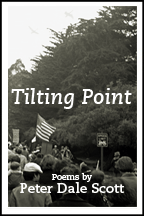 Peter Dale Scott has published a new chapbook of poems Tilting Point. You can read three poems from the volume here.
Coming to Jakarta: Peter Dale Scott reads and comments on his poem
Filed under: The Brouillon | Tags: Coming to Jakarta, deep politics, Peter Dale Scott, poetry
Leave a comment Freeman Ng has produced a series of videos, wherein Peter Dale Scott reads and comments on the first volume of his monumental trilogy Seculum, Coming to Jakarta.
Access the videos here
GOOGLING “Revolution” in North Africa
Filed under: The Brouillon | Tags: cyberspace, deep politics, Egyptian revolution, internet, Peter Dale Scott
Leave a comment The linked text GOOGLING “Revolution” in North Africa : How “Deep Politics” Successfully Corrupts A Non-Violent Protest Movement by Peter Dale Scott probes the cyber-representation of the recent revolutionary events in Egypt. In the wake of the splash Wikileaks made in recent memory, such circumspection about the internet as news medium is not without its value.
John Peck reviews Peter Dale Scott’s Mosaic Orpheus
Filed under: The Brouillon | Tags: Mosaic Orpheus, Peter Dale Scott
Leave a comment A trenchant, eloquent, substantial review of Peter Dale Scott’s Mosaic Orpheus by John Peck from Notre Dame Review #31.
The Doomsday Project, Deep Events, and the Shrinking of American Democracy
Filed under: The Brouillon | Tags: deep history, deep politics, Peter Dale Scott
Leave a comment Peter Dale Scott’s latest on-line article:
“In recent years I have become more and more concerned with the interactions between three important and alarming trends in recent American history. The first is America’s increasing militarization, and above all its inclination, even obsession, to involve itself in needless and pernicious wars. The second, closely related, is the progressive shrinking of public politics and the rule of law as they are subordinated, even domestically, to the requirements of covert U.S. operations abroad.
“The third, also closely related, is the important and increasingly deleterious impact on American history and the global extension of American power, of what I have called deep events. These events, like the JFK assassination, the Watergate break-in, or 9/11, which repeatedly involve law-breaking or violence, are mysterious to begin with, are embedded in ongoing covert processes, have consequences that enlarge covert government, and are subsequently covered up by systematic falsifications in media and internal government records….”
Read more here JapanFocus.

 Poeta Doctus