Archive for the ‘poetry’ Tag
A Timely Re-release: Peter Dale Scott reading from Minding the Darkness
Filed under: The Brouillon | Tags: Minding the Darkness, Peter Dale Scott, poetry, poetry readings
 Leave a comment
 Twenty years ago I got wind that Peter Dale Scott would be reading in the McGill University Library’s Rare Books Room. I had only recently discovered his work, in an excerpt from Minding the Darkness in Conjunctions, a poetry whose engagement with history and politics by means of an unabashedly citational poetics harmonized with my concerns and practice at the time, so I went.
When Scott solicited questions after his reading, I asked something like: “You have three books: the first [Coming to Jakarta] that begins by invoking three desks, at one Virgil’s Nekyia, an Inferno; then Listening to the Candle, a Purgatorio; now an old man’s Paradiso: all weaving historical, luminous details, personages modern and historical, autobiography, taking up the Tradition, all written in tercets: is there a Dantescan intertext?” to which he answered, “You, don’t go anywhere!”, an invitation to speak once all the other questions had been asked and answered. That was a fateful meeting, as Scott, the man and his work, have maintained an important place in my life and work, happily, since.
John Bertucci has now done us all the favour of uploading a video of Scott reading from that ultimate volume of his Seculum trilogy only a year after the one I attended. You can recapture an experience of Scott reading in the wake of the release of Minding the Darkness, here:
OULIPO now and then
Filed under: poems | Tags: Christian Bök, Ernst Robert Curtius, Eunoia, Joseph Conte, Ladonian Magnitudes, OULIPO, poetics, poetry, postmodern poetry
Leave a comment 
“Oulipo turns 60, but given how much we hear about it these days, it feels more like 150″ says George Murray at Bookninja. To some of us, it seems much older.
For my part, I learned about the OULIPO and composition by means of a generative device in the early nineties, thanks to Joseph Conte’s goldmine of a study, Infinite Design: The Forms of Postmodern Poetry. Not that long after (or so it seems this morning), Christian Bök’s Eunoia appeared to equal acclaim and, well, annoyance (a book, for those who don’t know, is composed by means of a generative device, after the OULIPO).
For me, the controversy was tiresome, having read Conte’s work and, more importantly, Ernst Robert Curtius’s classic oeuvre, European Literature and the Latin Middle Ages, which details ancient and medieval modes of composition which quickly dispel any illusions the OULIPO and its epigones are avant garde. (Though I do know that matter is more complex than I allow for here).
I expressed my impatience with the whole matter, boiling Curtius’ excurses into the following poem from Ladonian Magnitudes, one among several that got up the nose of that book’s most notorious reviewer. The poem is four quatrains and a concluding line, despite WordPress’ formatting constraints…
Liposuction & Related Procedures in Antiquity
Lasus Pindar’s master made a poem sans σ and a millennium later
Nestor of Laranda in Lycia wrote an Iliad each book less a letter Tryphrodorus Aegyptus did the Odyssey
So from Baroque Spain via Peter Rega
From Fabius Planciades Fulgentius’ De aetatibus mundi et hominis λειπoγραμματoς
Hucbald’s Charles the Bald eclogue beginning every word with C one-hundred and forty six lines
Late Roman grammarians’ παρόμoιoν
O Tite, tute, Tati, tibi tanta, tyranne, tulisti a scolia for a Caracalla’s Banquet
where as Aelius Spartianus has it from his brother Geta every dish alliterated
The so-called “figure poems” τεχνoπαίγνια in the Greek Anthology
Porfyrius Optatianus rendered in Constantine’s Latin
Alcuin, Raban Maur, Sixteenth Century Hellenism followed
Pre-Alexandrian Persian lines in trees and parasols
Eusonius follows Plato’s for the Sophists logodaedalia in his Technopaegnion
Each line of one poem starting and finishing with one syllable and the last word’s the next’s first
Catalogues of single syllable limbs, gods, foods, questions “yes” or “no”
A myth crib every line turning on one syllable
Grammatomastix’s monosyllables amputated prefixes lifted from Ennius and Virgil
The “versos de cabo roto” Urganda chants before “…a certain village in La Mancha…”
James Dunnigan: new chapbook & interview
Filed under: The Brouillon | Tags: Cactus Press, James Dunnigan, poetry, Wine and Fire
Leave a comment 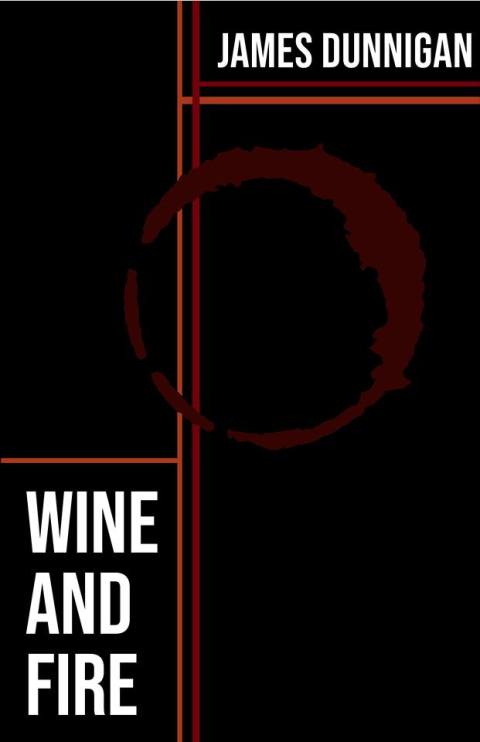
Design: Bianca Cuffaro
James Dunnigan launches his second chapbook Wine and Fire (Cactus Press, 2020) Tuesday 18 February 2020, 20h00 at the Accent Open Mic Vol. 25—Cactus Press launch, La Marche à côté, 5043 St-Denis, Montreal, Quebec. (Facebook Event page, here).
Dunnigan is also the author of The Stained Glass Sequence (Frog Hollow Chapbook Award, 2019) and was shortlisted for the Gwendolyn MacEwen Poetry Prize in 2018. His work has also appeared in CV2, Maisonneuve Magazine, and Montreal Writes. He writes in English and French, reads Latin and sells fish for a living.

You can read a series of five mini-interviews with him, here.
You can see and hear a recent reading, here.
Dunnigan is a singularly gifted young poet. If you’re in Montreal, this launch and this chapbook are not to be missed.
Corpus Sample: the poetic Wittgenstein
Filed under: poems | Tags: Grand Gnostic Central, philosophy, poems, poetry, Wittgenstein
Comments (10) A friend recently got a hold of the first and only book published during philosopher Ludwig Wittgenstein’s lifetime, the Tractatus Logico-Philosophicus. I don’t know what prompted my friend to order in a copy, but he was understandably perplexed; even Bertrand Russell famously failed to understand his student’s work. Philosophically, despite its immediate fame among the Logical Positivists, the Tractatus is, today, a “dead dog”, repudiated most famously by the author’s own reflections, published posthumously as the Philosophical Investigations. Nevertheless, a friend of my friend sought to console him, assuring him “the Tractatus is pure poetry.” Creative writers have tended to agree: Jerome Rothenberg and John Bloomberg-Rissman included sections from Philosophical Investigations in their assemblage of outsider poetry, Barbaric Vast & Wild, dramatist and novelist Thomas Bernhard published Wittgenstein’s Nephew in 1982, and Canadian poet-philosopher Jan Zwicky’s first book Wittgenstein Elegies appeared in 1986.
I don’t remember when I first encountered Wittgenstein, but it was surely before beginning my undergraduate studies. Those (eventually) were devoted to philosophy, and I wrote my honours paper on the private language argument in the Philosophical Investigations. To pass the time (four days) driving from Regina to Montreal, where we were going to study, a friend and I read through the Tractatus, doing our damnedest to make what sense of it we could. And my graduate studies resulted in a number of poetic texts, all engaging in various ways with the early and late Wittgenstein. Even more recently, a compositional method shared here takes an ironic inspiration from his remark that “meaning is use”.
I post below, then, two poems now included in my first trade edition Grand Gnostic Central. The first is a prose poem, borrowing liberally from Norman Malcolm’s memoir; the second is a poem that tries to come to terms with the Tractatus.

[from “Grand Gnostic Central”]
The walls are bare and the floor scrupulously clean. In the living-room, two canvas chairs and a plain wooden one around an iron heating-stove. In the other room, a cot and card-table, books, papers and pen. A man sits at the card table. His face is lean and tanned. He wears a flannel shirt and light grey flannel trousers. His shoes are highly polished. He looks concentrated and severe, striking out as if arguing. He stops, sits still. He remembers swimming—a small boy, the ease of floating, the sun and water in his eyes, closing them tight. He remembers how hard it was forcing himself down, down deep to the mud at the bottom, the water always pushing him back to the surface, his needing air pushing him back to the surface. He has written a treatise on logic. He knows those who do not know him think him an old man, irritable and obscure. He remembers writing his thoughts for the book in small notebooks he carried around. He remembers writing “If `the watch is shiny’ has sense…” He remembers the flash on the watch-face that gave him the example. It had rained and only now the sun cut through red clouds. The field’s mud is soupy and slick. He crouches down in the water at trench-bottom, once almost standing to keep his balance in the muck. He hears the sharp tiny ticking at his wrist. He dates the entry 16.6.15.
Holy Crow Channels LW
We know no sensations
give these propositions sense. Questions
that exact innocence free from naivete
demand a rigorous ignorance of the evident
apparent given as the one condition
for their initial
stuttered utterance.
The long tautology that bends say
the blade of a jet engine
to just the angle of most force
turns on this
when the need for further thrust
draws inertia from the potential
for doubt, unbinding concepts and arguments
and baffling mathematicians
just this side of mathematics.
We need our end to be
the final determination
of the rule that keeps stasis
appearing repeatedly, that blesses with some semblance
of regularity frequently enough
to let us see this
and hear that
completely unsurprised. These things we know
are hardly thought, for the common
is the category entered most
easily. We can count, yet,
to ask what numbers are
reveals the path that eases
the passage everywhere but where
the answer you expect to desire lies
and leads you to question
again the writings that made you
conclude the first proposition
that defined one doubtfully. For them
a mere analysis, for you
something more that flails you
to what is truly necessary. The clear thought
expressed as clearly as the fabric of language
will strain it
fascinates you with its immaculate muteness
that finally becomes a song so mythic
you are bound from it, fast,
and your hearing is filled
with what is spoken
in innocence, naively.
Action Books action
Filed under: The Brouillon | Tags: Action Books, poetry, poetry in translation
Leave a comment As an English-language Canadian poet, I’ve always starved and thirsted for almost anything foreign to most of what officially passes for my native poetic tradition. Action Books has been introducing some of the wildest, weirdest, far-outest poetry into English for years, and now their list is half price (with the checkout code ‘TRANSLATE’).
Do yourself and them and North American English-language poetry and line your shelves and blow your poetic mind now!

Manifesto
Action Books is transnational.
Action Books is interlingual.
Action Books is Futurist.
Action Books is No Future.
Action Books is feminist.
Action Books is political.
Action Books is for noisies.
Action Books believes in historical avant-gardes.
& unknowable dys-contemporary discontinuous occultly continuous anachronistic avant-gardes.
Art, Genre, Voice, Prophecy, Theatricality, Materials, the Bodies, Foreign Tongues, and Other Foreign Objects and Substances, if taken internally, may break apart societal forms.
“In an Emergency, Break Forms.”
Action Books: Art and Other Fluids
Praise the algorithm! Plunging into the silliness: Andrew Lloyd’s career as an Instagram poet
Filed under: Praise and Polemics | Tags: Instagram poetry, poetics, poetry, poetry criticism
Leave a comment Thanks to real poet Michael Boughn for sharing Andrew Lloyd’s article from Vice “I Faked My Way as an Instagram Poet, and It Went Bizarrely Well”—a fortuitous addendum to my last post, “Synchronicitious Critique”.
September 13 Synchronicity
Filed under: poems | Tags: Dan Philip Brack, DPB, poems, poetry, September 13, synchronicity, Zsolt Sőrés
Leave a comment For me, September 11 is often shadowed (if not overshadowed) by the Dawson College shooting of 2006, which (as a teacher there) I witnessed, from a fortunate, safe distance.
Today, however, reflecting on the work, I opened Ladonian Magnitudes by chance to the poem “Epistle to Zsolti”, a versified missive to my friend, Hungarian sound artist Zsolt Sőrés. The letter, as much as it overtly expresses a desire to correspond and communicate with a distant friend, as a poem, has other motivations, one of which was remarked by the “Gefin” in the poem (Hungarian-language poet Kemenes Géfin László, a close friend at the time), namely, the death of another friend, writer Daniel Philip Brack (DPB), September 13.

In acknowledgement of this manifold synchronicity, and in warm memory of DPB and the other friends in the poem, and the attachment that motivated it in the first place, I share it here.
Epistle to Zsolti
been on a Tom Waits
immersion course
for weeks now
buying him all up
latest and lastest
new or used
listening to just one new song
a day
carefully
these days Foreign Affairs 1977
like Blue Velvet’s soundtrack
reminiscent of Cronenberg’s Naked Lunch
even a couple of “One-eyed Jack’s” in the lyrics:
our cinematic interests
our show’s DAT I’m so eager to hear
because of a heightened self-consciousness about Performance
teaching again now two weeks
Primal Shamanic poetry and poetics
that is “magical”, “sacralizing”, “holy-ing” “aestheticizing”, “estranging” language-act
& “The Truth is Out Where?! Exploring the Unexplained”
eager to get you a draft of our interview (!)
write up a short article on why my favourite books today are Hungarian,
namely yours and Gefin’s
Poems for Jolanta urged me
around high noon today
to likewise edit the literary remains of dear departed DPB
Yes! He in the Budapest Suites
hopfrogging with me a parodic waltz
through that night empty streetcar subway hub under intersection of those big utcas
loud and lively red eyed Bacchic old electric blue shark skin suit skinny black tie 50s grey hat
who one Friday
September 13
overdosed OD’d
in San Francisco LA
right out of rehab
he who made
our furious correspondence
into spontaneous pseudonymous
“heteronyms” like Pessoa’s?
Kierkegaardian personae?
serial surreal literary works
whose literary remains
but for one
now lost?
novel on old 5-inch floppy
now my care
hardly able to pick them up
for grief
for guilt
the years since
so really should get together with Cronenbergian croney and computer design wiz and get to it
Did I ever send you photos of the Trabante?
Hold-ups began on our return in July
when installing Flashcard reader jammed access to my Office Suite
& December saw the whole house of cards come crashing down
Just when the Raelians announced they’d cloned a human being
& BBC Radio 4 Frankfurter Allgemeine Zeitung feuillton Times Higher Education Supplement all wanted my opinion
now I’m waiting for the cheques and checking my expectations that something poetic might come out of it
Sleeping, eating,
& now working
are all I’ve been able to do since December 3
But now apparently energetic enough to send out some feelers
which seems appropriate for someone who aspires to be
the antennae of the race
Corpus Sample: Materializations II: “Gloze”
Filed under: poems | Tags: Grand Gnostic Central, Jake the Dog, poems, poetics, poetry, Ty Hochban, videopoems
Comments (3) Last week’s “materialization” sought to concretize the language by collaging snippets of decontextualized conversation. This week’s tightens the knot, making “the language speak” about the language itself.
The philosopher Ludwig Wittgenstein is remembered for remarking that “meaning is use.” Taking this maxim literally, I collaged together examples of every use of the word ‘gloze’ drawn from the examples supplied by the Oxford English dictionary under the word’s entry. The word is thereby lexically if not semantically “emptied out” in a cubist fashion, putting Wittgenstein’s contention to an ironic test. The poem is further self-reflexive, because the word means to glare or inspect closely; therefore, the title can be taken to be the imperative tense, instructing the reader to gloze, gloss (another meaning), or otherwise attend to the word itself. The word has the added bonus, aside from its polysemy, of being a pun on the plural of the substantive ‘glow’ and the third person singular conjugation of the verb ‘to glow’ among other things. Attentive readers will also note the poem is a chance fourteen lines….
Though this compositional procedure held promise, I exploited it only two more times, to write the poem “Gnarled Box” (along with “Gloze” included in Grand Gnostic Central) and a longer, much more complex, intertextual work that develops a passage from Lautreamont’s Poesies fittingly entitled “Poesies”.
‘Gloze’ is also the name of the first, self-published chapbook, that served as my calling card in Germany during my first European tour in 1996. And, like “Elenium” it inspired a videopoem by Ty “Jake the Dog” Hochban, viewable after the poem.
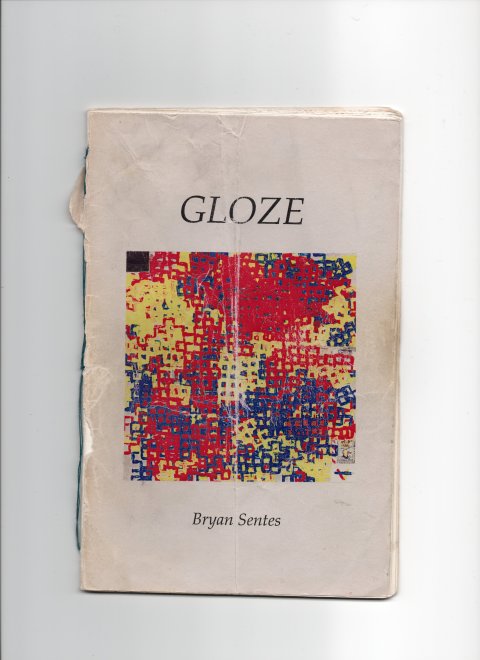
Gloze
No more men maye glosen withouten text
Than bylde materles. With fals talkyng
Many gloses are made. With Retorike,
Ne glosed eloquence, some to opteyn
Favour will flatter and glose, with new Glozes
Tainte the Text, and vnto you a fayned
Tale will gloze. Give a good glose from thy strain’d
Goggle eye, peep from the watry Humour,
And glow upon any word you may gloze,
The parasite glozes with sweet speeches,
With the tongue of flattery glozing deeds,
Known only to those who have glozed over
An illusory glozing of light dismally
Glimmering, glosing with the glory of day.
Corpus Sample: Materializations I: “Elenium”
Filed under: poems | Tags: collage, Jake the Dog, Ladonian Magnitudes, parataxis, poems, poetics, poetry, Ty Hochban, videopoems
Comments (3) 
Ironically, at a time when text is at its most material (as something to be cut and pasted, or mindlessly composed or translated by software) it is at the same time most invisible, the sign a mere window onto its meaning, disposable as a paper coffee cup once the latté is finished. Poets have, understandably, especially in recent decades, worked against this trend.
“Elenium” (aside from the elusiveness of its title) slows down the too-ready consumption of the language by complicating its logic. The poem collages overheard bits of conversation without any indication of which words belong to which speakers or even how many speakers there are. However old (and it is very old) this device is, it caused no little consternation to the most vociferous of the reviewers of Ladonian Magnitudes (see the “Product Description” at the book’s page at Amazon.ca) from which this poem is taken.
Happily, the poem inspired a video interpretation (by Ty “Jake the Dog” Hochban), viewable after the poem itself.
Elenium
The isle is full of voices
a tiny little yellow oval pill
Judy Garland ravaged by her phantoms
it’ll all be alright
they’re all pretty full—one’s puffed up
hashish, port, and In Memoriam
we must have some music, some more to drink
and then we are ready for “Shades of Callimachus…”
late night calls for coke are disturbing and boring
I always bring him something from Holland
what have we done yet? —I can see
the flower in the bud—and she is a bud!
let’s remember hysteria was thought to be a migrating uterus
you having sex would never look good
a colony mongrel hand-me-down genes
yet eyes are the guides of love still
that must have given you a twitch or two
with the Xanax I don’t feel like I need a cigarette
though you wouldn’t say you have beaten out your exile
Corpus Sample: “A Visitor from Jerry-Land”
Filed under: poems | Tags: identity, individuality, Ladonian Magnitudes, poems, poetics, poetry, the Death of the Subject
Leave a comment Last week I shared a poem a little more complex and elusive than what I’m wont to compose of late. Whatever difficulty it presented was more logical than anything.
However, a more persistent concern with no less complex consequences for that linguistic art whose medium is essentially public has been a struggle with how to maintain individuality in the face of all the forces that would liquidate it. During my undergraduate studies, “the Death of the Subject” was a hot topic. Today, the Subject is, again, dissolved in various identities, whether gender, race, class, or something other, or, even more gravely, as mere data, profiling a pattern of consumption.

In this poem, from Ladonian Magnitudes, that most public of things, language and text, is folded around the singularity of intertextuality and personal allusion to create a space for individual thought and, paradoxically, dialogue and expression. “A Visitor from Jerry-Land” answers an unpublished poem by the dedicatee (though included as an appendix to Ladonian Magnitudes). To further complicate things, its field of reference is unapologetically personal. Nevertheless, in this nearly hermetic space, it remains possible to engage urgent poetical, ethical, political, and existential matters at the site where they all in fact come into play, the individual person.
A Visitor from Jerry-Land
to Daniel O’Leary
“The makar must a wanderer be”
The chance
97% in my favour,
as even the hooligans
who stoned blind
Homer knew,
is the nether lands’
weather is variable
as the garden’s flowers’ colours’
pleasures under its lights.
Sloth, sallow, must swallow
its name’s root’s in Sanskrit
He-Who-Causes-To-Fail
Ferret out and squirrel away
what you can quoth
Master Ant smugly
even before his widescreen TV
where the Albanians’ Lada
is shot to shit and first one
on the scene’s no medic but
a cameraman focussed
on the slumped driver
his passenger’s shock-eyed begging.
The gravy, this meat’s juices
heat-pressed by kinetic attention.
We drove here in a Peugeot,
right away downed two Stoli shots,
and now, hours later, one makes
it up as he cooks supper while
the other scribbles his version
at the dining table. The sheer volume
of spirits swallowed and inspiring here
prevent the endless end of ill-fare.—
Look: the light waxes every morning
and night argues its obfuscations so
we might see its numbers plain.
In this light
an 18th century volume
of Juvenal with French crib
beside the new reading-chair upstairs
aside the modern English
concurs.

 Poeta Doctus