Archive for the ‘surrealism’ Tag
“Hell’s Printing House”: X Ore Assays (2001)
Filed under: Hell's Printing House | Tags: Canadian poetry, poetics, poetry, poetry chapbooks, poetry recordings, surrealism, X Ore Assays
 Comments (2)
Aside from the pages of little magazines and those of certain, indulgent anthologies, by poems really first made their way in the world in the form of chapbooks. I hadn’t yet published a full-length trade edition, when I went on a “European tour” in 1996, reading in Munich (twice), Heidelberg, and Amsterdam, two self-published chapbooks, Gloze (1995) and On the Phantom Air Ship Mystery (1995), my calling cards.
Joachim Utz, the sponsor of my reading at Heidelberg University’s Anglistiches Seminar, observed that my chapbooks reminded him of William Blake’s. This new category of post takes its inspiration from his remark. “Hell’s Printing House” will showcase my chapbooks, describing them, detailing their contents, linking poems that have already been published at Poeta Doctus, and presenting a new recording of one of their poems.
It is hoped these posts fill the lacunae between full-length collections, assuring those (apparently) few (and valued) readers who follow my production with interest that I am hard at work, going my own direction, at my own pace, trusting those intrigued might be charmed enough to tarry along….
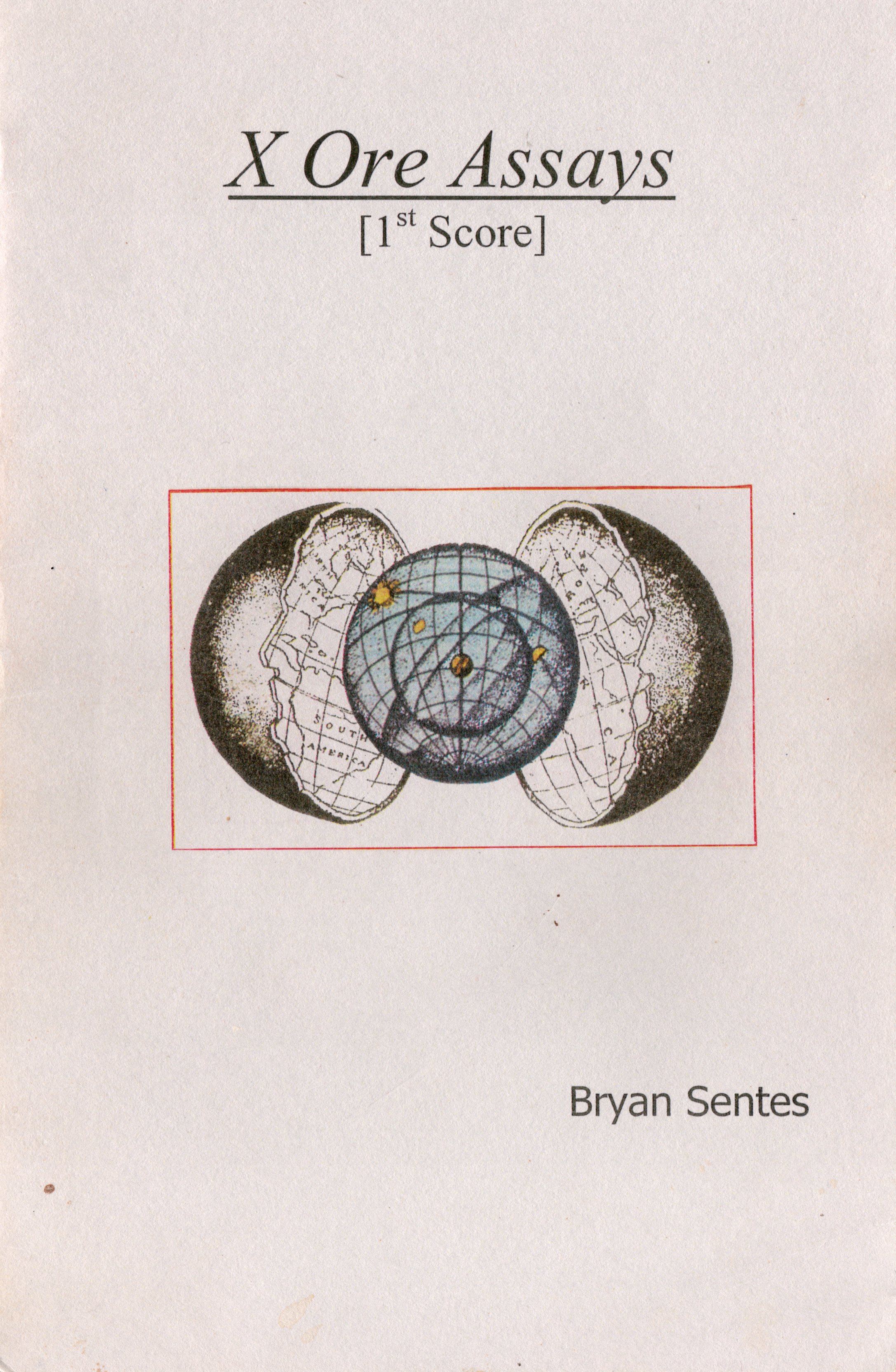
In 1998, I published my first trade edition, Grand Gnostic Central and other poems, which collected most of the poems in my previous chapbooks, other than those in On the Phantom Air Ship Mystery (which can be accessed here under the ‘Orthoteny‘ tag). I continued to mine and open new compositional veins in line with what I had written, but embarked in a totally different direction in late 2001 with X Ore Assays, which takes inspiration from a number of sources. The most immediate is FEHHLEHHE (Magyar Műhely, 2001) by the Hungarian musician, archivist, editor, writer, and cultural worker Zsolt Sőrés. FEHHLEHHE deploys a wide, wild range of linguistic disruption: disjunctive syntax, polyglottism, collage, sampling, homophony, and portmanteau words, among other means. X Ore Assays is in part an attempt to engage Sőrés’ text in kind, wrighting an English that would imaginably answer his Hungarian. A more remote but profounder influence is the homophonic style that myself and the late Dan Philip Brack (DPB) corresponded in, portions of which were intergrated into his series of short prose works, Letters from Jenny. In our correspondence, very few words were spelled in anything other than a pun, a delirious, funny, private literature, a practice whose linguistic energy I desired to tap in composing the project whose working title came to be X Ore Assays. An even deeper inspiration was the surreal practice of William Burroughs in writing “the word hoard” that was reworked and worked up into his breakthrough novels Naked Lunch, Interzone, The Soft Machine, The Ticket that Exploded, and Nova Express. I aimed to cleave close as I could to that first definition of Surrealism: “Dictation of thought in the absence of all control exercised by reason, outside of all aesthetic and moral preoccupation,” a much more fraught practice today than over two decades ago. The working title was motivated by this experiment: the texts, composed daily, would comprise a score (x-ore) of raw material (ore) to be assayed, measured, graded, and perhaps refined. However, a kind of ironic, poetic justice intervened. One of the days in this open-ended practice fell on September 11, inserting these texts radically and irretrievably in time’s flow. Curiously, that day was not immediately remarked; rather, hearing of, I think, Billy Collins’ refusal to write of the event almost a week later spurred, ultimately, fourteen more days of response, a supplemental sequence provisionally titled “Sewn Knot.”
That initial twenty, as a gesture of homage, I sent to Sőrés, who arranged to have them published in the Hungarian-language avant garde journal Magyar Műhely. “Sewn Knot” appeared, thanks to efforts of the editor-publisher of Broke magazine Andrea Strudensky, in the Canadian periodical dANDelion. “X Ore Assays” and “Sewn Knot” have presently been combined and are being revised and refined under the working title “after FEHHLEHHE,” which makes up the opening section of a manuscript-in-progress tentatively titled Fugue State.
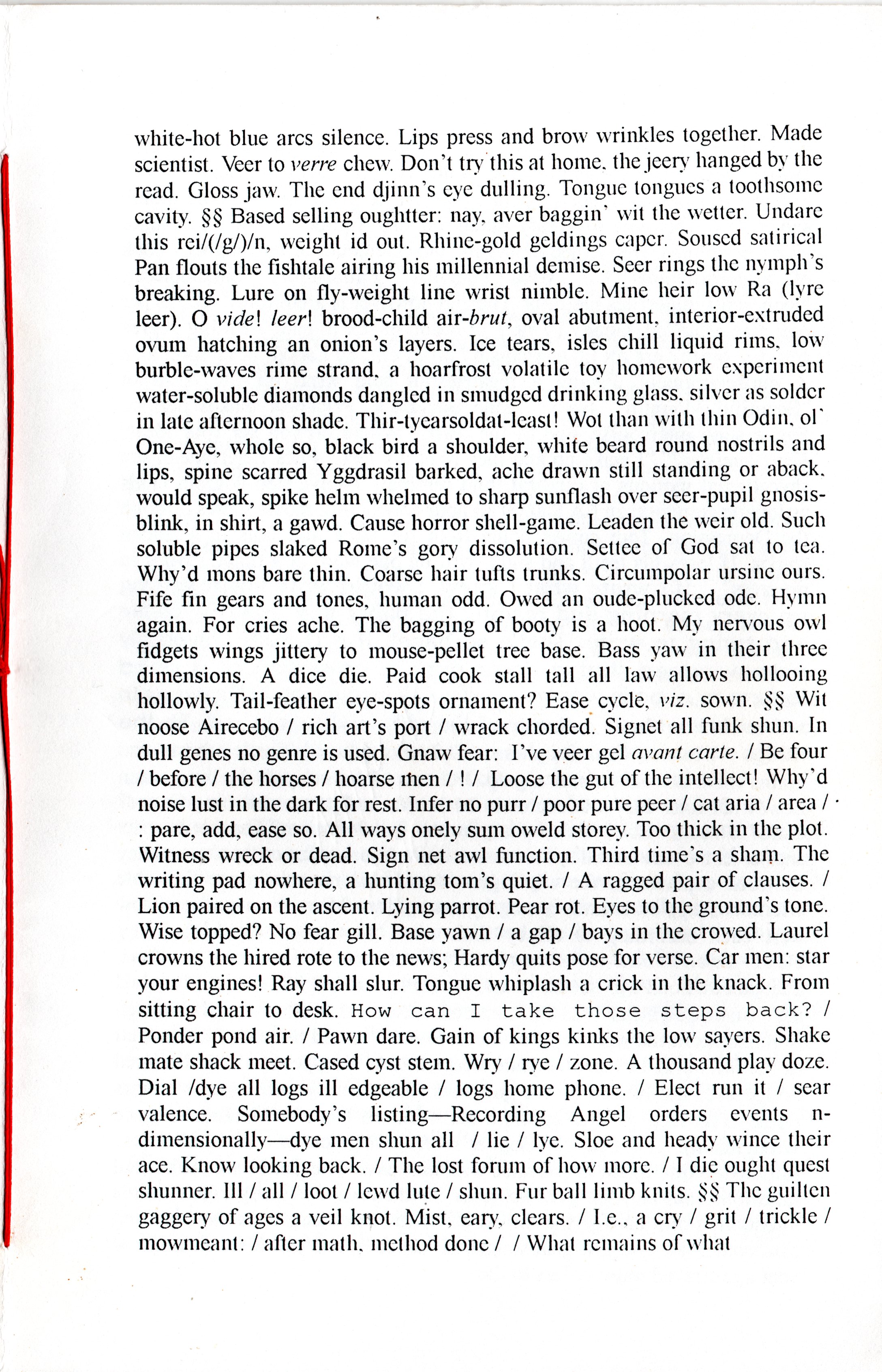
The sections responding in real time to 9/11 were not among those included in the chapbook; they can, however, be read, here. I reproduce, below, a page from the middle of the book, and read the day’s work beginning “Wit noose Airecebo..”
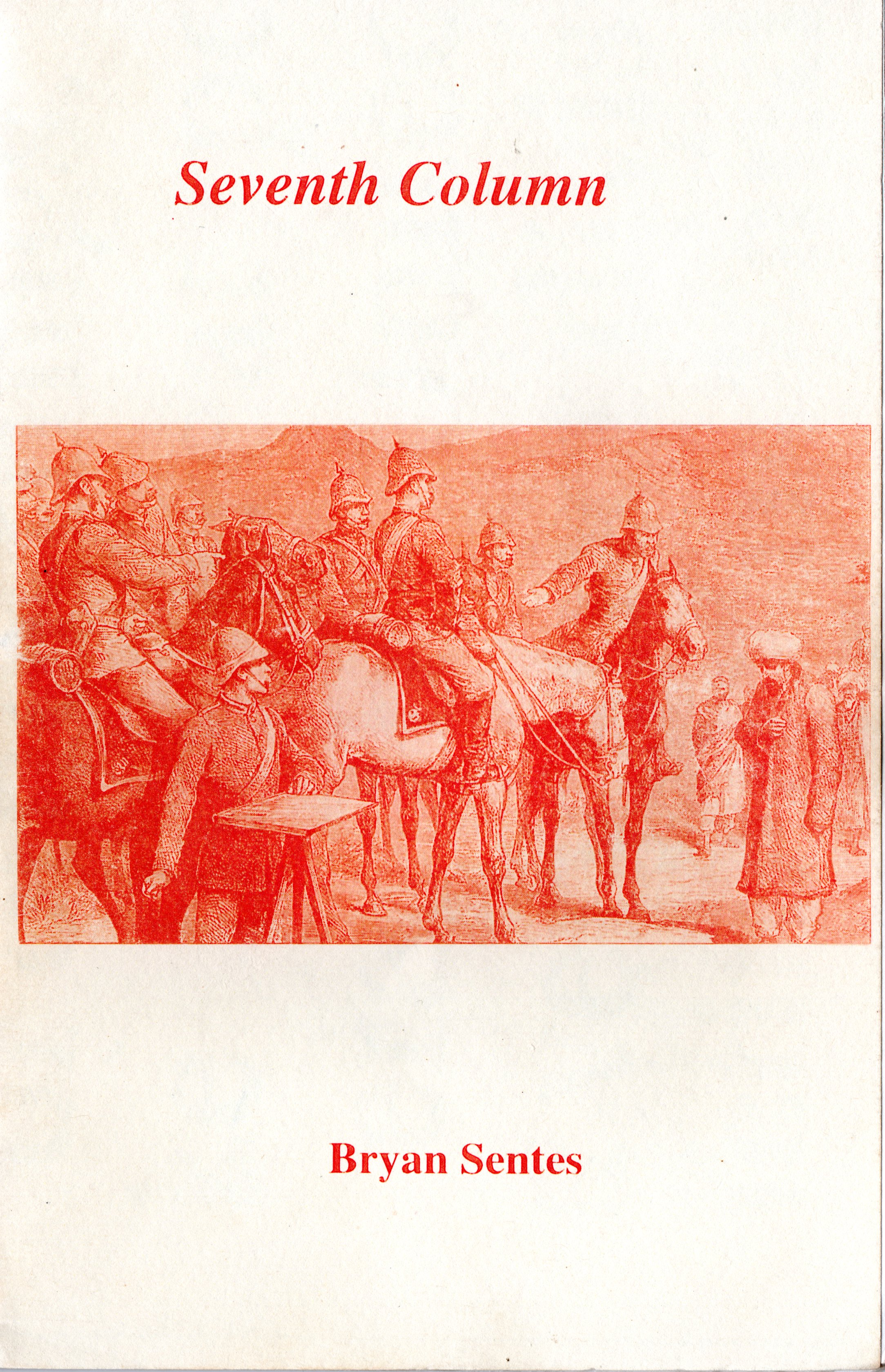
Next month: Seventh Column (2001).

 Poeta Doctus