Archive for the ‘the New Sentence’ Tag
“statements, terms, and jargon”: Saturday 2 September 2023
Filed under: "statements, terms, and jargon" | Tags: ecopoetics, Large Language Models, Peter Dale Scott, poetics, the New Sentence
 Leave a comment
Time constraints and temperament restrict many of my thoughts to remarks. Thus, what follows are emphatically fragments, metonymies (parts) of potentially more-extended discourses and drafts (essays) holding the promise of future elaboration….
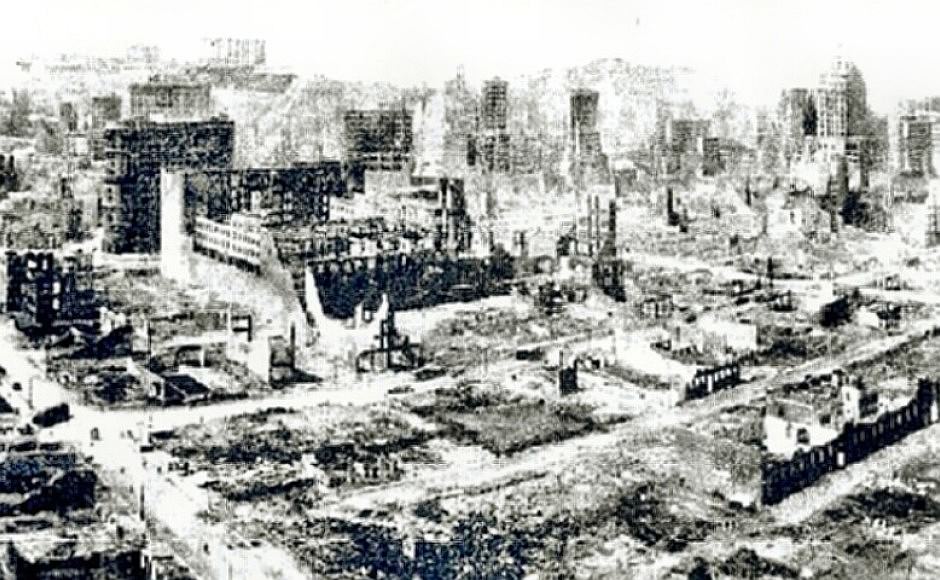
“If you want to change your life / burn down your house…” These words, which open Peter Dale Scott’s Minding the Darkness: A Poem for the Year 2000, strike an uncannily, untimely note in light of this season’s fires in Maui and in Canada’s north and west coast. The first canto of Scott’s long poem describes experiencing one of the no-less devastating wildfires Californians suffered in the closing years of last century. Both the fires in California and Maui left “rivulets of metal // from… melted cars.” From a broader, historical perspective, my German father-in-law, who came of age in the closing years of the Second World War in Germany’s industrial zone, the Ruhrgebeit, when he saw pictures of the devastation in Maui, was reminded of similar pictures he’d seen of a bombed-out Dresden. Such devastation, that stretches back, too, to that of the Great War, prompts Scott to cite Heidegger’s 1929 study, Kant and the Problem of Metaphysics, concerning “Dasein face to face // with its original nakedness.” Have we here, perhaps, a new literary topos?…

Large Language Models (LLMs), such as ChatGPT, do not write but, more exactly, perhaps, merely generate not even intertext but a permutation of its elements (words). Where intertext, rigorously, is “scraps of text that have existed or exist…the texts of the previous or surrounding culture… a new tissue of past citations…”, the “wake of the already-written”, what LLMs produce is only the most probable order of words. Do such prototexts not, imaginably (if not imaginatively) call forth, then, from poetry a countermeasure, the demand to compose in the least likely syntax? This demand transcends The New Sentence, wherein parataxis occurs only between sentences, urging a rereading of not only those most syntactically centripetal L=A=N=G=U=A=G=E poems, for example, but those explorations in this direction in, among others, the novels and poems of William Burroughs and John Cage, let alone those even older, deeper efforts to evade, avoid, or otherwise complicate the declarative sentence as “a complete(d) thought” in the poetry of Charles Olson, Ezra Pound, and William Carlos Williams, among so many others.
Or, from a related angle, chatbot “poems” need be considered in light of earlier modes of aleatoric composition, whether Burroughs’ Third Mind techniques or Cage’s or MacLow’s employment of the I Ching, or, farther back, Surrealism and Dada, or, even more radically, the various forms of divination throughout space and time, such as those collected in Jerome Rothenberg’s Technicians of the Sacred and remembered even in the classical heritage of antiquity (the Sybil’s leaves…). Given that the unconscious if not the “mindless” has been overtly and consciously employed in the composition of poetry to a variety of ends, chatbot “poems” or their precursors (which go back decades) are hardly “new.” Indeed, their very place in so-called “Late” Capitalism urges their scrutiny in light of the tradition, especially when they are employed “to write” “poems.” Is it inconsequential that Breton was a communist, that MacLow and, in his own way, Cage were anarchists?…
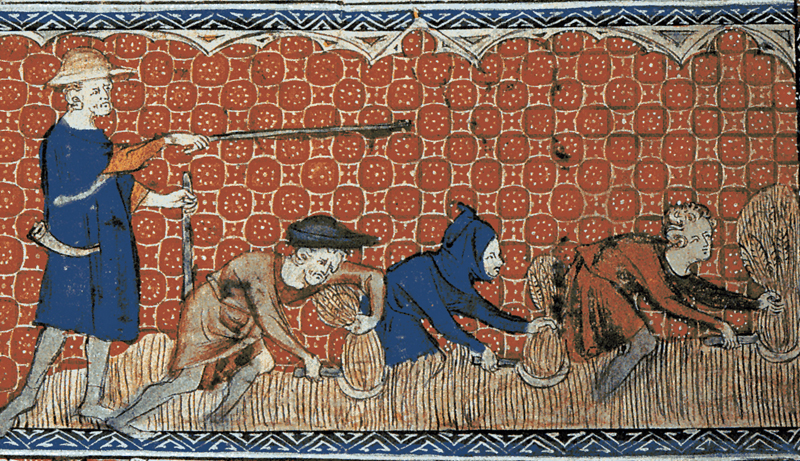
Perry Anderson, in his Passages from Antiquity to Feudalism, sketches the grounds for “The General Crisis” of the Fourteenth Century. On the one hand, agricultural production reached a limit: existing, arable land was becoming degraded, and land that could be reclaimed had been and was of a poor quality. At the same time, silver mining could neither dig deeper nor exploit the relatively poor-quality ore that could be accessed, affecting the amount of coin in circulation. This crisis in the forces of production was aggravated by the Black Death, which killed an estimated net 40% of the population of Europe.
Parallels to our present day are suggestive. The carrying capacity of the earth’s ecology has been breached (however much we do in fact produce enough food to feed the world’s population; the problem is one of distribution), and we cannot in principle exploit existing fossil fuel reserves without burning down our own house. Covid is hardly the Black Plague, but it is only one of the pathogens that have been and will be released by the progressing economic colonialization of what wilderness remains.
Nevertheless, on the other side of the Fourteenth Century and its crises was not total collapse, but the Renaissance….
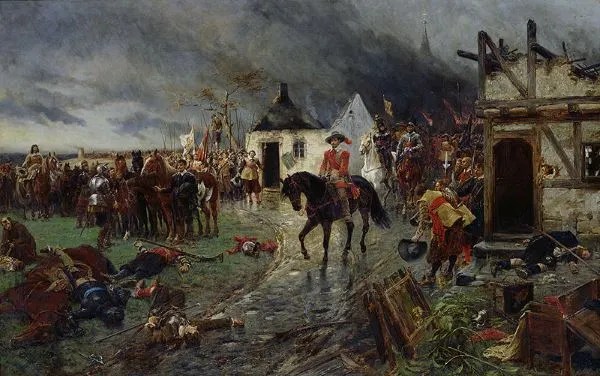
At a time of deep social fragmentation (Identity politics, ethnonationalisms…) and irrationality (a loss of consensus, determined by so many factors…) and no less in the face of the climate and more general environmental crisis is it not necessary, then, to revive the Universal and the Human?…
What’s the ideogram for ‘sheer inertia’?
Filed under: The Brouillon | Tags: Ideogram, Modernism, poetics, Revelator, Romanticism, Ron Silliman, the New Sentence
Leave a comment Normally, I’m given to giving more thought to what I post here and developing that thought at greater length and depth, but, sometimes, maybe, a blog is a place to allow oneself to think out loud, to essay some positions, without the explication and footnoting a more rigorously writ out thesis would demand. To wit:
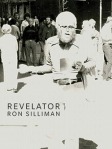
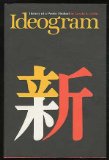 Reading a random piece of praise from Charles Bernstein for Ron Silliman’s latest addition to what amounts to his lifelong long poem, Revelator, I can’t help but think that the paratactic poetic of Silliman’s New Sentence is in a way the afterlife of Pound’s Ideogram, so trenchantly studied in what should be widely-known as the classic study by Laszlo Gefin. This insight, however true, helps articulate a growing discomfort and dissatisfaction with what passes for the contemporary avant garde in English-language poetry, which seems increasingly, to me, at any rate, as a dead end of that literary High Modernism that flourished in the first quarter of the Twentieth Century as that ghost of Romanticism that haunted the end of the Nineteenth Century was a faint echo of the Spirit of the first and second generations of British Romanticism about a century before it.
  However much our practice must be (never mind can’t help but be) “absolutely modern” (a modernity whose horizon, arguably, includes what is academically termed Romanticism, Modernism, and Postmodernism), said modernity is also always relative to its precursors, demanding, at times, a gesture for the sake of sheer differentiation, precisely what inspired Pound’s return to meter and rhyme in Hugh Selwyn Mauberly (1915!). That is to say, however pertinent parataxis might be said to be to our moment, as a poetic practice it has become, if not merely reflexive, at least de rigueur, which is to say as dogmatic as any compositional value in any school of poetry, another hollow idol for the hammer to sound.

 Poeta Doctus