Archive for the ‘notices and reviews’ Category
An Old Man’s Eagle Mind: on Peter Dale Scott’s Dreamcraft
Filed under: notices and reviews | Tags: Canadian poetry, Czeslaw Milosz, Dreamcraft, ethogeny, Peter Dale Scott, poetry, poetry reviews
 Leave a comment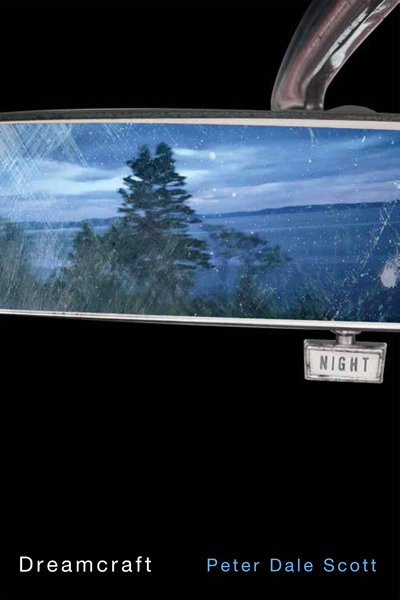
The publication of Peter Dale Scott‘s latest volume of poetry is bookended by last year’s appearance of his study of Czeslaw Milosz, Ecstatic Pessimist, and this year’s release of Reading the Dream: A Post-Secular History of Enmindment, quite the trifecta for a man who turned ninety-five in January of this year (2024).
The poems collected in Dreamcraft, on might say, have vista. This latest volume’s being published in the poet’s ninety-sixth year, it comes as no surprise to find poems on old age. “Eros at Ninety” is both humbly, humorously self-deprecating and wise. “A Ninety-Year-Old Rereads the Vita Nuova” and “After Sixty-Four Years” ruminate over the changing experience of art, here, that of Dante and Grieg, within a lifetime’s perspective. The longer one lives, the more acquaintances one loses to death: elegies for lost friends—Robert Silvers and Scott’s lifelong friend Daniel Ellsberg, among them—take up nearly a third of the book. Four poems are addressed to Scott’s friend, Leonard Cohen, the book’s title track, “Dreamcraft,” the explicit elegy “For Leonard Cohen (1934-2016),” “Commissar and Yogi,” and a poetic back-and-forth the two shared just before Cohen’s death, “Leonard and Peter” (included, as well, in the last collection of Cohen’s work, The Flame). The volume’s perspective, from within “the long curve of life” (words from the book’s first poem, “Presence”) is evident in the poems that embed the poet in larger processes, whether “the bicameral brain that makes // obsfucation of mere fact / so much more beautiful” (“The Condition of Water”), our genetic character (“Dreaming My DNA”), the Earth itself (“Deep Movement”), “cosmic space / …knowable / by those specks of light // at great distance from each other,” or History’s ethogeny, which Scott glosses as “cultural evolution” (“Moreness”). Loss and the long view bring the poet’s closest relations into focus in more intimate poems, those for his daughter, Cassie (“To My Daughter in Winnipeg” and “Missing Cassie”) and wife, Ronna Kabatznick (“Enlightenment” and “Red Rose”).
Last year’s publication of Ecstatic Pessimist: Czeslaw Milosz, Poet of Catastrophe and Hope reveals Milosz as a kind of éminence grise in Dreamcraft (and, indeed, throughout Scott’s poetry). Though their friendship at the University of California, Berkely, was short-lived (roughly from 1961-1967), Milosz’s notions of the function of poetry and the poet, as one whose “poetic act both anticipates [an emancipated] future and speeds its coming,” are determinative: anyone at all familiar with Scott’s poetry and prose will hear the echo of Milsoz’s Nobel Prize acceptance speech: “In a room where people unanimously maintain a conspiracy of silence, one word of truth sounds like a pistol shot.” Scott’s lifelong relationship to Milosz’s poetry and thought, if not with the man, finds expression in the five-part sequence “To Czeslaw Milosz,” wherein Scott reflects on that relationship, one Polish word or one poem or idea at a time. This sequence is balanced, as it were, by “The Forest of Wishing,” originally published in 1965, which addresses (among other things) Milosz’s reaction to the American Counterculture of the 1960s in an earlier style of Scott’s, remarkable for a more elusive density of suggestion than is found in his poetry from Coming to Jakarta (1988) to the present volume.
Scott’s mature style might be said to take its cue from Milosz’s admonition (also from his Nobel Prize acceptance speech) that the poet need “liberate [themselves] from borrowed styles in search for reality.” The result, in Scott’s case, is sure to irritate those readers who need their poetry to “tell it slant” (whether that spring from a post-Eliotean prejudice for “metaphor” or a post-Language demand that the linguistic medium be estranged, if the aesthetic inclination is even so self-aware). A case in point might be the poem “Pig”:
Aside from the poem’s being a recognizably generic “lyric” (a first-person anecdote climaxing in an epiphany), I can well imagine readers with a taste for the mimetic virtues of, say, Seamus Heaney, Eric Ormsby, or (more recently) Kayla Czaga, or the verbal deftness of Michael Ondaatje at his best, dissatisfied with the description of the pig’s butchering (in the second, third, and fourth tercets), desiring in place of, for example, the words ‘slaughtered’, ‘cutting’, and ‘squealing’ at least a more sensuously robust diction if not a vividly inventive image to present rather than refer to the action. Such readers would be even more scandalized by the poem “Mythogenesis” with its opening “The OED defines / both mythopoeia and mythogenesis / as the same: the creation of myths,” lines which set the tone for the explicatory prosaicness of the poem that follows (a prosaicness, however, that slyly reproduces, line for line, the original email sent to the editors of the Oxford English Dictionary). I, too, have struggled for my own reasons with this tendency in Scott’s style over the years, and, were this notice a “review,” I’d be obliged to indulge in the workshop nit-pickery that would find fault with (“criticize”) a certain word choice here, a syntax that might be made more mimetic there, or even the collection’s title, but such an approach too often merely brings into view the reviewer’s prejudices or limitations (let alone the hatchet they might have to grind) than serving to illuminate the work under consideration (a problematic addressed, in fact, by the book’s penultimate poem “A Quinkling Manifesto”). Scott, himself, has responded to critics who find his poetry too prosaic, reminding them the same accusation was levelled at the prosody of Williams Carlos Williams a century ago. One could point to that other compositional sensibility (with which Williams was briefly associated) present in the “Objectivist” poets (notable for their engagement), among them, Lorine Niedecker, Carl Rakosi, or Charles Reznikoff. But more to the point, it is precisely this clinamen of Scott’s style, the way it swerves from any such obvious borrowings or influence, that is an index of that essential drive in his entire oeuvre, a “search for reality,” the telos of his work that is the principle measure of its success or failure, if a critical judgement is indeed called for.
As I’ve observed, the poems in this latest (if not last) volume take the perspective of “an old man’s eagle mind” (as Yeats called it), wherein “the long curve of life” becomes visible, the horizon for whatever else might come into view. This perspective is, perhaps, no more evident than in the book’s final, thought-provoking poem with its explicitly ethogenic theme, “Esprit de l’Escalier“:
The poem, in post-secular fashion, has as its epigraph a verse from the Book of Zechariah (4:6) (Scott the first to my knowledge to articulate a post-secular sensibility, in advance of Habermas’ developing the concept in its present form in 2008), a verse with tonal implications for what follows. We are admonished to “not just talk about politics // which let’s face it / we can do nothing about” (at least those of “us here / at this Chanukah table”) but “about culture // preparing people’s minds / for tomorrow’s revolution” (words which, again, echo Milosz’s “The poetic act both anticipates the future and speeds its coming”). Curiously, the poem speaks of a “black windshield” (likely the image that, in part, inspires the book’s cover art) “smeared… // with the grime of facts,” a brow-furrowing sentiment to flow from the pen of so assiduous a researcher, whose work, prose and poetry, has laboured to uncover that “conspiracy of silence” and scatter it with a resounding “word of truth.” (That is, perplexing as long as we remain insensitive to the potential tonal complexity of ‘facts’ and the even more important and profound distinction to be made between “facts” and truth…). This grime is to be cleaned “with hope,” a hope that waits for “the great poet // on whose shoulder / that eagle flying / above and ahead of us // in the darkness / will come down briefly to rest.” These lines are richly suggestive. On the one hand, they mark Scott, I think, as one of those increasingly rare poets who demand poetry play an orienting if not guiding role in culture and society. On the other, that “eagle flying / above and ahead of us” is at first elusive as allusive. Is it a mere—if complex—metonymy, invoking the eagle’s powers of sight? Does it allude to the eagle formed by the just souls in the heaven of Jupiter in Paradiso XIX? Is it a symbol of God, via the bird often associated with Zeus (‘Z-eus’, ‘d-eus’ (which, regrettably, only rime with ‘th-eo’…))? More tentatively, it brings to this mind, anyway, the idea of the kommende Gott, the “coming god” in Hölderlin’s “Bread and Wine” (however much that god is, in fact, Dionysius…), perhaps that god who is the only one “who can save us” in Heidegger’s late, portentous phrase. This interpretive question is resolved, however, by turning to Reading the Dream, where we discover Scott’s eagle alludes to the spirit of Rousseau in Hölderlin’s ode to the French thinker, that “flies as the eagles do / Ahead of thunder-storms, preceding / Gods, his own gods, to announce their coming” (“wie Adler den / Gewittern, weissagend seinen / Kommenden Göttern voraus“). The rich figurative resonance of these lines that demands such learned, interpretive labour marks them, too, as belonging to a past, if not passed, poetic, one rarely practiced today, if at all.
For many, I think, Scott’s vatic stance in this poem (however domesticated in its opening scene) and the faith in poetry it expresses will place him beyond a certain pale. The present, at least North American, mood is more skeptical. Those with some historical sense will too easily remember those poets who aspired to influence, cultural, social, and political, and went “wrong, / thinking of rightness.” Auden’s words, “poetry makes nothing happen,” still express a common sentiment, and, for those who do engage the question of the relation of poetry and politics seriously, it remains an open-ended, complexly recalcitrant problem. In his defense, Scott, in Ecstatic Pessimist, invokes Virgil, Dante, Blake, Shelley, and Eliot (6). More forcefully, Scott’s study of Milosz is a sustained argument for the potential social force of poetry, exemplified by his subject, notably “his contributions in the 1950s and 1960s to what became the intellectual culture of Solidarność” (5). What is striking is how this last poem in Dreamcraft departs from Scott’s characteristic poetry-of-truths that ring out like “a pistol shot.” It might be argued that its prophetic vision, of that mysterious justice-to-come and its poet, draws on poetry’s power to posit the counterfactual (how matters could or should be, to paraphrase Aristotle), to imagine a non-place (u-topos), a place that is not because it is only yet-to-be, and only potentially so. In contrast to the probing of uncomfortable truths (facts) characteristic of so much of Scott’s poetry, the fictionality of the poem’s vision (its being (only) imagined) invites, demands, a suspension of disbelief (the condition of imagining what is not as if it were), evoking our Negative Capability, that ability to live “in uncertainties, Mysteries, doubts, without any irritable reaching after fact and reason.” By its very unreality, then, the poem evokes that resolve that poetry—and social action—require….
That Scott’s oeuvre in this way, from his Seculum trilogy to Dreamcraft, demands the engaged reader to consider and wrestle with the art of poetry, poetry and politics, investigative fact and visionary fiction is evidence of its sophisticated achievement. Such reflection, it has long seemed to me, is the condition for any understanding of poetry, worthy of the name, an understanding that needs precede any critical appraisal. This resistance to a ready assimilation to existing literary-aesthetic canons—despite the surface, apparently-prosaic transparency of the poetry—testifies to Scott’s poetry’s being poetry, making, creating works possessed of a novel uncanniness that adds something new, not merely accomplished, to the world of letters, if not the world-at-large.
(If so moved, you can purchase a copy of Dreamcraft by clicking on the book’s cover, above.)
On George Slobodzian’s Apokryfa
Filed under: notices and reviews | Tags: Apokryfa, Cactus Press, Canadian poetry, Devon Gallant, George Slobodzian, poetry, poetry chapbooks, poetry reviews, Willow Loveday Little
Leave a comment 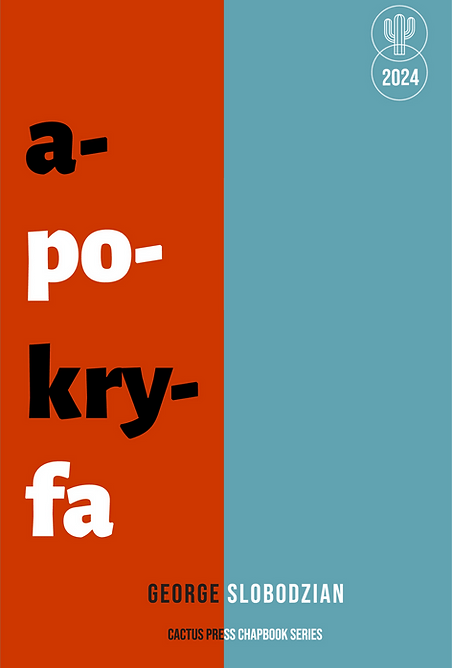
Culture must be—as the word itself might suggest—cultured, seeded and carefully tended. Such care takes many forms in Canada, from ever-diminishing (if however appreciated) government funding, to the selfless, meagrely-rewarded efforts of those who—in the case of our literary culture—publish small magazines and books of poetry, to more grassroots efforts.
In recent years, in Montreal, Devon Gallant and collaborators have cultured an urban poetic garden, organizing the Accent Reading Series, which combines an open-mic (as polylingual as the city) and a spotlight on one or two featured readers, and which has, accordingly, gathered a small, poetic community. One of the fruits of this endeavour is Cactus Press, which, to date, has issued over thirty chapbooks and the first trade edition of the unnervingly-talented Willow Loveday Little, (Vice) Viscera (2022).
One of the newest of these chapbooks is George Slobodzian’s Apokryfa, his second with Cactus Press. Apokryfa gathers eighteen poems, old and new, organizing them in three sections, “In the Garden,” “Et Homo Factum Est,” and “Tale.” The first reflects on childhood and youth, the second works up and on, more-or-less, Catholic mythology, while the last reworks fairy tales. However much at first glance these sections might suggest a progression from autobiographical truth to overt fiction, a more canny, poetic sensibility is at play that subverts such too-easy, hard-and-fast distinctions.
But this sophisticated sensibility is only one aspect of these eighteen poems, which, perhaps more importantly, reveal a poet at the top of his game. While, from the “Tale” section, “Other Dwarves” and “Deliverance” (a riff on “Rapunzel”), might seem relatively light, they are not without their wit (in the case of the former) or rich suggestiveness (in the case of the latter). Most of the poems are, however, so to say, more thematically substantive. “Radisson Slough,” recounting how the boy speaker “Out hunting with [his] father / and brothers, …was the dog,” concerns as much a moment in one’s lifelong loss-of-innocence as much as, perhaps, weightier epistemological matters when “in search of the warm reward / of a grain plump duck,” the boy finds “instead the corpse // of an abandoned crane / half-submerged and corrupt, / its great wings still engaged / in a sort of flight until” he touches it, and it sinks. “The Annunciation” in the chapbook’s second section, “Et Homo Factum Est” grimly recasts the Archangel Gabriel as the agent of some unnamed totalitarian regime with an uncannily ironic gift of prophecy who foretells the life of the expected son, a malcontent (and who wouldn’t be under such a system?) who leads “an entirely unremarkable childhood,” in the end only to “be taken / into the appropriate custody” to finally succumb “to his diseases.” And, in the book’s final section, that persistent question if not problem of “the Subject” (however much presently eclipsed by that of Identity) is taken up in a sly play on Delmore Schwartz’s “The Heavy Bear Who Goes With Me” in “4th Bear” and the provocatively reflexive “Tale” (which begins: “in a dark forest I found you / not knowing you were / the dark forest and the trail / I was following was the trail / I was making those were / my own breadcrumbs…”).
Those with poetic ears attuned to melopoeia will already have remarked the deft, phonemic harmonies of “the warm reward / of a grain plump duck.” Slobodzian’s undeniable prosodic gift (which I have previously remarked), though present, is at once more under- and overplayed, as it were. Though passages of the quality of that from “Radisson Slough” are not infrequent, the language tends to be plainer, shaped more by rhythm than harmony; at the same time, there is, at times, a marked deployment of rhyme (especially in “Rapunzel”). But Slobodzian’s talent and artistry all come together perhaps nowhere most markedly as in “Pysanka (The Written Egg),” from the book’s first section. Here, a boy, barely out of infancy, sits with his grandmother as she draws a stylus “across the surface / of an Easter egg,” while the boy watches. The poem is a small tour de force in the ease with which it delineates a primal moment of culture (the grandmother’s “fingers [know] these things” and take the boy’s hand) and, reflexively, poiesis itself in the image of “the risen sun / a flaming rose / above an endless line.” These three lines should suggest just how extended an exegesis and appreciation the poem calls for.
Gallant and Cactus Press have surely done us a service in collating and sharing this handful of poems. One can only hope there is some acquisitions editor at a trade press with the savvy to offer to gather them into that full-length volume we’ve been waiting for for too long.
A Sideways Glance at Don McKay’s Angular Unconformity
Filed under: notices and reviews | Tags: Angular Unconformity, Canadian poetry, Canadian Primal, Don McKay, Mark Dickinson, poetry reviews, Robert Bringhurst
Leave a comment Mark Dickinson’s Canadian Primal: Poets, Places, and the Music of Meaning, a groundbreaking study of the lives and work of Dennis Lee, Don McKay, Robert Bringhurst, Jan Zwicky, and Tim Lilburn has been open in my hands since landing there only a few days ago. Having just finished the chapter on Don McKay, I’m reminded I wrote a short notice of McKay’s collected poems  when it appeared in 2014 for a very good website, now defunct. Because it is a sharp, short review, I share it here, now, so it might remain on record. (The curious can read a more sweeping essay on the oeuvre of Robert Bringhurst, here).
“Hard to say this awkwardly / enough”: a review of Don McKay’s Angular Unconformity Collected Poems 1970-2014
Angular Unconformity is hardly amenable to a short review, collecting as it does ten volumes of poetry, supplemented by a sheaf of new work, more than 500 pages, a lifetime of poetic production. Moreover, any reader acquainted with contemporary Canadian anglophone poetry can’t be unacquainted with Don McKay, a two-time winner of the Governor General’s award for Night Field (1991) and Another Gravity (2000) and the Griffin Poetry Prize for Strike/Slip (2006). He is accordingly admired and targeted for these accomplishments and for his influence as an editor and teacher.
Nevertheless, one can characterize the stylistic development of McKay’s poetry with relative ease. The poetics of the first two volumes collected here, Long Sault (1975) and Lependu (1978), are influenced not so much by Purdy or Ted Hughes (as one critic would mysteriously have it) but by the New American Poetry, specifically Olson’s Projective Verse and The Maximus Poems or William Carlos Williams’ Paterson, especially where Long Sault becomes personified in (at least) the book’s fourth section. Lependu torques up the conceit of place and person, in this case London, Ontario and Lependu, in a more focussed, dense, and documentary fashion, but one that is self-aware enough to play fast and loose with its sources for its own artistic ends.
However, with Birding, or desire (1983) McKay finds his groove. In the book’s opening poem “Field Marks” (93) one finds what might be a description of much of McKay’s work from this point on: “…a bird book full of / lavish illustrations with a text of metaphor” (7-8). While in “Adagio for a Fallen Sparrow” (125) in the same volume the poet points to his “shelf / with Keats and Shelley and The Birds of Canada” (21-22). In these lines McKay presciently parodies the reputation this and following volumes will earn him, that of the Nature (i.e. Romantic) poet whose main thematic vehicle is Canada’s birds. Like any parody, however, this one possesses a perverse truth, for a primary objective of McKay’s poetry is one shared with Novalis and Wordsworth, to render the familiar strange, to percieve the things of the world as if for the first time. As McKay writes in the essay “Baler Twine” from Vis à Vis (2001): “in such defamiliarization…we encounter the momentary circumvention of the mind’s categories to glimpse some thing’s autonomy—its rawness, its duende, its alien being” (21). This “circumvention of the mind’s categories” is simultaneously an eschewal of the mind’s drive to dominate via knowing, a refusal of what McKay terms, following Levinas, “the primordial grasp” in favour of a “poetic attention” wherein the poem reaches for “things sensuously through the caress” (23).
The poems caress their objects with two hands: on the one, a fluctuation of lexicon and tone, while, on the other, a protean metaphorization. The poems mix so-called High and Low culture, “lascivious as Beardsley, sweet as Shirley Temple”, the vernacular and the discourses of geology, philosophy, and (of course) ornithology, English and French, gravity and humour. McKay’s artistic drive to refresh perception by means of poetic redescription shares something with the “rosy-fingered dawn.” But his style differs from epic simile or Metaphysical conceit or even that more recent predilection for what John Crowe Ransom termed “texture” (theme developed by a consistent pattern of trope and scheme). McKay’s metaphors are more impulsive and local, often working strictly within the context of the line more than the stanza or entire poem. A map in The Muskwa Assemblage (2008) is “skewed to the diagonal….as though some formerly symmetrical design had been invaded by irresistable divinity, some Dionysus headed northwest”; the reader of the map “might have been a crime scene investigator”, the geograpy variegated “[a]s though deep form, like a medicine dream, were forcing its way up from the mantle” (480).
Readers, then, must negotiate a constantly changing linguistic landscape bent on “the circumvention of the mind’s categories”. These demands aren’t the product of a high-handed virtuousity but the humility that underwrites McKay’s species of “poetic attention” whose restless articulations stammer to admit it’s all too “[h]ard to say this awkwardly / enough” (“February Willows” 3-4, in Sanding Down this Rocking Chair on a Windy Night (1987), p. 191). McKay’s art works against a certain eloquence, against consistency, knowledge, mastery. The first two books possess more a vector of compositional means than the focussed, polished exploitation of a given set of techniques. The constant shifts in vocabulary, tone, and trope, the bad jokes, all serve to puncture the authority of the poet who must work both with and against his poetic fate, inheritor of the Romantic prophetic or vatic mode that humbles itself to take up a poetry of attention anxious to exploit every linguistic resource not for the sake of Art but perception.
Chez Pam Pam: new volume from George Slobodzian
Filed under: notices and reviews | Tags: Cactus Press, Chez Pam Pam, George Slobodzian, poetry, poetry publishing
Leave a comment George Slobodzian, a poet-friend whose work I’ve admired and often lauded from the  start (over thirty years ago, now) finally has a new volume of poems out: a hefty forty-five-page chapbook Chez Pam Pam from Montreal’s Cactus Press.
For now, it’s readable only as an e-book (for all of CAN$5.00). I look forward to holding the physical volume in hand. In the meantime, you can whet your appetite for the real thing with Slobodzian’s poetry, which is, more importantly, the real thing.
Blurring the senses of ‘vision’: a review of Neil Rushton’s Set Controls for the Heart of the Sun
Filed under: notices and reviews | Tags: book reviews, entheogens, Faeries, fiction, Neil Rushton, psychedelics
Comments (1) Neil Rushton’s Set Controls for the Heart of the Sun is a timely and accomplished first novel.
The book is timely, in the first instance, because of the character of the narrator-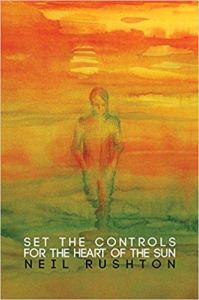 protagonist’s life. He is a broken soul, depressed and suffering a kind of PTSD following the sudden death of his mother and sister in a car crash. His unresolved grief culminates in a psychotic break while waiting in line in a shop landing him in a psychiatric ward. When the story proper begins, we find him released and living alone and friendless, eking out his life on a combination of government assistance and freelance webdesign, self-medicating with cannabis and, most importantly, psychedelics, given him by a shadowy, semi-official figure, Ober. Despite the extremity of his condition, the narrator is a Millenial type, depressed, medicated, and living precariously, whose typicality is reinforced by his remaining anonymous.
The novel is germane, further, because of its thematic concerns: psychedelia and entheogens, transhumanism, nonhuman intelligences, and, more traditionally, because of their inescapability, suffering and mortality. Without giving too much away, the novel plots the narrator’s treatment with increasingly experimental psychedelics under Ober’s, and soon his colleagues’, care. As one might well imagine, as the treatment progresses, what is real becomes more precarious and amorphous. The deftness and delicacy with which this aspect of the narrative is dealt is one of the novel’s stylistic accomplishments.
The narrator’s treatment and attendant visionary experiences introduce another timely topic, transhumanism. But, unlike the simpleminded, techno-utopian version of Ray Kurzweil, Rushton envisions, or so it seems, given neither the reader nor the narrator are sure of what is real or not at any given time, a transcendence via entheogenically-driven evolution. The plot is haunted, too, not only by visions of the posthuman, but of the non-human. Weird, protean intelligences appear throughout, impish, defamiliarized versions of the folkloric Faery, here turned to a more modern or postmodern significance. Rushton’s uncanny re-imagined Little People bring to mind David Lynch’s unsettling, daemonic inhabitants of the Black Lodge. And anyone acquainted with the evergrowing body of entheogenic literature will be reminded of the entity reports that compose one part of it.
In more conventional, literary terms, the emotional heart of the book is the narrator’s unresolved grief and the attendant need to come to terms with mortality. Beneath the theatrical trappings remarked above (nevertheless, a not unimportant part of the novel’s architecture) is the process of the narrator’s painful and harrowing exploration of the painful frailty of human connection, familial and otherwise. One risk the novel takes is in its attempts to employ the extremes of the plot as a means to defamiliarize and so make new its heady thematic and emotional content.
And it’s just here in how ably this otherwise apparently unassuming novel carries off this difficult task that its more literary artistic achievements shine. Despite being a novel of first-person introspection and profound experience, psychedelic and emotional, the plot never bogs down, an accomplishment in its own right. The growing disorientation of the narrator over the reality of his experiences is deftly handled so that that confusion is vividly represented but without ever confusing or frustrating the reader. Despite the gravity and complexity of its concerns, the novel is constructed with a sly, intertextual irony, drawing on Shakespeare, Byron, Lewis Carroll, pop culture, folklore ancient and modern, and other sources to weave the plot’s materials, which, as they are slowly revealed, complicate, intensify, and lighten the reading experience.
In the wake of the French Revolution’s descent into the Terror, trust and hope in Progress or the sudden advent of a new world or age both faded. Writers, then, struggled to understand and render this new, obscure relation to time, history, and endings, composing in answer works without a clear ending or even, sometimes, beginning, novels and poems where reality and imagination, realistic prose, fairy tale, and dream, all served to blur the meanings of ‘vision’, most notably in those works of Romantic Irony, such as Novalis’ unfinished and unfinishable novel Heinrich von Ofterdingen, forerunners of those forays into postmodern undecidability, such as the novels of Thomas Pynchon.
Rushton’s Set the Controls for the Heart of the Sun is a deceptively unassuming participant in this tradition, equally our condition. It combines the perennially, personally urgent matters of death and grief, the real material conditions of millenial life under neoliberal capitalism, a more overarching concern with the fate of humankind, and speculations about knowledge and reality all within a narrative equally introspective and plot-driven, woven of an ambivalent tissue of the present moment and the literary inheritance. Rushton’s book finds a home on the bookshelf, beside titles by William Burroughs, Terrence McKenna, and their fellow travellers.
Neil Rushton. Set Controls for the Heart of the Sun. London: Austin MaCauley, 2016. 289 pp.
Neil Rushton is an archaeologist and freelance writer who has published on a wide  variety of topics from castle fortifications to folklore. Recently he has been exploring the confluence between consciousness, insanity and reality and how they are affected through the use of a wide variety of psychotropic drugs. His first novel, Set the Controls for the Heart of the Sun, explores these issues to the backdrop of Syd Barrett and Pink Floyd. He also writes a blog-site devoted to the mythology and reality of the faeries: https://deadbutdreaming.wordpress.com/
Prophecy in Reverse: a notice of The Relevance of Romanticism: Essays on German Romantic Philosophy
Filed under: notices and reviews | Tags: Analytic philosophy, Canadian poetry, conceptual poetry, Continental philosophy, Early German Romanticism, ecopoetics, ecopoetry, Frühromantik, literary theory, philosophy, poetics, poetry, Romanticism, The Relevance of Romanticism
Comments (6) 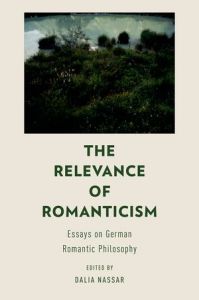
Anyone who studied Philosophy or Literary Theory at a certain point will be all too familiar with the bitter and apparently insurmountable divisions between Anglo-Saxon and Continental developments in these disciplines, a conflict that extends to the literary world, where, in English-language Canadian poetry, the schools of latter-day Johnsonians and that of the Theory-inflected avant-garde eye each other warily and dismissively, when they bother to regard each other at all. Of late, some attempts at a synthesis have been attempted, under the rubrics “hybrid” or “steampunk” poetics, or the “post-Language” or “Conceptual lyric.” However, all these attempts suffer a lack of depth and conceptual resources prey as they are to the prejudices of their precursors.
Most immediately, a straw man Wordsworth has been the whipping-boy of the grad schooled avant-garde, while our latter-day practitioners of Nobelese owe their complacent modernity ultimately to the struggles of early Modernism to define itself over against its late British Romantic forerunners. Ironically, in both cases, though it seems generally unacknowledged, Romanticism was roundly defended by the Yale School, in both the Deconstructions of Geoffrey Hartman and Paul de Man and the Aesthetic Criticism of Harold Bloom. The former showed English Romantic poetry to be as linguistically self-aware as any L=A=N=G=U=A=G=E poem, while, for the latter, a Romantic stance became synonymous with poetry-as-such. Nevertheless, the sentiment of trenchant materialist critiques, such as Jerome McGann’s The Romantic Ideology, that Romanticism is firmly a thing of the past, seems the norm. Romantic poetry and poetics, in various guises, however, has given some small signs of resurgence, first, in Rothenberg’s and Robinson’s 2009 assemblage of Romantic and Postromantic Poetry (Poems for the Millennium, Volume III), a welcome dilation and extension of Robert Duncan’s unapologetic if idiosyncratic High Romanticism, and in the exploration and development of kitsch carried out in the criticism and poetry of, for example, Daniel Tiffany.
In any case, past divisions or present attempts at synthesis have carried on ignorant of the groundbreaking research and thinking going in Germany. Patient scholars laboured at producing the first or new critical editions of Hölderlin and Novalis. Meanwhile, Dieter Henrich and his students pursued diligent and painstaking research in an attempt to reconstruct the post-Kantian maelstrom of literary, critical, and philosophical activity centred around Jena and the short-lived journal The Athenaeum. Henrich’s student Manfred Frank built on these studies, exploiting the conceptual and argumentative resources they provided to come to grips in new ways with questions around language and meaning, history, the subject, politics, society, and the environment. In France, Lacoue-Labarthe and Jean-Luc Nancy brought the heritage of The Athenaeum to bear on contemporary thought in The Literary Absolute, published in France in 1978 and in English translation in 1988. Finally, 1990s England produced analogous work from Richard Eldridge and Andrew Bowie, whose 1997 From Romanticism to Critical Theory: the Philosophy of German Literary Theory along with Frank’s now out-of-print What is Neostructuralism? (1989) are required reading for anyone eager to think apart from and beyond the staid, false dilemmas of present-day philosophical, literary culture. Not to be outdone, even Slavoj Žižek has contributed to the revival,development and exploitation of Schelling’s philosophical work.
It is within this horizon of preliminary scholarly and critical accomplishment that a strikingly welcome collection appears, The Relevance of Romanticism (ed. Dalia Nassar, Oxford University Press, 2014). The volume collects sixteen essays addressing history, language, sociability, poetry, painting, mythology, mathematics, and the environment within the context of the philosophy of early German Romanticism. Contributors include scholars well-known to anyone familiar with this field—Manfred Frank, Frederick Beiser, Karl Ameriks, Michael N Forster, and Richard Eldridge—as well as eleven others, all of whose work is informative, eye-opening and thought-provoking.
The first two essays by Manfred Frank and Frederick Beiser frame the debate concerning the relative Realism or Idealism of early German (or Jena) Romanticism. Offhand, the debate certainly seems esoteric, but it has its finger on the pulse not only of the most current philosophical concerns, namely those that have inspired the various “new materalisms,” object oriented ontology or speculative realism, but also the controversies about how exactly the human being (or Subject) is to be conceived. As Bruce Mathews remarks in the course of his contribution, this problematic is one whose
consequences are far from academic. As Manfred Frank has repeatedly warned, to surrender our subjectivity and free will to the deterministic vocabulary of the natural sciences will not only undermine the personal accountability that supports moral action, but it will also lead to a “political fatalism” that will destroy the legitimacy of society’s defining institutions. (202)
The next four essays explore, as their section title declares, History, Hermeneutics, and Sociability. Karl Ameriks constructs a typology for philosophies of history—circular, linear, and chaotic—in order to illuminate Friedrich Schlegel’s famous definition of Romantic poetry as “progressive” and “universal.” Michael N Forster condenses his two studies of German philosophy of language (After Herder: Philosophy of Language in the German Tradition (2010) and German Philosophy of Language: from Schlegel to Hegel and Beyond (2013)) in a dense but less pointed chapter that, though informative, passes over the equally valuable if more obscure work of Novalis and more importantly fails to make as clear as need be how much de Saussure, structuralist linguistics, semiotics, and post-structuralist philosophy stem from and twist the more thorough-going and coherent contributions of Herder, Friedrich Schlegel, Schleiermacher, and von Humboldt (a point well-made in detail by Frank in his What is Neostructuralism? and Boris Gasparov’s Beyond Pure Reason (2013)). The pair of essays by Kristin Gjesdal and Jane Kneller address an aspect of Jena Romanticism not widely enough surveyed (to my limited knowledge), namely the social dimension and pertinence of the movement. The Jena circle was infamously cosmopolitan and egalitarian, not only in terms of class and religion but of gender, too, values absolutely essential to the Berlin salon society within which its members moved and to Schleiermacher’s idea of sociability in his Essay on a Theory of Social Behaviour.
The five contributions of the volume’s third part address literature, art, and mythology. Richard Eldridge reads Hölderlin’s fragment “Rousseau” with attention to what it says about subjectivity and finitude. Brady Bowman and Keren Gorodeisky explore the lively pertinence of Jena Romantic thinking to reflections on the truth of art in analytic philosophy and the fragmentary form and pragmatic content of Wittgenstein’s philosophy in relation to Friedrich Schlegel’s. A real eye-opener for me is Laure Cahen-Maurel’s study of the painting and art theory of David Caspar Friedrich and its influence on Abstract Expressionism and the art of Anish Kapoor. Surely the most gripping read, however, is Bruce Mathews’ “The New Mythology: Romanticism Between Religion and Humanism” that takes up Schelling’s speculations concerning a mythology that would harmonize art and science, humankind and nature, a discourse that holds the promise of helping us avoid what Schelling already in 1804 foresaw as “the annihilation of nature.” No remark by Žižek on the environment or environmentalism or any tract on ecopoetics or ecopoetical work I can think of open such compelling vistas or place a higher or more urgent demand on the imaginative artist or thinker than these fifteen or so pages.
The book’s final section, Science and Nature, is no less surprisingly informative or pertinent to the present day. Anyone who believes the Romantic thinker is a wooly-brained dilettante will find that prejudice shattered here. One learns in the contributions from Paul Redding, John H Smith, and David W Wood that Novalis (a mining engineer by trade), Friedrich Schlegel, and Salomon Maimon (surely one of Kant’s most idiosyncratic interpreters and critics) were absolutely contemporary in their knowledge of the most advanced mathematics of the day, particularly that having to do with controversies over the then relatively new infinitesimal calculus and the nature of the infinite, notions that informed Schlegel’s definition of Romantic Poesie as “progressive.” Redding shows how Novalis’ fragmentary notes on computation remain relevant to contemporary philosophy of mind, artificial intelligence, and procedural, cyber- or Conceptual poetries. Regarding this aspect of Novalis’ thinking, Redding observes
We can see how the interests of the poet and the computationalist might converge…and a point of convergence can indeed be found in the strange case of the combinatorial poetics of Erycius Puteanus, a seventeenth-century humanist whose generation of multiple verses to the Virgin Mary from a single eight-word poem came to the attention of Liebniz…An eight-word, one-line Latin hexameter…formed the base from which Puteanus generated 1,022 verse permutations… (228)
Equally startling is the relation of geometry and algebra and calculus to the concepts of philosophy of Fichte and Novalis and the relevance of the former’s Wissenschaftslehre to such mathematical luminaries as Herman Weyl. Amanda Jo Goldstein’s contribution on Herder’s “irritable empiricism” complements Forster’s on Herder’s language philosophy, laying out as it does Herder’s peculiar theories concerning sensation, culture, and language and their unknottable intertwining that weaves poetic tropes into our very nerve fibres and their “irritations” two centuries in advance of similar proposals made by Canguilhem, Jacob, or Foucault and in a much more compelling way for poets and poetics. Likewise, the volume’s final piece, Dalia Nassar’s “Romantic Empiricism after the ‘End of Nature'” complements Mathews’ on Schelling’s New Mythology, setting out to clarify and legitimate Goethe’s concept of science and nature in the context of the contestations over the very idea of Nature itself.
Nassar’s collection should disturb the prejudice that Romanticism is dustily antique and that our absolute modernity is a quantum advance upon its quaint notions. As the philosophies of Kant and Hegel come to be seen to possess potentials to illuminate the present moment, so the thinking between theirs comes to the fore. Not only do we share the more general horizon with the Jena Romantics—developments in technoscience and its worldview and the attendant social and environmental predations of industrialism—but their terms define our own in advance. Indeed, the essays in this volume propose that it is our thinking that is a pale shadow of theirs and that the promise of their speculations resides in our future.
Peter Dale Scott’s Tilting Point: “tilting at the mills of state / with a lance of paper”
Filed under: notices and reviews | Tags: criticism, Peter Dale Scott, reviews, Tilting Point
Leave a comment Peter Dale Scott’s first full volume of poetry since Mosaic Orpheus (2009) collects ten new poems that speak from the vantage point of a lifetime and his singular interrogation of the American Empire. The first eight, short poems reflect on the eros of old age, the “drive’s decline”, a shift to “love not as acquisition but as gift”, an eros poignantly in love with living more than with any one beloved, that lifts
…once again
for an instant
into this abiding
awareness
of all there is
Fifty-seven of the volume’s seventy-pages are taken up by two longer works Loving America and Changing North America, the former probing the schizophrenic love-hate relationship Scott has developed over decades’ engagement with his adopted country (“the cradle of the worst and the best” as Leonard Cohen sings), the latter searching for resolutions to the country’s increasingly pathological contradictions.
The profound pertinence of Scott’s message is tuned to a style tempered to communicate it. Tellingly, at least four of the book’s poems, including many of the long poems’ sections, first appeared on “the spreading / leafwork of the Internet,” an index of Scott’s urgent desire to get the word out. His classical manner verges on the prosaic, even the pedestrian at times, guided throughout by a democratic ideal to address the widest possible audience, such as in the startling “To the Tea-Party Patriots: A Berkeley Professor says Hello!”. Often, that audience is an expressed dedicatee or interlocutor, poets or friends, including Daniel Ellsberg, Allen Ginsberg, Denise Levertov, Czeslaw Milosz, and Walt Whitman, among many others.
More ruminative readers, however, will not mistake the clear surface of Scott’s language for a shallowness of thought or knowledge. Already, for example, in the volume’s first piece “Homing: A Winter Poem,” Scott’s simplicity belies a profound complexity of reference, the tracing of which is the richly rewarding work his writing invites: the significance of the dedication to Tomas Tranströmer, the epigraph from Genesis, the allusions to ‘Jubal’ and ‘Urthona’ and the poet speaker’s “dead parents,” among others, coupled with the intratextual references—the “tilt of the earth” nodding to the collection’s title and the “glimpse of odyssey” that winks at the poem dedicated to Milosz “Not for long”—all point to a profound and unending network of meaningfulness, a characteristic virtue of literary art.
For all its accomplished polish Scott’s poetry is no mere aesthetic production. His manner is chosen to address matters of the utmost consequence, the character and fate of America, a topic that has inspired him to produce more than eight volumes of painstaking investigative scholarship into the machinations and abuses of power and a monumental long poem Seculum (in three volumes, Coming to Jakarta (1988), Listening to the Candle (1992), and Minding the Darkness (2000)). It is in the book’s two long poems that Scott most firmly grasps this theme that runs throughout his life’s work, work that rises to his friend Milosz’s question “What is poetry which does not save / Nations or peoples?// A connivance with official lies…” Scott’s answer to Milosz’s demand is, in part,
… to write any poem
encompassing this nation
one must have an awareness
of gratuitous murder
committed by released felons
in uniform for sport
without forgetting the grace
of a doe drinking from a forest stream
Scott’s theme, like Whitman’s before him, has vista. The periplum of this territory his work traces and this latest book continues invites and demands our attentive study.
Tilting Point, Peter Dale Scott, San Luis Obispo: Word Palace Press, 2012

 Poeta Doctus