Archive for the ‘The Brouillon’ Category
Slobodzian’s “Ars Poetica” en français!
Slobodzian’s “Ars Poetica” en français!
The indefatigable Antoine Malette has produced another translation of a fine, uncollected poem by George Slobodzian. Both the English-language original and Malette’s translation are readable at the link!
Twits in the Twitterverse: Ellis, Munro, and the Nobel
Filed under: The Brouillon | Tags: Alice Munro, Brett Easton Ellis, literary criticism, Nobel Prize for Literature
 Leave a comment
 One splash Alice Munro’s winning this year’s Nobel Prize for literature made stirred a teapot tempest in the Twitterverse, proving again, if any further evidence were called for, just how anathema Twitter is to thought. To wit, Brett Easton Ellis tweeted “Alice Munro is so completely overrated,” then expanded on his judgement an hour later: “Alice Munro was always an overrated writer and now that she’s won The Nobel she always will be. The Nobel is a joke and has been for ages….” The cacophonous reaction was as swift, overwhelming, and damning as it was puerile.
First, I unreservedly applaud Munro’s winning the prize and the well-deserved attention the award will bring to her oeuvre. What interests me is why Ellis, given the kind of prose he writes, might be moved to remark what he does about the regard given Munro’s writing and the character of the Nobel Prize.
Even a passing familiarity with these writers’ works prompts an initial answer: Ellis is a satirist of modern, urban life, whose writing is intimately bound up with the present, sociocultural moment, so much so his novels have been adapted to the screen and subject to virulent denunciations. Munro, on the other hand, is characteristically described by The New Yorker magazine fiction editor Deborah Treisman: “Her work is very provincial in that it’s based in small towns and rural parts of Canada for the most part. At the same time, what she does with the characters in those places is show us their universality, their humanity.” The same CBC article goes on to sum it up quite nicely:
Munro… has been called Canada’s Chekhov. Similar to the work of the Russian short-story master, plot is usually secondary.
Munro’s stories focus on striking portraits of women living in small-town Ontario. They revolve around small epiphanies encountered by her characters, often when current events illuminate something that happened in the past.
Clearly, the ends and means of Ellis’ and Munro’s writing couldn’t be more different. However much resentment might be blamed for Ellis’s tweet, the terms of praise for Munro’s work are revealing and illuminate the second part of Ellis’s second tweet concerning the Nobel Prize’s being “a joke.”
Munro’s stories are praised for focussing on character more than plot, on her characters’ “universality, their humanity.” The universal humanity of these characters is revealed in their experiencing “epiphanies” that illuminate their and by virtue of their universality our little slices of shared life. The critical idiom here is hardly as spontaneously universal as Munro’s characters’ epiphanies. Rather, it’s the discourse of a conservative, humanist, classicist aesthetic, the same operative, for example, in Yeats’ and Eliot’s being awarded the prize (despite their respective dalliances with fascism and antisemitism) but not Joyce. The drama and prose of the late Thomas Bernhard remain second to none in their stylistic bravura and social and existential profundity, but they would never have been considered for the prize precisely because of their obsessive style, pitiless intelligence, and relentless truthtelling. Examples could be multiplied.
The most telling judgement is Munro’s being called “Canada’s Chekhov.” But the Chekhov invoked here is the tamed, canonized caricature of the writer
who amazed his audiences in the early 1880s. He was particularly interested in the absurd, and repatterned the anecdote and vignette forms of the popular press into innovative forms of writing: pieces in the guise of National Census questions, a test set by a mad mathematician, a proposal to the board of a medical school, the twisted “questions and answers” of popular women’s magazines….
The smug propriety of the praise showered on Munro is arguably as shallow as Ellis’ dismissal and the subsequent brainlessness of the backlash to his tweet. The bitter grain of truth in Ellis’ second tweet is that prizes, however much they materially further even a deserving writer’s career, are perhaps more revealing of literary values than of a writer’s worth.
John Bloomberg-Rissman: From In The House of the Hangman, with a commentary on the work in progress
Filed under: The Brouillon | Tags: John Bloomberg-Rissman, poetics
Leave a comment  John Bloomberg-Rissman: From In The House of the Hangman, with a commentary on the work in progress
Despite my persistent efforts to make my own work singularly weird, it is sometimes gratifying to find other poets working along similar lines, ameliorating somewhat my sense of alienation from the poetic milieu. Here and in other texts, John Bloomberg-Rissman composes in a manner similar to the method I adopted in the triptych Swim or Sear, Seventh Column, and March End Prill, in this instance “written / composed /constructed in real time, daily, out of the materials presented by that day (whether via RSS feed, Facebook, books received in the mail, emails, tv, conversation, or anything else the day brings).” My own application of this method was perceptively appreciated in a recent review.
New Selected Poems of Paul Celan
Filed under: The Brouillon | Tags: L=A=N=G=U=A=G=E poetry, Mainstream poetry, Paul Celan, Workshop poetry
Leave a comment 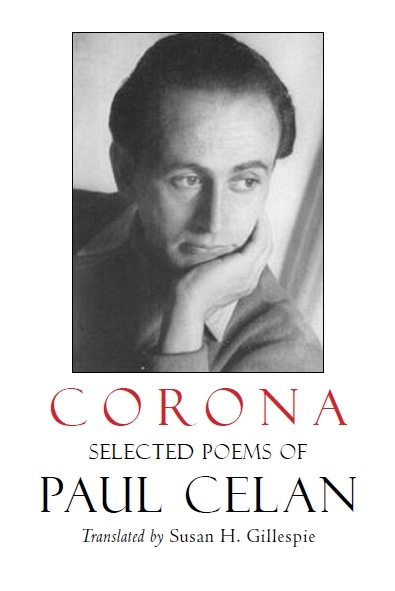 I’ve been hunting up and following those of my contemporaries eager to slip between the Scylla of Academic L=A=N=G=U=A=G=E poetry and the Charybdis of the Mainstream Workshop poem, and synchronicitously I see a new selected poems of Paul Celan is in the offing, one whose selection upsets the reception of Celan that would make of him an anti-lyrical, formalist, proto-L=A=N=G=U=A=G=E poet. As Station Hill’s catalogue puts it:
Paul Celan, arguably the mid-20th century’s most important German-language poet, is commonly pigeonholed as a poet of the Holocaust—a term, however, he never used. Undoing facile assumptions about Celan, Corona charts a more idiosyncratic and personal path through Celan’s large oeuvre, choosing 103 poems from among the more than 900 Celan published. The bilingual selection includes work from all of Celan’s periods and genres. Without ignoring the poet’s well-known work of memory and memorialization, it seeks to open a space for new appreciation of Celan’s love poems, as well as his poems on political events, painful reflections on his stays in mental hospitals, and quasi-burlesque verse.
My interest is piqued!
Michael Heller, an Introduction to his Poetry
Filed under: The Brouillon | Tags: Michael Heller, Objectivism
Leave a comment immanent occasions blogspot has beaten me to putting up some remarks on Michael Heller‘s poetry, now collected in his This Constellation is a Name. You can read the post, here .
.
“The Tao of 9/11”
Filed under: The Brouillon | Tags: 9/11, Peter Dale Scott, poetry
Comments (1) I’ve noticed a few folks posting 9/11 poems, which prompts me to post this one by Peter Dale Scott, that dares to come to grips with the dark roots of the matter.
The Role of Scholarship in Contemporary […] Poetry
Filed under: The Brouillon | Tags: contemporary poetry, Johannes Göransson, literary criticism
Leave a comment The Role of Scholarship in Contemporary […] Poetry
Johannes Göransson has posted over at the Montevidayo blog the first of some spirited observations and reflections on the role of scholarship in contemporary American poetry (and, by extension, Canadian, at least, though certainly with provisos…). His critique of PhD poets or those scholars who deign to approach contemporary poetry is one with which this writer (despite the blog’s name, Poeta Doctus does not hold a PhD…) is in some agreement…
Poetry Goes Intermedia: A brief summary of videopoetry | Moving Poems Forum
Filed under: The Brouillon | Tags: Gerhard Rühm, Hubert Sielecki, Martina Pfeiler, Moving Poems, Tom Konyves, videopoetry
Leave a comment Montreal’s own Tom Konyves presents A brief summary of videopoetry, concerning a media-materially logical extension of the Poem!
Scroll down the comments to Konyves’ post to find links to examples of what he’s on about. One example is “Ungleiche Brüder”.
The groundbreaking study of video and intermedia poetry is Dr. Martina Pfeiler’s aptly titled Poetry Goes Intermedia (sadly, presently only available in the German-language original). Her typology, with examples, is summarized (again, in German) here.
Happy Birthday, Charles Reznikoff
Filed under: The Brouillon | Tags: Allen Ginsberg, Charles Bernstein, Charles Reznikoff, Conceptualism, Kirill Medvedev, Michael Heller, Objectivism, Objectivist School, Testimony
Leave a comment Happy Birthday, Charles Reznikoff
The Allen Ginsberg Project has thoughtfully posted a recording of a reading in honour of American Objectivist poet Charles Reznikoff, the promise and possibilities of whose work are, happily, increasingly appreciated, from yesterday’s late Beats to today’s Conceptualists and more direct descendants, such as Michael Heller (whose volume of collected poems This Constellation is a Name was published just last year). The Objectivists’ fame has reached even to Russia: Kirill Medvedev (a very compelling figure in his own right) reflects on their legacy in his poem “The End of the Ceasefire (The End of the Objectivist School?)”. Perhaps with the excesses of Capital and America’s warmongering Reznikoff’s executors will feel the time is ripe to reissue Reznikoff’s cold-eyed, unrelenting castigation of exploitation and racism, Testimony.
(My difference of opinion with certain latter-day receptions of Reznikoff’s work can be found here).
More Slobodzian en français
Antoine Mallette produces another excellent French-language translation of a poem by George Slobodzian deserving of greater dissemination, in any language. Read it here: Excursion à Woodlawn (Woodlawn Excursion) – George Slobodzian @ . :: Antoine Malette.com :: ..

 Poeta Doctus