Corpus Sample: “Hamburger Smalltalk”
Filed under: poems | Tags: poems, poetry, political poetry, race science
 Comments (1)
 While I was trying to imagine a set list for my last reading, I had thought to perform poems that, though written in the early 90s, spoke to today’s world situation. One of these would surely have been the following poem, “Hamburger Smalltalk”, composed in 1991 and later collected in Grand Gnostic Central and other poems.
One of the stops during my first visit to Europe was Hamburg, Germany, where we stayed a few days with a couple, friends of my partner at the time. One was widely travelled and had lived some time in Africa. During a very pleasant, evening walk, with our respective partners and the dog, he related the anecdote the poem retells. Accordingly, the poem is spoken in his voice, complete with Germanisms of syntax and expression.
Hamburger Smalltalk
You’ve seen a picture of a cheetah
on a gazelle: its teeth in its neck
bent back, its leg
around the gazelle’s hind leg
to break its back.
Cheetahs are a serious nuisance
for farmers in southwest Africa. Lions
and other cats kill what they need
and leave something
for the jackals and vultures.
A cheetah goes into blood-frenzies—
if you have a herd of sheep
in the morning you’ll find forty
torn apart and maybe seven lambs
carried off.
The farmers know their herds
they watch and know which cows are ready
to calve and if a calf goes missing
they mark the mother
and send her next to the abattoir.
Now you’ll see five cows gang up
on a cheetah to protect the calves
and drive it off.
(He shook his head and chuckled)
The white tribe of Africa.
New on the Video Page: Accent Poetry series 29 July 2019
Filed under: The Brouillon | Tags: Accent poetry series, poems, poetry, poetry readings
Leave a Comment New on the Video Page!
Thanks to Devon Gallant for the invite; and a pleasure to have read with that evening’s other featured reader, Derek Webster.
As I have the creative metabolism of a pop star (i.e., roughly a dozen new poems a year), new volumes of work are slow to appear. Four of the seven poems I perform here are therefore “new”.
Play list:
1. Budapest Suites I (from Grand Gnostic Central)
2.”European Decadence in medias res” (from Ladonian Magnitudes)
3. Hamburg & Kassel sections from “Made in Germany”
4. Toronto Suite
5. “By Mullet River”
6. “Flying Saucers” (from Grand Gnostic Central)
7. “A sonnet is a moment’s &c.”
Doom porn: What would Martin Luther do?
Filed under: Ecology, poems | Tags: climate change, doom porn, ecopoetics, ecopoetry, Gerard Manley Hopkins, global warming, poems, poetry
Comments (1) Again, as happens, acquaintances I believe should know better, being educated, intelligent, and reflective, let the doomporn clickbait get the better of their sincere, best intentions and share distressing articles, such as this one about a report by two (2) Australians this spring positing that there is a “‘High Likelihood of Human Civilization Coming to an End’ Starting in 2050”.
Nearly, already, three decades back, a similar despair, coupled with Hopkins’ “God’s Grandeur” I had by heart and the offhand remark by a friend visiting the lush, extinct volcano near his birthplace, inspired a poem in answer (the second of seven Budapest Suites in Grand Gnostic Central).
Budapest Suites II
for Laszlo Gefin
“There is a god here!”
In wild strawberry entangling thistle,
In maple saplings, a shroud on loam,
In chestnut and cherry blossoms over tree-line,
In goldenrod and grass, every green stalk, bowed with seed.
And there is a god who
Quarries slate for imperial highways,
Mines iron-ore out of greed,
Who would have Mount Ság again
Ash and rock.
And there is a god
In the seared, scarred, spent, still,
For lichen, poppies and song
Here rise from the bared
And broken rock to the air!
Just last year, some widely-publicized remarks by Mayer Hillman (“We’re doomed!”) inspired a number of responses, an early version of one I posted here the last time a friend disseminated some other bleak pessimism…
I’m hardly a Bjorn Lomborg playing down the gravity of the situation and the urgent, concerted, radical action it calls for, including the need for no less focussed, lively and creative reflection and critique to articulate a post-anthropocentric, if not post-humanist, biocentric ecosophy. But nor am I a latter-day Jeremiah confusing his insight into the woes and flaws of the present with visions of imminent, righteous catastrophe. (It’s high time I address at greater length this newly-arisen apocalyptic tone in cultural criticism…).
To wit, and not for the last time, I’m sure, I share here two unpublished (…because editors [eye-roll emoji][facepalm emoji]…) sections of the sequence “Made in Germany”, composed in 2012.
Waiting on a train to what was
the East, the summer of the year
the New Age believed the World
would end, wildfires smoke
from Colorado to Croatia,
floodwaters deeper than memory
drown southern Russia and Thailand,
tornadoes plough the Midwest,
hurricanes blow past records
on the Eastern Seaboard.
∞
http:// arctic-news.blogspot.de/p/global-extinction-within-one-human.html?spref=fb (21.07.2012)
Asked what he would do were the world to end
next day, Luther replied, “Plant an apple tree.”

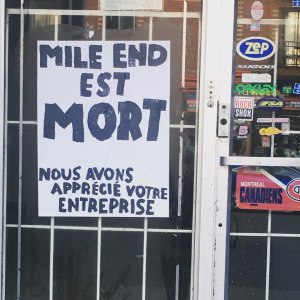
“Mile End est mort…”
Filed under: poems, The Brouillon | Tags: gentrification, Mile End, poetry
Comments (6) For the more than three decades I’ve lived in Montreal, I’ve lived in the quarter known generally as The Plateau and more specifically and recently (to my ears, anyway) Mile End, most notably at “Grand Gnostic Central” on the corner of Rachel and St. Urbain (scenes from the cinematic version of The Apprenticeship of Duddy Kravitz were filmed just up the block), a couple of locations on Hutchison and Parc Avenue south of Bernard, and, since 1996 (for the time being) on the corner of St Joseph and Parc in what our landlady calls her Chateau du Parc.
Credit: Mary Shelley
Montreal, like any number of cities on earth, is suffering a process of gentrification. In my area, it’s been underway for years, but it’s picked up since a number of software companies (Ubisoft and Softimage) have moved in. When it all began, I reflected that more affordable if less “desirable” neighborhoods attract those who can afford to live in them, which will often include creatives, writers, painters, artists, and so forth. Their creative energies, by a cruel dialectic, make the neighborhood more beautiful, pleasant and lively, attracting more residents and businesses, beginning a process of, well, gentrification. The creatives and others who made the place attractive in the first place are forced to move out, to some other quarter, sometimes in some other city, where the process can begin all over again.
A poem in Ladonian Magnitudes, “The Intersection” remarks this process. I share it below as a manner of memorial.
The Intersection
where l’Esplanade
meets Villeneuve
that spring dusk
the air’s first
breathable classic
sunlit redbrick
the unique quaint
three-storey walkups
characteristic of
the quarter’s charm
are almost all
so made up
like new the one
run down white tshirt
underarm stain yellow
building with muddy
white frames peeling
around cracked panes
stands out like
never among
those other fronts
kept up for years
without a thought
of what they’d go for
Set List: Accent Reading Series: Monday 29 July 2019
Filed under: The Brouillon | Tags: poetry, poetry readings, travel
Leave a Comment  Having settled on poems that have to do with travel for my upcoming reading, I post here the set list and link poems on-line that are among those I’ll perform, for interested parties.
“European Decadence in medias res” (from Ladonian Magnitudes)
Budapest Suites I (from Grand Gnostic Central)
Two poems from Made in Germany, (“In Berlin, at the Mehringdamm U-Bahn station…” and “Cabbie on Documenta13”)
Toronto Suite (early versions of two of three poems in the suite can be read here and here)
“À Québec” (from Grand Gnostic Central)
“The Intersection” (from Ladonian Magnitudes)
“By Mullet River”
“A Sonnet is a moments, &tc.”
At the Accent Weekly bilingual poetry series & Open Mic
Filed under: The Brouillon | Tags: Accent poetry series, poetry, poetry readings
Leave a Comment It’s rare and special when I get to share my work in public, and I’m grateful for this latest opportunity.
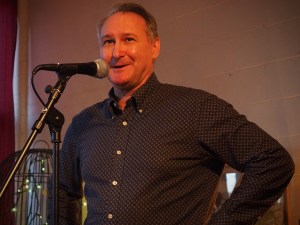
credit Brian Campbell
I’ll be one of two featured readers (with Derek Webster) at the next Accent reading series event:
Monday 29 July
at ‘La Marche a Cote’ 5043 St. Denis, Montreal, Quebec.
Officially things get underway at 19h00, but the real fit hits the shan around 20H00!
I’m working on my fifteen-minute set, now: at present, I’ll either be reading poems pertinent to the moment from my first two books, or, since we’ll all be stuck in town, maybe a selection of poems about anywhere other than Montreal!
You can read more about the series, here.
A theme with vista: food
Filed under: poems | Tags: alchemy, food, food poetry, poems, poetry, tuna recipes
Comments (1) An Australian acquaintance I know through our shared admiration for the poetry and political writing of Peter Dale Scott is fast becoming a shadow co-editor for Poeta Doctus. She weekly or so will share poems on-line, one of which has already prompted my sharing one of my own.
Today, she shared Daniel Nyikos’ poem about making Hungarian potato soup. This resonated with me for numerous reasons: food is a persistent theme in my own work, and my father’s family are Hungarian immigrants (my sister holds in her possession my grandmother’s handwritten recipe for potato soup). I share below, therefore, two (!) poems, from Ladonian Magnitudes.
The first, “Marmitako“, is similar to Nyikos’ (though it never made it into the pages of Poetry), about a traditional, Portuguese fish stew. Things have changed since it was written, as to eat tuna, today, is both to dose yourself with mercury and to contribute to the extinction of the fish. The second, “Horizontal Gold Noble Mercury”, concerns mercury, too—explicitly, but in a more rarefied sense—and, consequently, sustenance in a more sophisticated manner. Bon appetit!
Marmitako
They cut the tail section off some
Of the tuna, bonito, and mackerel
They caught, skinned and boned it,
Cleaned it up in buckets, chopped it
Up and threw it in the iron stewpot
On top of the onions, garlic, tomatoes,
And dried red peppers, cleaned and chopped,
Simmering there, oil bubbling through,
Shared loaves and some good red wine,
That Friday of all days still offshore.
Horizontal Gold Noble Mercury
1/2 grapefruit, red or white, sliced banana on bowl muesli w/ 2% milk or 1% yoghurt, brown toast w/ jam or honey on peanutbutter, 1 espresso
Piece sprouted unleavened Manna Bread, 1 espresso
Sandwich, russet apple or pear, 1 espresso
2 nights now, stir fry of Spanish onion, Hungarian pepper, bean sprouts, broccoli, tofu; 1 espresso
4500 mg vitamin C daily until cold is gone
There stands a house under the mountain of the world
Be thou the happy subject of my books, a brave craft
Dash’d all to pieces, my tongue, this air,
Born here of parents born here of parents
The same, hoping to cease not, till death

Bradford & Rad on House House Press
Filed under: The Brouillon | Tags: Anahita Jamali Rad, David Bradford, House House Press, literary publishing, poetry, poetry publishing, publishing
Leave a Comment Back when David Bradford published his chapbook Call Out back in 2017, he was kind enough to answer a few questions concerning the book and his art and life.
Now, you can read, here, he and collaborator Anahita Jamali Rad answer some more queries concerning their House House Press, a publisher of
poetry chapbooks, pamphlets and ephemera that seeks out rigorous politics of peripherality, scaffoldings for debris, studies of mess, and everything in between, with a primary focus on radical BIPOC writing practices.

Budapest on my mind
A friend of mine recently shared Anya Silver’s poem “Doing Laundry in Budapest”, which brought to mind a thematically-related poem of my own, from my first chapbook Budapest Suites (Montreal: Pneuma, 1994) and first trade edition, Grand Gnostic Central and other poems. I share it here for my friend’s, and anyone else’s, pleasure.

“Apply what you know to what you feel that’s more than enough”
On Váci utca, mongrel pigeons, flapping,
Mount American-style shopfront windows.
Grey cops in pairs or trios patrol;
Country people bag handiwork, whistling.
At the end of Vörösmárty tér, a blind man begs fillérs at tables in Gerbaud—
A blond father yells No! at a Gypsy girl and daughter.
Behind me a woman asks for directions:
Bocsanat. Nem magyar. “Nem Magyar?!”
NOTES:
Váci utca is a famous commercial street in Budapest; Vörösmárty tér is a square at the end of the street; fillérs at the time (1991) were pennies; Gerbaud is a famous café on, I believe, the square; the Hungarian that ends the poem can be translated roughly as “Pardon me. I’m not Hungarian.” “You’re not Hungarian?!”
I am aware that the racial designation of the girl and daughter in line 6 might, today, be read as an epithet; I retain it here as an index of the time of the poem’s composition; its use, innocent at that time, was also prompted by the alliteration with ‘Gerbeaud’….
“We’re doomed.”
Filed under: Ecology, poems | Tags: ecological despair, ecology, ecopoetics, ecopoetry, global warming, insect apocalypse, Manu Saunders
Comments (1) ….or, as the refrain of another “Dark Mountain” climate change jeremiad would put it, “It’s worse than that.”
It is, surely, rationally difficult not to deny the gravity of global warming and environmental degradation in general and not to fall prey to anxiety or even despair. It is not irrational, however, to maintain an open, critical mind and culture hope.
For instance, even fairly responsible media sources distort the findings of ecological researchers. For example, two recent studies of declines in insect biomass inspired copy such as “insect apocalypse,” “global ecosystem collapse,” “loss of all insects within 100 years,” and “collapse of entire food webs.” However, learned reflection reveals the matter is less dramatic, far more complex, though hardly without concern. The same can be said for headlines about how humans have wiped out 60% of all animals on Earth in the last 30 to 40 years.
Much more could be said in this vein, but not quite eight months back, similar, dire and final pronouncements from Mayer Hillman prompted a number of poetic responses, of which the tersest and most direct was this:
Replies to Mayer Hillman
“We’re doomed.”
Your therapist would guide you
gently to see you’re fortune telling.
The dialectician would unfold the thought
that determination does not
foreclose unforeseen developments
being the condition of its own negation.
A happy chance slip of memory recalls
“What is real now was only once imagined”.