An irritable gloss on the nearly Baroque
Filed under: Praise and Polemics | Tags: Montevidayo blog, nearly Baroque, poetry, poetry criticism, Stephen Burt
 Leave a Comment
 I’d been eavesdropping on the recent kerfuffle around Stephen Burt’s “Nearly Baroque” mainly via the Montevidayo blog and had been provoked to compose a far-reaching, involved, learned response, but then I read the definition that opens Burt’s essay:
The twenty-first-century poets of the nearly Baroque want art that puts excess, invention, and ornament first. It is art that cannot be reduced to its own explanation, that shows off its material textures, its artificiality, its descent from prior art, its location in history. These poets want an art that can always give, or could always show, more.
That “art that puts excess, invention, and ornament first” is the point of contention engaged at Montevidayo, not impertinently. But the points that follow strike me as stale and suffocating (an impression that could be articulated and defended at tiresome length).
First, no poem, no matter how close to pedestrian speech, no matter how prosaic, no matter how close to “writing degree zero” it may be is ever reducible “to its own explanation”: no discourse is even reducible to its own repetition, since no word let alone any utterance is ever reducible to a single meaning.
The concerns over the fore- or backgrounding of material texture, artificiality, descent from prior art, or location in history are much more complex and interesting and would lend themselves to lengthy excursus were I tempted to be more self-indulgent and less respectful of my reader’s learning and patience. Briefly, all poems possess a graphic or phonic dimension, an artificiality (being an artefact), a relation to if not descent from prior art (poetry or otherwise), and relation to a given constellation of historical conditions, the visibility of which is dependent on the perceiver’s sensibilities. The poem by itself cannot flaunt or foreground any of its possible aesthetic dimensions because their perceptibility is itself contingent. (This play of presence and absence and its historical contingency became the principle of late Formalist literary history, as in the work of Mukarovsky.)
At work here is a reified opposition variously expressed by pairs such as work/text, symbolic/semiotic, word/world, absorptive/antiabsorptive, readership/thinkership, etc, which are all arguably subsumable under the opposition between the Classic and Mannered (an opposition not itself undeconstructable…)—but that was the topic of the aforementioned long-winded response I here eschew for the sake of the sanity of all concerned.
In brief, every poem always gives more and can be made to show more because of the very nature of the poem as a linguistic artefact. As an example I offer a brief study of the sonic qualities of a most non-Baroque poem, here.
Call and response: community and collaboration
Filed under: poems | Tags: Bruce Rice, collaboration, poetry
Leave a Comment When T. S. Eliot died, Ezra Pound famously and bitterly quipped: “Who is there to share a joke with?”
I’ve been in a similar funk for some time now. This sense of acute isolation was recently aggravated by a friend’s lauding the sense of collaborative community she felt working with her publisher. Ironically, this same publisher recently despaired over getting any interesting conversations going given the hermetic nature of most social circles that are too often made up of like-minded, nodding heads.
That’s why it’s heart-warming and somewhat heartening to escape this dilemma and collaborate by chance. Yesterday, Bruce Rice, a poet I knew when I resided in Saskatchewan, posted a picture of a chickadee feeding from his hand at a writer’s retreat where he’s staying. The picture reminded me of a little ditty from March End Prill, which I shared with him. My lines, in turn, prompted him to compose a pantoum and put the picture, my poem, and his together as a spontaneous, e-broadsheet, which I share here, thankful for the ephemeral community that enabled the collaboration (including the chickadee!).

“the haven from sophistications and contentions”–a translation of George Slobodzian’s “Happy Hour”
Today, I read on Facebook a friend rightfully take to task a new anthology of Canadian poetry for its lack of translations. Later, I read how one poet tweeted squibs over a retrograde and self-indulgent column that riled a friend of the columnist to snark back via his own blog while everyone ignores the column’s sentiment was preemptively taken down by happy synchronicity days before. A poet-publisher laments the roadblocks to conversation and posits turning his back on the futility of finding the like-minded to work it all out in private in his journal instead. Meanwhile, the work goes on, here, a translation, from English to French, of a fine, understated lyric, “Happy Hour”.
Amy King’s Third Way
Stein may not be your tray of brownies like she is for Amy King, but in the course of her guest post over at the Poetry Foundation King makes a sweet observation, not without pertinence to the Canadian situation:
Most of us, I think, are exposed to smalls swaths cut from the vastness of poetry, focused on our own shores, but that is a betrayal created by a myopic education system and the mentality of “best of” lists and ranking systems we’re expected to fight through for recognition. When I see “Best of” in a title, I ask, “Best for what?” On the surface, ours is a misguided view of what poetry can be, what it can do. There is an American poetry spectrum that seems to be pinned on either end by notions of “accessibility” and “obscurity” or “mainstream” and “avant-garde.” Even our two major critics, Helen Vendler and Marjorie Perloff, are considered coach-advocates for those camps. Such western concepts mislead with their dichotomous proclivities and really only serve the business end of poetry relegated to the creation of anthologies, book promotion and sales, distribution of reading funds and platforms, academic job descriptions and canon-making syllabi. They obscure what poetry does in the world, to and for people, and how poetry broadens and deepens perspectives as lenses we are born to, craft from, and process through.
Publisher of the Month: BookThug : Small Press Distribution
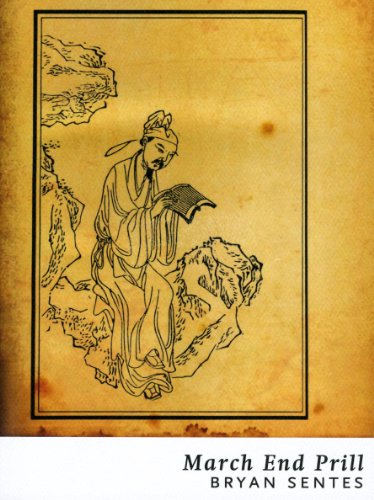
March End Prill
If you didn’t get your copy of March End Prill when it came out, here’s your chance to get it at nearly half price, as BookThug is Publisher of the Month at Small Press Distribution. BookThug is one eclectic publisher, so a quick browse of its list is likely to turn up other valuable discoveries, never mind the mindboggling offerings at SPD.
A source study of Charles Reznikoff’s “Amelia”
Filed under: The Brouillon | Tags: Charles Reznikoff, Objectivism, poetry, poetry criticism, Richard Hyland
Leave a Comment A source study of Charles Reznikoff’s “Amelia”
The late, great Objectivist poet Charles Reznikoff has long been a favorite and model of mine. Jacket 2 does us all the favor of publishing a study of Reznikoff’s poem “Amelia” from his multi-volume work Testimony, criminally out of print. Charles Bernstein summarizes the virtues and import of this excellent piece of literary scholarship:
Richard Hyland, Distinguished Professor, Rutgers Law School, Camden, New Jersey, has compiled the fullest account of the sources of a Reznikoff poem, together with a detailed commentary on theAmelia Kirwan case and the poem Reznikoff wrote based on this case. Many of Reznikoff’s poems, especially those in Testimony, are based on legal records. But there has been little research on the exact relationship between the legal record and the poem, with the general assumption that Reznikoff used only language from the legal records, cutting away but not adding any of his own words. The key to Reznikoff’s aesthetic is his selection and condensation of the source materials.
Surely Reznikoff is a paradigmatic poet for all documentary and source-based poetry of the 20th century and exemplary for many of us who use appropriated or found material in our work. By looking at the 1910 court records, we can now see the source of the language that Reznikoff incorporated into his poem, at least in this one instance. Hyland goes much further. By contrasting the aesthetic pitch of Reznikoff’s slim poem with the social efficacy of Judge Edward Bartlett’s magisterial decision, Hyland gets to the core issue of the office of poetry. Reznikoff’s poem, he notes, perhaps wryly, is “weak.”
New for the new year, the New Gnosticism in poetry!
New for the new year, the New Gnosticism in poetry!
Why not start this new year off with something new, a primer on the New Gnosticism in poetry at the journal Talisman? The New Gnosticism got up Barrett Watten’s nose, so there must be something to it!
(And not to chew on any sour grapes, here (more like raisins, at this point), but apparently Grand Gnostic Central was or is just too Canadian for inclusion…)
Grand Gnostic Central
That’s not typing, that’s écriture
Filed under: The Brouillon | Tags: écriture, Clark Coolidge, Jack Kerouac, literary criticism, Ron Silliman, the novel, Truman Capote, Visions of Cody
Leave a Comment Truman Capote famously quipped regarding Kerouac’s writing, “That’s not writing, that’s typing!” Happily, thanks to the heightened serendipitous dimensions of cyberspace, I happened on a closer reader of Kerouac, Clark Coolidge. One can mouse around the links from the original Jacket2 posting, but what caught my attention was Ron Silliman’s remark that
One test of Coolidge as a critic – you can find some other non-Kerouac samples as well on his EPC web page – is that he gets the importance of Visions of Cody, not just as a central work in the Kerouac canon, but quite possibly the Great Novel of the past century, right up on a par with Ulysses & Gravity’s Rainbow & the best of Faulkner (who is not unlike Kerouac in that his best work often comes in passages, rather than entire books).
I’ve long admired Kerouac’s achievement in The Legend of Dulouz, his novels taken as one multivolume work, but I can’t recall having encountered anyone else who appreciated what happens when the novel taps into its original energies as the genre that is by definition novel, as “the genre that contains all other genres,” when the narrative becomes écriture and one doesn’t know what one is reading anymore, only that one is reading. I’m glad to have chanced on someone else who gets it.
George Slobodzian’s “Poems for the Old Guy Who Used to Live Here”
George Slobodzian’s “Poems for the Old Guy Who Used to Live Here”
As translating machine Antoine Malette writes: read it in English or in French but read it!
Click on the thumbnail to get yourself a copy of the collection that includes this sequence.

What’s the ideogram for ‘sheer inertia’?
Filed under: The Brouillon | Tags: Ideogram, Modernism, poetics, Revelator, Romanticism, Ron Silliman, the New Sentence
Leave a Comment Normally, I’m given to giving more thought to what I post here and developing that thought at greater length and depth, but, sometimes, maybe, a blog is a place to allow oneself to think out loud, to essay some positions, without the explication and footnoting a more rigorously writ out thesis would demand. To wit:
 Reading a random piece of praise from Charles Bernstein for Ron Silliman’s latest addition to what amounts to his lifelong long poem, Revelator, I can’t help but think that the paratactic poetic of Silliman’s New Sentence is in a way the afterlife of Pound’s Ideogram, so trenchantly studied in what should be widely-known as the classic study by Laszlo Gefin. This insight, however true, helps articulate a growing discomfort and dissatisfaction with what passes for the contemporary avant garde in English-language poetry, which seems increasingly, to me, at any rate, as a dead end of that literary High Modernism that flourished in the first quarter of the Twentieth Century as that ghost of Romanticism that haunted the end of the Nineteenth Century was a faint echo of the Spirit of the first and second generations of British Romanticism about a century before it.
  However much our practice must be (never mind can’t help but be) “absolutely modern” (a modernity whose horizon, arguably, includes what is academically termed Romanticism, Modernism, and Postmodernism), said modernity is also always relative to its precursors, demanding, at times, a gesture for the sake of sheer differentiation, precisely what inspired Pound’s return to meter and rhyme in Hugh Selwyn Mauberly (1915!). That is to say, however pertinent parataxis might be said to be to our moment, as a poetic practice it has become, if not merely reflexive, at least de rigueur, which is to say as dogmatic as any compositional value in any school of poetry, another hollow idol for the hammer to sound.

 Poeta Doctus