Archive for the ‘Cactus Press’ Tag
On George Slobodzian’s Apokryfa
Filed under: notices and reviews | Tags: Apokryfa, Cactus Press, Canadian poetry, Devon Gallant, George Slobodzian, poetry, poetry chapbooks, poetry reviews, Willow Loveday Little
 Leave a comment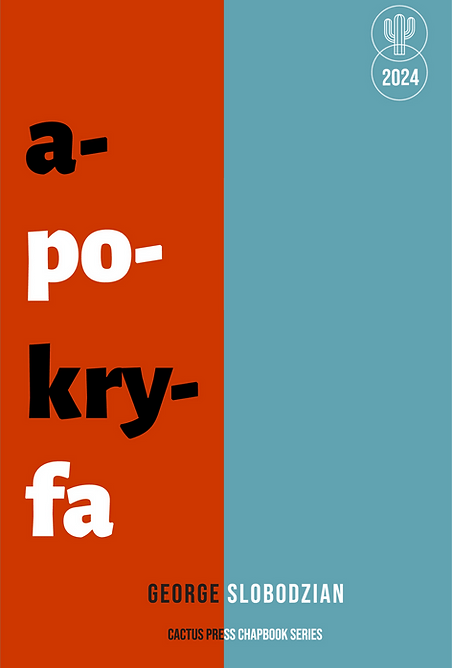
Culture must be—as the word itself might suggest—cultured, seeded and carefully tended. Such care takes many forms in Canada, from ever-diminishing (if however appreciated) government funding, to the selfless, meagrely-rewarded efforts of those who—in the case of our literary culture—publish small magazines and books of poetry, to more grassroots efforts.
In recent years, in Montreal, Devon Gallant and collaborators have cultured an urban poetic garden, organizing the Accent Reading Series, which combines an open-mic (as polylingual as the city) and a spotlight on one or two featured readers, and which has, accordingly, gathered a small, poetic community. One of the fruits of this endeavour is Cactus Press, which, to date, has issued over thirty chapbooks and the first trade edition of the unnervingly-talented Willow Loveday Little, (Vice) Viscera (2022).
One of the newest of these chapbooks is George Slobodzian’s Apokryfa, his second with Cactus Press. Apokryfa gathers eighteen poems, old and new, organizing them in three sections, “In the Garden,” “Et Homo Factum Est,” and “Tale.” The first reflects on childhood and youth, the second works up and on, more-or-less, Catholic mythology, while the last reworks fairy tales. However much at first glance these sections might suggest a progression from autobiographical truth to overt fiction, a more canny, poetic sensibility is at play that subverts such too-easy, hard-and-fast distinctions.
But this sophisticated sensibility is only one aspect of these eighteen poems, which, perhaps more importantly, reveal a poet at the top of his game. While, from the “Tale” section, “Other Dwarves” and “Deliverance” (a riff on “Rapunzel”), might seem relatively light, they are not without their wit (in the case of the former) or rich suggestiveness (in the case of the latter). Most of the poems are, however, so to say, more thematically substantive. “Radisson Slough,” recounting how the boy speaker “Out hunting with [his] father / and brothers, …was the dog,” concerns as much a moment in one’s lifelong loss-of-innocence as much as, perhaps, weightier epistemological matters when “in search of the warm reward / of a grain plump duck,” the boy finds “instead the corpse // of an abandoned crane / half-submerged and corrupt, / its great wings still engaged / in a sort of flight until” he touches it, and it sinks. “The Annunciation” in the chapbook’s second section, “Et Homo Factum Est” grimly recasts the Archangel Gabriel as the agent of some unnamed totalitarian regime with an uncannily ironic gift of prophecy who foretells the life of the expected son, a malcontent (and who wouldn’t be under such a system?) who leads “an entirely unremarkable childhood,” in the end only to “be taken / into the appropriate custody” to finally succumb “to his diseases.” And, in the book’s final section, that persistent question if not problem of “the Subject” (however much presently eclipsed by that of Identity) is taken up in a sly play on Delmore Schwartz’s “The Heavy Bear Who Goes With Me” in “4th Bear” and the provocatively reflexive “Tale” (which begins: “in a dark forest I found you / not knowing you were / the dark forest and the trail / I was following was the trail / I was making those were / my own breadcrumbs…”).
Those with poetic ears attuned to melopoeia will already have remarked the deft, phonemic harmonies of “the warm reward / of a grain plump duck.” Slobodzian’s undeniable prosodic gift (which I have previously remarked), though present, is at once more under- and overplayed, as it were. Though passages of the quality of that from “Radisson Slough” are not infrequent, the language tends to be plainer, shaped more by rhythm than harmony; at the same time, there is, at times, a marked deployment of rhyme (especially in “Rapunzel”). But Slobodzian’s talent and artistry all come together perhaps nowhere most markedly as in “Pysanka (The Written Egg),” from the book’s first section. Here, a boy, barely out of infancy, sits with his grandmother as she draws a stylus “across the surface / of an Easter egg,” while the boy watches. The poem is a small tour de force in the ease with which it delineates a primal moment of culture (the grandmother’s “fingers [know] these things” and take the boy’s hand) and, reflexively, poiesis itself in the image of “the risen sun / a flaming rose / above an endless line.” These three lines should suggest just how extended an exegesis and appreciation the poem calls for.
Gallant and Cactus Press have surely done us a service in collating and sharing this handful of poems. One can only hope there is some acquisitions editor at a trade press with the savvy to offer to gather them into that full-length volume we’ve been waiting for for too long.
Willow Loveday Little on James Dunnigan’s Windchime Concerto
Filed under: The Brouillon | Tags: (Vice) Viscera, Cactus Press, Canadian poetry, James Dunnigan, poetry, poetry reviews, Willow Loveday Little, Windchime Concerto, Yolk Literary Journal
Comments (1) 
Like, wow.
Very happy to share here a brief but no less impactful review/essay by one of Montreal’s—nay, English Canada’s—most exciting young poets on another no less exciting young poet.
You can snag a copy of Little’s first trade edition, (Vice) Viscera, here. Read her review essay here.
(Did I mention the folks at Yolk are doing great things?)
The thing is to praise
Filed under: The Brouillon | Tags: Cactus Press, Canadian poetry, domesdaynotebook, Frog Hollow Press, James Dunnigan, poetry, poetry criticism, The Stained Glass Sequence, Wine and Fire
Leave a comment 
A while back, I ventured a few words on James Dunnigan’s The Stained Glass Sequence. As chance would have it, another set of notes, appreciative of the chapbook’s virtues, has turned up, which can be read, here. The anonymous reviewer (who seems to hail from Ireland) shares my appreciation for the sequence’s reflexive dimension:
Stained glass itself is like a decoration hung on perception, one that refracts the light and shadow of the reality behind, transforming it into a more ornate version. Poet James Dunnigan leverages that quality as the foundational conceit for The Stained Glass Sequence, a chapbook plunged in reflection on another primordial creative force: language. But it’s not for the sake of an academic lesson so much as a means to show how poetry transfigures society into civilization.
High, and well-deserved, praise.
Readers whose interest has been piqued can follow up on The Stained Glass Sequence by getting a hold of Dunnigan’s markedly uncanny and no less accomplished follow-up, Wine and Fire (Cactus Press, 2020), whose launch can be viewed, here.
Now the only question is which acquisitions editor will be canny enough to grab the manuscript of Dunnigan’s first, full-length collection…
“As on a holiday” launch, for your poetry viewing pleasure…
Filed under: poems | Tags: As on a holiday, Cactus Press, poems, poetry, poetry readings, poetry recordings
Comments (2) The March 24, 2021 launch of my latest chapbook is now up online: if you missed the event, you can catch it here.
New Chapbook: As on a holiday…
Filed under: The Brouillon | Tags: As on a holiday, Cactus Press, Canadian poetry, poetry
Leave a comment 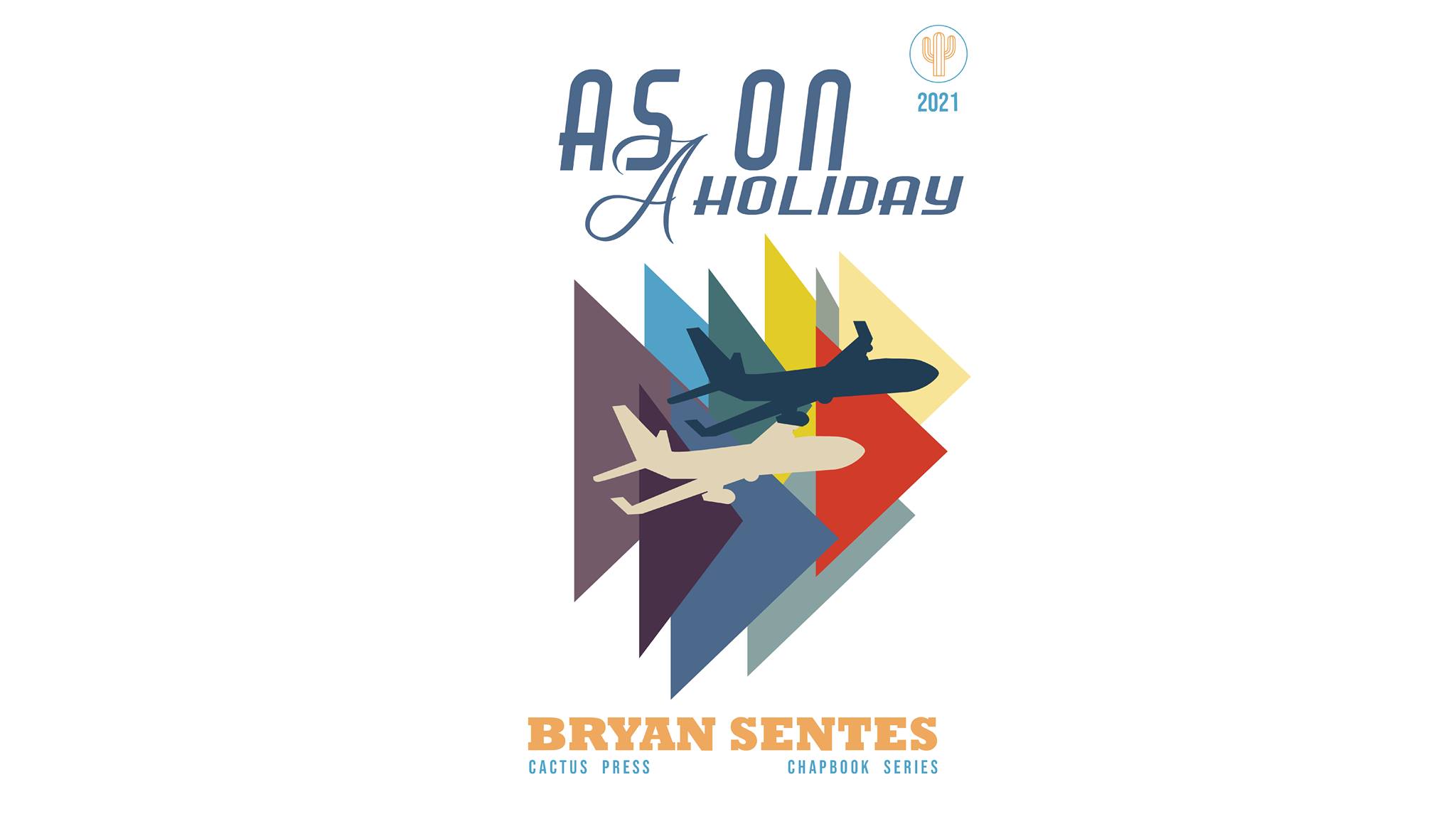
I launch my latest chapbook, As on a holiday, with Montreal’s Cactus Press 24 March 2021 20h00 ET. The chapbook collates four short sequences composed during and about trips to Germany (2012), Slovakia (2014), Toronto (2017), and Saskatchewan (2018).
You can access the Zoom link at the Facebook Event page, here.
You can read an earlier version of one of the poems from the Toronto suite, here.
The indefatigable rob mcclennan has published a wi(l)de-ranging interview with the press’ three editors, here.
I’ve invested this year’s Public Lending Rights cheque in a new microphone, so the sound quality of the launch is sure to be top notch! Copies of the limited-edition chapbook are available in print and electronic formats through the publisher, linked above.
Save the date!
James Dunnigan’s Wine and Fire now available as an e-book
Filed under: The Brouillon | Tags: Cactus Press, Canadian poetry, James Dunnigan, poetry, Wine and Fire
Leave a comment James Dunnigan is one of the most exciting young new poets I know writing today, a claim I make rarely.
Now, his chapbook Wine and Fire is available as an e-book for $5.00 Canadian, less than the cost of a pumpkin spice latte and a hell of lot sweeter and more nutritious!
You can see and hear Dunnigan read, below, and get your e-copy of Wine and Fire, here.
Chez Pam Pam: new volume from George Slobodzian
Filed under: notices and reviews | Tags: Cactus Press, Chez Pam Pam, George Slobodzian, poetry, poetry publishing
Leave a comment George Slobodzian, a poet-friend whose work I’ve admired and often lauded from the  start (over thirty years ago, now) finally has a new volume of poems out: a hefty forty-five-page chapbook Chez Pam Pam from Montreal’s Cactus Press.
For now, it’s readable only as an e-book (for all of CAN$5.00). I look forward to holding the physical volume in hand. In the meantime, you can whet your appetite for the real thing with Slobodzian’s poetry, which is, more importantly, the real thing.
James Dunnigan: new chapbook & interview
Filed under: The Brouillon | Tags: Cactus Press, James Dunnigan, poetry, Wine and Fire
Leave a comment 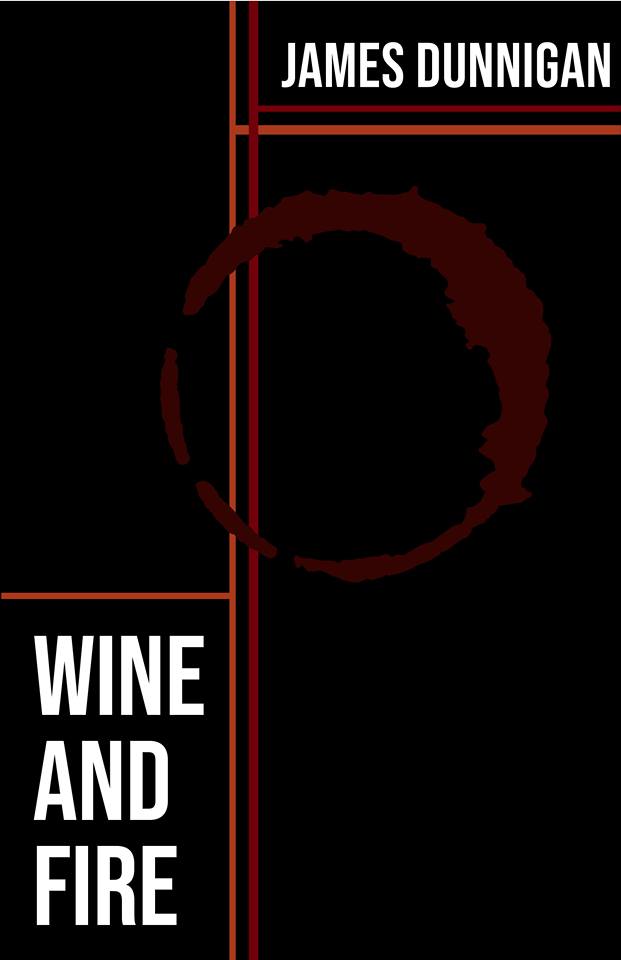
Design: Bianca Cuffaro
James Dunnigan launches his second chapbook Wine and Fire (Cactus Press, 2020) Tuesday 18 February 2020, 20h00 at the Accent Open Mic Vol. 25—Cactus Press launch, La Marche à côté, 5043 St-Denis, Montreal, Quebec. (Facebook Event page, here).
Dunnigan is also the author of The Stained Glass Sequence (Frog Hollow Chapbook Award, 2019) and was shortlisted for the Gwendolyn MacEwen Poetry Prize in 2018. His work has also appeared in CV2, Maisonneuve Magazine, and Montreal Writes. He writes in English and French, reads Latin and sells fish for a living.

You can read a series of five mini-interviews with him, here.
You can see and hear a recent reading, here.
Dunnigan is a singularly gifted young poet. If you’re in Montreal, this launch and this chapbook are not to be missed.

 Poeta Doctus