Archive for the ‘Jerome Rothenberg’ Tag
The Serpent and the Fire and Louis Riel
Filed under: The Brouillon | Tags: Antoine Malette, ethnopoetics, Javier Taboada, Jerome Rothenberg, Louis Riel, poetics, poetry, poetry-in-translation
 Leave a comment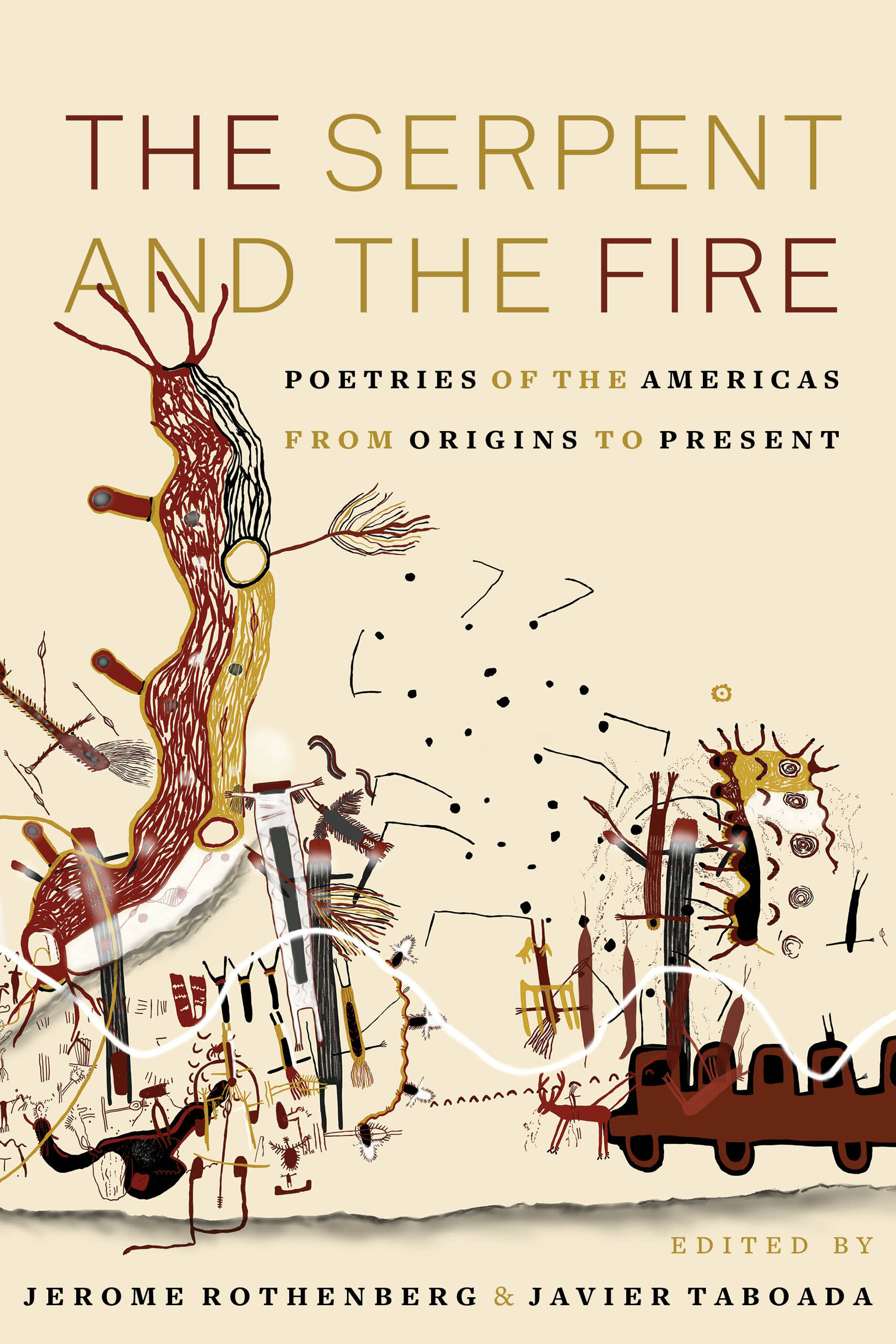
This month marks the publication of the final assemblage of Jerome Rothenberg (with co-editor Javier Taboada), The Fire and the Serpent.
As the publisher’s website tells us:
Jerome Rothenberg’s final anthology—an experiment in omnipoetics with Javier Taboada—reaches into the deepest origins of the Americas, north and south, to redefine America and its poetries.
The Serpent and the Fire breaks out of deeply entrenched models that limit “American” literature to work written in English within the present boundaries of the United States. Editors Jerome Rothenberg and Javier Taboada gather vital pieces from all parts of the Western Hemisphere and the breadth of European and Indigenous languages within: a unique range of cultures and languages going back several millennia, an experiment in what the editors call an American “omnipoetics.”
The Serpent and the Fire is divided into four chronological sections—from early pre-Columbian times to the immediately contemporary—and five thematic sections that move freely across languages and shifting geographical boundaries to underscore the complexities, conflicts, contradictions, and continuities of the poetry of the Americas. The book also boasts contextualizing commentaries to connect the poets and poems in dialogue across time and space.
Included in the volume’s vast spatiotemporal range are poems by bp Nichol and Nicole Brossard, along with a contribution by myself and Antoine Malette, translations of some sections of Louis Riel’s Massinahican. To whet your appetite, I invite you to sample that translation and some remarks about it, here.
And, as an added bonus, I invite you to save 30% when you purchase a copy of this book from the University of California Press website: just enter code EMAIL30 at check out. (Hopefully the cost of shipping and handling won’t negate the savings…).
AN OMNIPOETICS MANIFESTO, from PRE-FACE TO A HEMISPHERIC GATHERING OF THE POETRY & POETICS OF THE AMERICAS “FROM ORIGINS TO PRESENT”
Filed under: The Brouillon | Tags: enthnopoetics, Javier Taboada, Jerome Rothenberg, Louis Riel, Omnipoetics manifesto, poetics
Leave a comment 
I share here an excerpt from the Pre-face to Rothenberg’s and Taboada’s forthcoming assemblage of poetry and poetics from the Americas, from origins to the present. Not only is the omnipoetics manifesto therein of overriding interest in its own right, but Rothenberg’s and Taboada’s anthology also includes a translation from Louis Riel’s Massinahican by Antoine Malette and myself, some of which can be read, here.
The post, first published 4 October 2023, at Rothenberg’s Poems and Poetics blogspot can be read, here.
Absolutely modern Romanticism
Filed under: The Brouillon | Tags: Jeffrey C. Robinson, Jerome Rothenberg, poetics, poetry, Romanticism
Comments (1) 
Welcome news from Jerome Rothenberg concerning a new initiative by Jeffrey C. Robinson, with whom he edited an essential assemblage Poems for the Millennium, Volume Three: Romantic and Postromantic poetry.
Announced is a putative collection of “75 or so statements, terms, and jargon from the ‘Romantic mother-lode’ (Anne Waldman) with the hope that together, with accompanying commentary, they will accumulate irrefutably a major well-spring for modern and contemporary innovative poetry,” a collection that will prompt a “recognition of [romantic poetics] as a loose system of outlandish thought for the renovation of poetry in the service of a renovation of society.” Robinson highlights a handful of salient concerns (in his words): a new view of the world, sub specie aeternitatis; the not unrelated symbolic implications of Jacob’s Dream; the Fragment as Coherence over Unity and the Future; and a stance Against “palpable design”.
Romanticism, as a sensibility, but always too-much anchored to a concept of its being an historical period, has been resurgent, at least, since the reaction to the strictures of (at least, anglophone) literary Modernism (e.g., the criticism of T. E. Hulme, T. S. Eliot, Ezra Pound) and the (ideological) aesthetic of the New Criticism. The poetics at work in the poetry of Robert Duncan and Allen Ginsberg and in the criticism of Harold Bloom, Geoffrey Hartman, and Paul de Man are well-known examples of this countermovement. However, first, with the scholary innovation of “constellation studies” and the resultant, rigorous reappraisal of Jena Romanticism and German Idealism (here, the names Dieter Henrich, Manfred Frank, Philippe Lacoue-Labarthe, Jean-Luc Nancy, and Andrew Bowie are exemplary) through the 1970s and 1990s served (at least among those paying attention) to utterly reorient the place and value of the thinking called “Theory” and the poetics and compositional practice that Theory influenced. Into this context, though with their own perspective on the matter and what’s at stake, step Rothenberg and Robinson with the above-mentioned assemblage (2009), the accompanying volume of poetics Active Romanticism (eds. Julie Carr and Jeffrey C. Robinson, 2015), and Robinson’s just announced project.
However much my own thoughts (and practice) are more or less in harmony with Robinson’s, there are points both of disagreement and concurrence. Coming of intellectual age studying Existentialism and Phenomenology (which, like Sartre, has led to an engagement with Historical Materialism) I’m leery of the invocation of the Spinozistic idea of viewing the world (and human life (and history)) sub specie aeternitatis (though, admittedly, Robinson does spin this notion in his own way). My aesthetic is very much, as I say, “ontological”, attending to what is given as the primary material, a nonjudgemental sensibility as phenomenological, Objectivist, “mindful”, or—as our romantic forbears (and descendants) put it, “prophetic” or “vatic”, an aesthetic that might well be said to be, in Robinson’s words, “forgiving.” In as much as such a stance is variously “estranging”, a literary value articulated by Novalis and Coleridge well in advance of Shklovsky, I am, again, in agreement. More philosophically (if not fundamentally), the view Robinson espouses here is in line with various posthumanist philosophical movements, such as Object Oriented Ontology (despite its antiKantian stance) and Timothy Morton’s not-unrelated Dark Ecology, the renewed interest in psychedelics, and other attempts to re-enchant the world, such as those of scholars Jeffrey Kripal, Jason Ãnanda Josephson Storm, and Marshall Sahlins, currents that pique my curiosity but no less my skepticism.
Robinson’s invocation of the fragment is welcome; my own poetics orbits the metonymical, which is essentially fragmental, in the Romantic sense. I find the futurity of the fragment demands more brow-furrowing; the optimism of writing for the future must, as, for example, much of the early writing of the Beat Generation did under the shadow of nuclear annihilation, be tempered by the very real possibility of cultural-historical foreclosure, the anxiety that has moved many young people from reproducing in the face of the threats of climate change…
What I find of most promise in Robinson’s proposals is his invocation of a poetics that eschews a “palpable design” (“We hate poetry that has a palpable design upon us,” in Keats’ words). This approval might seem jarring in light of my invocation of the climate crisis and my admitted Historical Materialist sympathies, but anyone who has read, for example, Adorno’s essay on the drama of Sartre and Brecht “Commitment” will have a better idea of a writing without “palpable design.” Robinson invokes Vicente Huidbro, the Chilean poet of Altazor, “who locates palpable design as an intrusion of the ‘horribly official stamp of approval of a prior judgment (perhaps of long standing) at the moment of production’.” As Robinson glosses Huidbro:
Palpable design, while it may have been internalized, comes from without, from the social and cultural spheres, from “custom,” from the panopticon, from a voracious market economy with its association of any product, including a poem, with its acquisition, and from gender, race, and class inequities; it appears in poetry as received forms and received modes of speech that produces the familiar and consoling.
Here, Robinson’s writing of the fragment as a “pro-ject” invokes vital aspects of Olson’s Projective Verse as much as Nicanor Parra’s “anti-poetry” and the creative spirit and attendant strange novelty (creation) that runs from Dante, Cervantes, and Shakespeare (the Holy Trinity of the Jena Romantics) down to today. What is demanded by unprecendented times is an unprecendented poetry. Indeed, we live on a planet never inhabited by Homo Sapiens. What more radical call to make it new could be sounded?
“Rothenberg’s concept of ethnopoetics works as a brilliant counter to the dominant literary regime of tight ass Brits and their Yankee counterparts.”
Filed under: Poetry, The Brouillon | Tags: ethnopoetics, Jerome Rothenberg, poetry anthologies
Leave a comment I’ve said to anyone who will listen that any understanding of poetry—what it has been,  is, and can be—ignorant of Rothenberg’s ethnopoetics is rootless and perverse.
Here’s an appreciation of his project I happened on by chance. Poets, ignore it at your peril!
In Good Company
Filed under: The Brouillon | Tags: Ezra Pound, Jerome Rothenberg, Louis Dudek, poems, poetry, Romanticism
Comments (1)  Jerome Rothenberg posted today some poems from his “Pound Project”, a set of sixteen-line poems that riff off lines of Pound’s. Rothenberg writes Pound is “a strong poetry influence for many of us ([him]self [& myself] included)”. And the poetic at work in his series echoes that at work in a sequence of poems I wrote in response to (Ezraversity graduate) Louis Dudek’s penultimate book of poems.
Rothenberg has been an important influence and/or poeticultural coworker for me, too: his Technicians of the Sacred strongly orients my own understanding of what poetry has and can be, and his Poems for the Millenium assemblages, especially Volume III, Romantic and Postromantic poetry, resonate with my own present concerns. It’s good to be in such spiritual, poetic company, however physically distant.
Jerome Rothenberg on “The Symposium of the Whole”
Filed under: The Brouillon | Tags: ethnopoetics, Jerome Rothenberg, poetry
Leave a comment Rothenberg’s Technicians of the Sacred has been central and essential to my understanding of what poetry is and can be since I first started teaching from it at the turn of the millennium. I find it difficult even to discuss poetry and poetics in an informed fashion with anyone unfamiliar with it, or with those equally expansive volumes, assembling poems for the millennium, that followed.
Now, Technicians is being issued in a third edition, fifty years after the first. On this auspicious occasion, Jerome Rothenberg offers some words on the reissue and its timeliness, given the rise of ethnonationalisms, on the one hand, and the on-going extinctions of languages, their poetries, and speakers and singers, on the other. Linked is a talk on the new edition and ethnopoetics given recently at the The Faculty of Arts, The University of Melbourne.
Ignore at the peril to your own poetic spirit.
Symposium of the Whole to be reissued!
Filed under: The Brouillon | Tags: ethnopoetics, Jerome Rothenberg, Symposium of the Whole, Technicians of the Sacred
Comments (1) I’ve often said I have a hard time discussing poetry seriously with anyone unacquainted with Jerome Rothenberg’s groundbreaking assemblage Technicians of the Sacred. Though it is still available, for too long the companion volume of poetics, Symposium of the Whole, has been out of print, and now happy word comes that these two volumes will soon be reissued in updated form.
Read Rothenberg’s original Pre-face and announcement of reissue here.
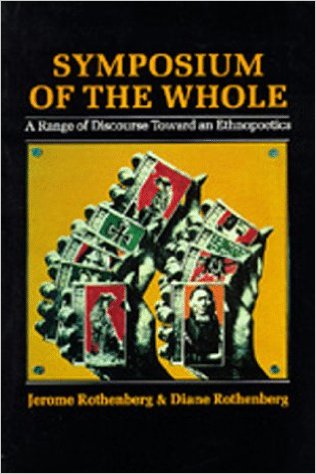
Symposium of the Whole cover

 Poeta Doctus