Archive for the ‘poetry reviews’ Tag
An Old Man’s Eagle Mind: on Peter Dale Scott’s Dreamcraft
Filed under: notices and reviews | Tags: Canadian poetry, Czeslaw Milosz, Dreamcraft, ethogeny, Peter Dale Scott, poetry, poetry reviews
 Leave a comment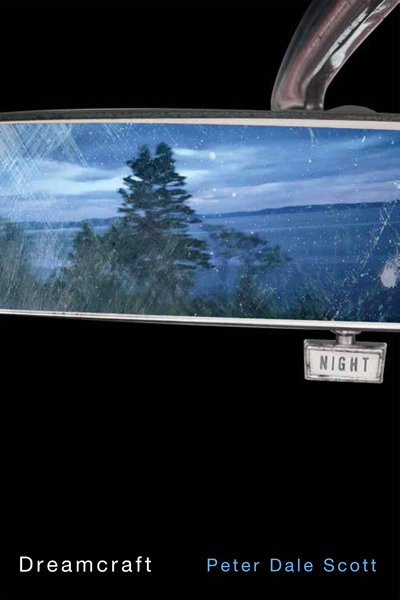
The publication of Peter Dale Scott‘s latest volume of poetry is bookended by last year’s appearance of his study of Czeslaw Milosz, Ecstatic Pessimist, and this year’s release of Reading the Dream: A Post-Secular History of Enmindment, quite the trifecta for a man who turned ninety-five in January of this year (2024).
The poems collected in Dreamcraft, on might say, have vista. This latest volume’s being published in the poet’s ninety-sixth year, it comes as no surprise to find poems on old age. “Eros at Ninety” is both humbly, humorously self-deprecating and wise. “A Ninety-Year-Old Rereads the Vita Nuova” and “After Sixty-Four Years” ruminate over the changing experience of art, here, that of Dante and Grieg, within a lifetime’s perspective. The longer one lives, the more acquaintances one loses to death: elegies for lost friends—Robert Silvers and Scott’s lifelong friend Daniel Ellsberg, among them—take up nearly a third of the book. Four poems are addressed to Scott’s friend, Leonard Cohen, the book’s title track, “Dreamcraft,” the explicit elegy “For Leonard Cohen (1934-2016),” “Commissar and Yogi,” and a poetic back-and-forth the two shared just before Cohen’s death, “Leonard and Peter” (included, as well, in the last collection of Cohen’s work, The Flame). The volume’s perspective, from within “the long curve of life” (words from the book’s first poem, “Presence”) is evident in the poems that embed the poet in larger processes, whether “the bicameral brain that makes // obsfucation of mere fact / so much more beautiful” (“The Condition of Water”), our genetic character (“Dreaming My DNA”), the Earth itself (“Deep Movement”), “cosmic space / …knowable / by those specks of light // at great distance from each other,” or History’s ethogeny, which Scott glosses as “cultural evolution” (“Moreness”). Loss and the long view bring the poet’s closest relations into focus in more intimate poems, those for his daughter, Cassie (“To My Daughter in Winnipeg” and “Missing Cassie”) and wife, Ronna Kabatznick (“Enlightenment” and “Red Rose”).
Last year’s publication of Ecstatic Pessimist: Czeslaw Milosz, Poet of Catastrophe and Hope reveals Milosz as a kind of éminence grise in Dreamcraft (and, indeed, throughout Scott’s poetry). Though their friendship at the University of California, Berkely, was short-lived (roughly from 1961-1967), Milosz’s notions of the function of poetry and the poet, as one whose “poetic act both anticipates [an emancipated] future and speeds its coming,” are determinative: anyone at all familiar with Scott’s poetry and prose will hear the echo of Milsoz’s Nobel Prize acceptance speech: “In a room where people unanimously maintain a conspiracy of silence, one word of truth sounds like a pistol shot.” Scott’s lifelong relationship to Milosz’s poetry and thought, if not with the man, finds expression in the five-part sequence “To Czeslaw Milosz,” wherein Scott reflects on that relationship, one Polish word or one poem or idea at a time. This sequence is balanced, as it were, by “The Forest of Wishing,” originally published in 1965, which addresses (among other things) Milosz’s reaction to the American Counterculture of the 1960s in an earlier style of Scott’s, remarkable for a more elusive density of suggestion than is found in his poetry from Coming to Jakarta (1988) to the present volume.
Scott’s mature style might be said to take its cue from Milosz’s admonition (also from his Nobel Prize acceptance speech) that the poet need “liberate [themselves] from borrowed styles in search for reality.” The result, in Scott’s case, is sure to irritate those readers who need their poetry to “tell it slant” (whether that spring from a post-Eliotean prejudice for “metaphor” or a post-Language demand that the linguistic medium be estranged, if the aesthetic inclination is even so self-aware). A case in point might be the poem “Pig”:
Aside from the poem’s being a recognizably generic “lyric” (a first-person anecdote climaxing in an epiphany), I can well imagine readers with a taste for the mimetic virtues of, say, Seamus Heaney, Eric Ormsby, or (more recently) Kayla Czaga, or the verbal deftness of Michael Ondaatje at his best, dissatisfied with the description of the pig’s butchering (in the second, third, and fourth tercets), desiring in place of, for example, the words ‘slaughtered’, ‘cutting’, and ‘squealing’ at least a more sensuously robust diction if not a vividly inventive image to present rather than refer to the action. Such readers would be even more scandalized by the poem “Mythogenesis” with its opening “The OED defines / both mythopoeia and mythogenesis / as the same: the creation of myths,” lines which set the tone for the explicatory prosaicness of the poem that follows (a prosaicness, however, that slyly reproduces, line for line, the original email sent to the editors of the Oxford English Dictionary). I, too, have struggled for my own reasons with this tendency in Scott’s style over the years, and, were this notice a “review,” I’d be obliged to indulge in the workshop nit-pickery that would find fault with (“criticize”) a certain word choice here, a syntax that might be made more mimetic there, or even the collection’s title, but such an approach too often merely brings into view the reviewer’s prejudices or limitations (let alone the hatchet they might have to grind) than serving to illuminate the work under consideration (a problematic addressed, in fact, by the book’s penultimate poem “A Quinkling Manifesto”). Scott, himself, has responded to critics who find his poetry too prosaic, reminding them the same accusation was levelled at the prosody of Williams Carlos Williams a century ago. One could point to that other compositional sensibility (with which Williams was briefly associated) present in the “Objectivist” poets (notable for their engagement), among them, Lorine Niedecker, Carl Rakosi, or Charles Reznikoff. But more to the point, it is precisely this clinamen of Scott’s style, the way it swerves from any such obvious borrowings or influence, that is an index of that essential drive in his entire oeuvre, a “search for reality,” the telos of his work that is the principle measure of its success or failure, if a critical judgement is indeed called for.
As I’ve observed, the poems in this latest (if not last) volume take the perspective of “an old man’s eagle mind” (as Yeats called it), wherein “the long curve of life” becomes visible, the horizon for whatever else might come into view. This perspective is, perhaps, no more evident than in the book’s final, thought-provoking poem with its explicitly ethogenic theme, “Esprit de l’Escalier“:
The poem, in post-secular fashion, has as its epigraph a verse from the Book of Zechariah (4:6) (Scott the first to my knowledge to articulate a post-secular sensibility, in advance of Habermas’ developing the concept in its present form in 2008), a verse with tonal implications for what follows. We are admonished to “not just talk about politics // which let’s face it / we can do nothing about” (at least those of “us here / at this Chanukah table”) but “about culture // preparing people’s minds / for tomorrow’s revolution” (words which, again, echo Milosz’s “The poetic act both anticipates the future and speeds its coming”). Curiously, the poem speaks of a “black windshield” (likely the image that, in part, inspires the book’s cover art) “smeared… // with the grime of facts,” a brow-furrowing sentiment to flow from the pen of so assiduous a researcher, whose work, prose and poetry, has laboured to uncover that “conspiracy of silence” and scatter it with a resounding “word of truth.” (That is, perplexing as long as we remain insensitive to the potential tonal complexity of ‘facts’ and the even more important and profound distinction to be made between “facts” and truth…). This grime is to be cleaned “with hope,” a hope that waits for “the great poet // on whose shoulder / that eagle flying / above and ahead of us // in the darkness / will come down briefly to rest.” These lines are richly suggestive. On the one hand, they mark Scott, I think, as one of those increasingly rare poets who demand poetry play an orienting if not guiding role in culture and society. On the other, that “eagle flying / above and ahead of us” is at first elusive as allusive. Is it a mere—if complex—metonymy, invoking the eagle’s powers of sight? Does it allude to the eagle formed by the just souls in the heaven of Jupiter in Paradiso XIX? Is it a symbol of God, via the bird often associated with Zeus (‘Z-eus’, ‘d-eus’ (which, regrettably, only rime with ‘th-eo’…))? More tentatively, it brings to this mind, anyway, the idea of the kommende Gott, the “coming god” in Hölderlin’s “Bread and Wine” (however much that god is, in fact, Dionysius…), perhaps that god who is the only one “who can save us” in Heidegger’s late, portentous phrase. This interpretive question is resolved, however, by turning to Reading the Dream, where we discover Scott’s eagle alludes to the spirit of Rousseau in Hölderlin’s ode to the French thinker, that “flies as the eagles do / Ahead of thunder-storms, preceding / Gods, his own gods, to announce their coming” (“wie Adler den / Gewittern, weissagend seinen / Kommenden Göttern voraus“). The rich figurative resonance of these lines that demands such learned, interpretive labour marks them, too, as belonging to a past, if not passed, poetic, one rarely practiced today, if at all.
For many, I think, Scott’s vatic stance in this poem (however domesticated in its opening scene) and the faith in poetry it expresses will place him beyond a certain pale. The present, at least North American, mood is more skeptical. Those with some historical sense will too easily remember those poets who aspired to influence, cultural, social, and political, and went “wrong, / thinking of rightness.” Auden’s words, “poetry makes nothing happen,” still express a common sentiment, and, for those who do engage the question of the relation of poetry and politics seriously, it remains an open-ended, complexly recalcitrant problem. In his defense, Scott, in Ecstatic Pessimist, invokes Virgil, Dante, Blake, Shelley, and Eliot (6). More forcefully, Scott’s study of Milosz is a sustained argument for the potential social force of poetry, exemplified by his subject, notably “his contributions in the 1950s and 1960s to what became the intellectual culture of Solidarność” (5). What is striking is how this last poem in Dreamcraft departs from Scott’s characteristic poetry-of-truths that ring out like “a pistol shot.” It might be argued that its prophetic vision, of that mysterious justice-to-come and its poet, draws on poetry’s power to posit the counterfactual (how matters could or should be, to paraphrase Aristotle), to imagine a non-place (u-topos), a place that is not because it is only yet-to-be, and only potentially so. In contrast to the probing of uncomfortable truths (facts) characteristic of so much of Scott’s poetry, the fictionality of the poem’s vision (its being (only) imagined) invites, demands, a suspension of disbelief (the condition of imagining what is not as if it were), evoking our Negative Capability, that ability to live “in uncertainties, Mysteries, doubts, without any irritable reaching after fact and reason.” By its very unreality, then, the poem evokes that resolve that poetry—and social action—require….
That Scott’s oeuvre in this way, from his Seculum trilogy to Dreamcraft, demands the engaged reader to consider and wrestle with the art of poetry, poetry and politics, investigative fact and visionary fiction is evidence of its sophisticated achievement. Such reflection, it has long seemed to me, is the condition for any understanding of poetry, worthy of the name, an understanding that needs precede any critical appraisal. This resistance to a ready assimilation to existing literary-aesthetic canons—despite the surface, apparently-prosaic transparency of the poetry—testifies to Scott’s poetry’s being poetry, making, creating works possessed of a novel uncanniness that adds something new, not merely accomplished, to the world of letters, if not the world-at-large.
(If so moved, you can purchase a copy of Dreamcraft by clicking on the book’s cover, above.)
On George Slobodzian’s Apokryfa
Filed under: notices and reviews | Tags: Apokryfa, Cactus Press, Canadian poetry, Devon Gallant, George Slobodzian, poetry, poetry chapbooks, poetry reviews, Willow Loveday Little
Leave a comment 
Culture must be—as the word itself might suggest—cultured, seeded and carefully tended. Such care takes many forms in Canada, from ever-diminishing (if however appreciated) government funding, to the selfless, meagrely-rewarded efforts of those who—in the case of our literary culture—publish small magazines and books of poetry, to more grassroots efforts.
In recent years, in Montreal, Devon Gallant and collaborators have cultured an urban poetic garden, organizing the Accent Reading Series, which combines an open-mic (as polylingual as the city) and a spotlight on one or two featured readers, and which has, accordingly, gathered a small, poetic community. One of the fruits of this endeavour is Cactus Press, which, to date, has issued over thirty chapbooks and the first trade edition of the unnervingly-talented Willow Loveday Little, (Vice) Viscera (2022).
One of the newest of these chapbooks is George Slobodzian’s Apokryfa, his second with Cactus Press. Apokryfa gathers eighteen poems, old and new, organizing them in three sections, “In the Garden,” “Et Homo Factum Est,” and “Tale.” The first reflects on childhood and youth, the second works up and on, more-or-less, Catholic mythology, while the last reworks fairy tales. However much at first glance these sections might suggest a progression from autobiographical truth to overt fiction, a more canny, poetic sensibility is at play that subverts such too-easy, hard-and-fast distinctions.
But this sophisticated sensibility is only one aspect of these eighteen poems, which, perhaps more importantly, reveal a poet at the top of his game. While, from the “Tale” section, “Other Dwarves” and “Deliverance” (a riff on “Rapunzel”), might seem relatively light, they are not without their wit (in the case of the former) or rich suggestiveness (in the case of the latter). Most of the poems are, however, so to say, more thematically substantive. “Radisson Slough,” recounting how the boy speaker “Out hunting with [his] father / and brothers, …was the dog,” concerns as much a moment in one’s lifelong loss-of-innocence as much as, perhaps, weightier epistemological matters when “in search of the warm reward / of a grain plump duck,” the boy finds “instead the corpse // of an abandoned crane / half-submerged and corrupt, / its great wings still engaged / in a sort of flight until” he touches it, and it sinks. “The Annunciation” in the chapbook’s second section, “Et Homo Factum Est” grimly recasts the Archangel Gabriel as the agent of some unnamed totalitarian regime with an uncannily ironic gift of prophecy who foretells the life of the expected son, a malcontent (and who wouldn’t be under such a system?) who leads “an entirely unremarkable childhood,” in the end only to “be taken / into the appropriate custody” to finally succumb “to his diseases.” And, in the book’s final section, that persistent question if not problem of “the Subject” (however much presently eclipsed by that of Identity) is taken up in a sly play on Delmore Schwartz’s “The Heavy Bear Who Goes With Me” in “4th Bear” and the provocatively reflexive “Tale” (which begins: “in a dark forest I found you / not knowing you were / the dark forest and the trail / I was following was the trail / I was making those were / my own breadcrumbs…”).
Those with poetic ears attuned to melopoeia will already have remarked the deft, phonemic harmonies of “the warm reward / of a grain plump duck.” Slobodzian’s undeniable prosodic gift (which I have previously remarked), though present, is at once more under- and overplayed, as it were. Though passages of the quality of that from “Radisson Slough” are not infrequent, the language tends to be plainer, shaped more by rhythm than harmony; at the same time, there is, at times, a marked deployment of rhyme (especially in “Rapunzel”). But Slobodzian’s talent and artistry all come together perhaps nowhere most markedly as in “Pysanka (The Written Egg),” from the book’s first section. Here, a boy, barely out of infancy, sits with his grandmother as she draws a stylus “across the surface / of an Easter egg,” while the boy watches. The poem is a small tour de force in the ease with which it delineates a primal moment of culture (the grandmother’s “fingers [know] these things” and take the boy’s hand) and, reflexively, poiesis itself in the image of “the risen sun / a flaming rose / above an endless line.” These three lines should suggest just how extended an exegesis and appreciation the poem calls for.
Gallant and Cactus Press have surely done us a service in collating and sharing this handful of poems. One can only hope there is some acquisitions editor at a trade press with the savvy to offer to gather them into that full-length volume we’ve been waiting for for too long.
Willow Loveday Little on James Dunnigan’s Windchime Concerto
Filed under: The Brouillon | Tags: (Vice) Viscera, Cactus Press, Canadian poetry, James Dunnigan, poetry, poetry reviews, Willow Loveday Little, Windchime Concerto, Yolk Literary Journal
Comments (1) 
Like, wow.
Very happy to share here a brief but no less impactful review/essay by one of Montreal’s—nay, English Canada’s—most exciting young poets on another no less exciting young poet.
You can snag a copy of Little’s first trade edition, (Vice) Viscera, here. Read her review essay here.
(Did I mention the folks at Yolk are doing great things?)
A Sideways Glance at Don McKay’s Angular Unconformity
Filed under: notices and reviews | Tags: Angular Unconformity, Canadian poetry, Canadian Primal, Don McKay, Mark Dickinson, poetry reviews, Robert Bringhurst
Leave a comment Mark Dickinson’s Canadian Primal: Poets, Places, and the Music of Meaning, a groundbreaking study of the lives and work of Dennis Lee, Don McKay, Robert Bringhurst, Jan Zwicky, and Tim Lilburn has been open in my hands since landing there only a few days ago. Having just finished the chapter on Don McKay, I’m reminded I wrote a short notice of McKay’s collected poems  when it appeared in 2014 for a very good website, now defunct. Because it is a sharp, short review, I share it here, now, so it might remain on record. (The curious can read a more sweeping essay on the oeuvre of Robert Bringhurst, here).
“Hard to say this awkwardly / enough”: a review of Don McKay’s Angular Unconformity Collected Poems 1970-2014
Angular Unconformity is hardly amenable to a short review, collecting as it does ten volumes of poetry, supplemented by a sheaf of new work, more than 500 pages, a lifetime of poetic production. Moreover, any reader acquainted with contemporary Canadian anglophone poetry can’t be unacquainted with Don McKay, a two-time winner of the Governor General’s award for Night Field (1991) and Another Gravity (2000) and the Griffin Poetry Prize for Strike/Slip (2006). He is accordingly admired and targeted for these accomplishments and for his influence as an editor and teacher.
Nevertheless, one can characterize the stylistic development of McKay’s poetry with relative ease. The poetics of the first two volumes collected here, Long Sault (1975) and Lependu (1978), are influenced not so much by Purdy or Ted Hughes (as one critic would mysteriously have it) but by the New American Poetry, specifically Olson’s Projective Verse and The Maximus Poems or William Carlos Williams’ Paterson, especially where Long Sault becomes personified in (at least) the book’s fourth section. Lependu torques up the conceit of place and person, in this case London, Ontario and Lependu, in a more focussed, dense, and documentary fashion, but one that is self-aware enough to play fast and loose with its sources for its own artistic ends.
However, with Birding, or desire (1983) McKay finds his groove. In the book’s opening poem “Field Marks” (93) one finds what might be a description of much of McKay’s work from this point on: “…a bird book full of / lavish illustrations with a text of metaphor” (7-8). While in “Adagio for a Fallen Sparrow” (125) in the same volume the poet points to his “shelf / with Keats and Shelley and The Birds of Canada” (21-22). In these lines McKay presciently parodies the reputation this and following volumes will earn him, that of the Nature (i.e. Romantic) poet whose main thematic vehicle is Canada’s birds. Like any parody, however, this one possesses a perverse truth, for a primary objective of McKay’s poetry is one shared with Novalis and Wordsworth, to render the familiar strange, to percieve the things of the world as if for the first time. As McKay writes in the essay “Baler Twine” from Vis à Vis (2001): “in such defamiliarization…we encounter the momentary circumvention of the mind’s categories to glimpse some thing’s autonomy—its rawness, its duende, its alien being” (21). This “circumvention of the mind’s categories” is simultaneously an eschewal of the mind’s drive to dominate via knowing, a refusal of what McKay terms, following Levinas, “the primordial grasp” in favour of a “poetic attention” wherein the poem reaches for “things sensuously through the caress” (23).
The poems caress their objects with two hands: on the one, a fluctuation of lexicon and tone, while, on the other, a protean metaphorization. The poems mix so-called High and Low culture, “lascivious as Beardsley, sweet as Shirley Temple”, the vernacular and the discourses of geology, philosophy, and (of course) ornithology, English and French, gravity and humour. McKay’s artistic drive to refresh perception by means of poetic redescription shares something with the “rosy-fingered dawn.” But his style differs from epic simile or Metaphysical conceit or even that more recent predilection for what John Crowe Ransom termed “texture” (theme developed by a consistent pattern of trope and scheme). McKay’s metaphors are more impulsive and local, often working strictly within the context of the line more than the stanza or entire poem. A map in The Muskwa Assemblage (2008) is “skewed to the diagonal….as though some formerly symmetrical design had been invaded by irresistable divinity, some Dionysus headed northwest”; the reader of the map “might have been a crime scene investigator”, the geograpy variegated “[a]s though deep form, like a medicine dream, were forcing its way up from the mantle” (480).
Readers, then, must negotiate a constantly changing linguistic landscape bent on “the circumvention of the mind’s categories”. These demands aren’t the product of a high-handed virtuousity but the humility that underwrites McKay’s species of “poetic attention” whose restless articulations stammer to admit it’s all too “[h]ard to say this awkwardly / enough” (“February Willows” 3-4, in Sanding Down this Rocking Chair on a Windy Night (1987), p. 191). McKay’s art works against a certain eloquence, against consistency, knowledge, mastery. The first two books possess more a vector of compositional means than the focussed, polished exploitation of a given set of techniques. The constant shifts in vocabulary, tone, and trope, the bad jokes, all serve to puncture the authority of the poet who must work both with and against his poetic fate, inheritor of the Romantic prophetic or vatic mode that humbles itself to take up a poetry of attention anxious to exploit every linguistic resource not for the sake of Art but perception.
Reflections on James Dunnigan’s ‘The Stained Glass Sequence’
Filed under: Praise and Polemics | Tags: Frog Hollow Press, James Dunnigan, poetry, poetry criticism, poetry reviews, The Stained Glass Sequence
Comments (2) I had the chance recently to discuss how James Dunnigan’s The Stained Glass Sequence 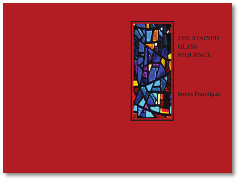 just out from Frog Hollow Press might be received. It’s a weird poem in the context of present-day English-language poetry, with gestures and stances more reminiscent of High Modernism, intricate and allusive, than anything you might read on a visit to, say, the Poetry website….
It was the refractory complexities of just the suite’s title that made me think “How someone who reads poetry can review it is just beyond me….” which I posted on social media, which, in turn, received (among others) a telling reply: “It is a form of reading, at best.”
Taken by itself (the thread did wind on…), this response can be taken to be representative in several ways. First, it assumes the spontaneous authority of the vulgar usage of the verb ‘to read’, an authority that in certain regards is beyond reproach but which is also constantly in danger of asymptoting to the thoughtless. More significantly it enacts precisely what my original post found problematic, since it seems either to refuse or fail to register the stress on ‘reads‘ indicated by the italics (to suggest the word twists in some way from the ordinary sense) and the claim made in the predicate (which further torques the notion of reading from its accepted sense); that is, it doesn’t read or try to understand the original post, seeming more concerned to leave everything the way it is, its complacency disturbed just enough to defend the status quo and defer reflection.
In the same way, many readers will no doubt pass over the implications of the title. If there’s one dogged misperception that has persisted since the late Eighteenth Century it’s the Baconian idea that the word is or should function as a transparent medium, a window onto the world, a notion the title troubles doubly, for stained, unlike transparent, glass, though translucent, colours what might be viewed through it, and, more importantly, its pieces are a medium to compose a design or picture the window frames rather than a view through it. To borrow a two centuries’ old terminology, the title suggests the sequence’s language not so much represents but presents. Any reading, let alone evaluation, of the sequence that fails to assiduously and consistently treat the language as refractory rather than transparent will fail to appreciate it in the first place.
Of course, such reflexivity, a gesture that goes back to Homer, is only a start to the title’s formal sophistication. Its grammar, likewise, throws light on the poem: it is composed of a substantive (‘sequence’) preceded by three modifiers (‘The Stained Glass’…). If one considers the middle two words in themselves, in the etymology that roots their adjectival function, they, too, possess the same syntax, a substantive ‘glass’ modified by ‘stained’. This is to say, the syntax of the title, in a way, is nested, or, better, framed, the way the implications of the title arguably frame, or should, the reception of the poem.
And reading the sequence, the attentive reader will remark how little stained glass or stained-glass windows actually appear in the poem. The sequence opens ekphrastically, describing a painting by Chagall, stained glass is mentioned as such in the second part, the fourth section is in four “panels”, and Michelangelo and the Sistine Chapel are remarked in the fifth. That the poem makes far more consistent reference to painting than stained glass suggests all the more the formal reflexivity of the title than its naming “an important theme” that the sequence takes up and develops.
A careful, thoughtful reader may well mark, too, another complication. The title is, in a way, paradoxical, modifying a temporal noun (‘sequence’, a pattern than unfolds linearly in time) with a spatial modifier (‘stained glass’, a translucent medium that either colours light or is itself used in the composition of a design or picture, a work of art perceived spatially). There is then a tension, as the sequence is, perhaps, a series of spaces arranged in time, though the title names the sequence as a sequence, as a temporal form, as language itself is.
Any reading of Dunnigan’s book that fails to read (in the most emphatic sense) even the title will likewise falter in understanding the sequence the title frames and thereby governs. And if so much is at work even before the first word of the poem is read, let alone on every line, if this reader is a reviewer, how little weight will their judgement carry if they fail to register these first—preliminary, guiding, essential—aspects of the poem?
Two (more) solitudes
Filed under: The Brouillon | Tags: avant-garde, Canadian poetry, Cinema of the Present, experimental poetry, Lisa Robertson, poetry, poetry reviews
Leave a comment Anyone acquainted with English-language Canadian poetry will know that it’s divided into a variety of mutually uncomprehending schools, a staid-of-affairs most recently borne out in a discussion thread concerning a recent review of Lisa Robertson’s Cinema of the the Present in the National Post.
The thread’s originator first took up three strands, more-or-less: the review is “jargon crusted”, often nonsensical and stylistically repulsive. The review, however, employs little jargon: “identity formation,” “deixis,” and “deictic shifters” are the only offenders, and the last two are explained, if a little clumsily; the accusation of nonsense, meanwhile, was quickly downgraded to the charge that the review’s style would fail to excite the “intelligent yet non-specialist reader” to rush out and buy the book.
What strikes me as more curious though is what the review’s “style” indicates about the reception of avant-garde poetry. As one acute interlocutor observed “a poem whose second line is ‘You move into the distributive texture of an experimental protocol’ might be asking for this sort of review,” a remark that might be taken to mean that “experimental” poetry demands a particular response, in this case, one couched in the discourse developed over the past century precisely in answer to new art forms for which no existing critical vocabulary seemed fit. Indeed, ‘shifter’ is a most appropriate term in this respect, introduced by Otto Jespersen in 1923, taken up by Roman Jakobson in 1956 and, most tellingly, by Emile Benveniste, a linguist whose work deeply informs Robertson’s.
In one respect, then, the review might be said to possess a pedagogical purpose, attempting to orient the “ordinary reader” to be better able to approach a work that might otherwise seem outlandish and perplexing. Regardless of its purpose, however, the review’s “content” and “form” should be less disconcerting than its spontaneously possessing a ready fluency to articulate and appreciate an “experimental” work. How “experimental” can a work be, after all, when it is composed and readily appreciated within an already existing set of institutional, artistic-critical conventions? It would seem “experimental” only to those offended by there being more things in the heaven and earth of poetry than they read in their English classes. The review and discussion thread, then, are less indices of the alienation of the “specialist” from the “non-specialist” than of the fractious relativity of two equally well-established schools.
A number of curious implications unfold from this reconfiguration of the issue. Those defenders of the “intelligent yet non-specialist reader” come to appear disingenuous: the criticism of poetry, already a very specific concern, is never merely a matter of intelligence, Eliot’s famous dictum notwithstanding, but is inescapably rooted in education. As Paul de Man observed (in his essay “The Resistance to Theory”): “even the most intuitive, empirical and theoretically low key writers on literature [make] use of a minimal set of concepts (tone, organic form, allusion, tradition, historical situation, etc. ) of at least some general import.” To pretend that the understanding and appreciation of poetry is not enabled and cultured by a particular schooling hides the social specificity of the language(s) of criticism, which is to pretend the language of one group is that common to all, which is to assume a commonality whose universality is merely a repression of difference. The specialized, literary critical vocabulary that sticks out as it does, however, ironically gambles an initial, potentially-alienating difference in the hopes of cashing in on the winnings of a wider understanding, all for the sake of rendering the unfamiliar familiar.
Where it appears perverse to restrict poetry reviewing to a non-technical language (even when it is explained in “layman’s terms”), while terms such as “lipids,” “stem cells,” or even “molecule” for that matter can be found in the same newspaper as the review in question, it seems equally, ironically counterproductive to anaesthetize what is uniquely lively in a work. The criticism that restricts itself to recognizable formulae reinforces the illusion that all is already right with the world and that there is nothing new under the sun that would require an effort at cognition, as true for the resolutely plain-spoken journalist-critic as for the reviewer in question, for whom Robertson’s book can hold no surprises nor upend his critico-theoretical status quo, understanding the work as he does in advance thanks to the conceptual schemata that enable his understanding and appreciation in the first place.
Robertson’s—anyone’s—poetry is surely better served by a—dare I say—”dialectical” criticism, that introduces the work without interrupting the ensuing, hopefully unending and open-ended, conversation that is the life of art and of the mind.
from the Rhein-Neckar-Zeitung 13 June 2013
Filed under: The Brouillon | Tags: George Slobodzian, poetry reviews
Leave a comment 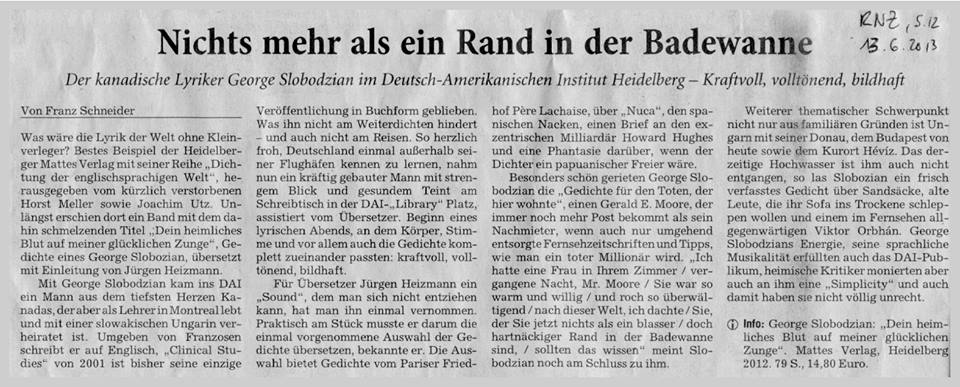
When was the last time you read a review of a poetry READING in a Canadian newspaper? Well, they do it in Germany! Here, of George Slobodzian launching a German-language selection of his poetry in Heidelberg.
On ‘criticism’ and ‘polemic’
Filed under: Praise and Polemics | Tags: Assiniboia, literary criticism, Michael Lista, poetry criticism, poetry reviews, Tim Lilburn
Comments (1) I wasn’t going to comment. I don’t have the time (too busy keeping my head above the term’s end grading tsunami), and I don’t want to tempt the trolls out from under their bridges. And I know despite my most strenuous attempts at clarity I’m going to be maliciously or innocently misunderstood or dismissed. So I’m just going to speak my peace and leave it at that, for now.
The Véhicule Press blog posted an excerpt from Michael Lista’s recent review of Tim Lilburn’s most recent book of poetry (all necessary, contextualizing links can be found on/at the original post). Even the charitable reader at this point has already discerned the proportions of this controversy’s teacup. Now, my point is neither to agree or disagree with Lista nor to damn or defend Lilburn’s book. Rather, I want to take exception to Starnino’s contention that Lista’s review rises from literary journalism to the level of criticism.
I imagine Starnino so approves of Lista’s review because it is articulate, high-spirited, and, most importantly, evaluatively polemical. That the literary values that underwrite the review are those shared by Starnino likely also plays a role in his recommendation. But the point here is not what aesthetic values one holds, but what should count as criticism.
What is lacking in Lista’s polemic is what would make it criticism, namely an autocritical moment. An illuminating literary criticism would—should, to my mind—always relativize itself, openly acknowledging the aesthetic grounds from which it makes its judgements and, as importantly, articulating the aesthetic grounds that orient the practice that it would evaluate. Anyone who understands me will also see, I think, that the kind of discourse I characterize here is inconsistent, shall we say, with the agonistic, but ultimately futile, kind of literary journalistic debate that so exhilarates a certain kind of critic, futile because it only ever sharpens divisions (not, necessarily, an exercise without value) but, worse, congeals and hardens positions, instead of opening them up to the inescapable limitations of their respective perspectives and, most importantly, expanding and quickening literary awareness. Said fault is shared by every camp I know, classicist, mainstream, or avant-garde.
But what I—and I will speak only for myself here—find tiresomely irritating about the passage Starnino quotes from Lista is how Lista’s literary aesthetics is, arguably, snugly (if not smugly) ensconced somewhere in the middle of the Eighteenth century. He would seem to argue against Lilburn that poetry is representational, “anthropomorphizing nature by transubstantiating it into the most human elements—language and metaphor” as he puts it. Well,—and here I write for “the present knowers”—such a philosophically ignorant thesis can only make me shake my head and shudder at the length of the bibliography of suggested, or, in Starnino’s words, “required” reading needed to bring Lista and those of like opinion into even the early Nineteenth century…

 Poeta Doctus