Archive for the ‘The Brouillon’ Category
Concerning Cosmopolitan Poetics
Filed under: The Brouillon | Tags: ethnopoetics, poetics, poetry, prosody, Weltliteratur
 Leave a comment
 The Véhicule Press blog recently highlighted one aspect of Daryl Hines’ poetry picked out for praise by James Pollock, who just edited The Essential Daryl Hines for Porcupine’s Quill here in Canada. Writing of what so impresses him, Pollock remarks that Hines’
knowledge of and engagement with such a wide range of poetic traditions—ancient Greek and Latin, Spanish baroque, Elizabethan, French, American—revealed him as a true cosmopolitan, a perfect antidote to the literary provincialism I’d winced at in so much Canadian poetry.
I share Pollock’s impatient dissatisfaction with artistic and critical parochialism, and Hines’ technique surely evidences a comprehensiveness worthy of respect, but I’d press for a more truly “cosmopolitan” poetics.
Poets have often looked beyond their own borders to refresh and expand their art. Examples are too many: the importation of forms and themes from Moorish poetry into French and Italian in the Middle Ages, French and Italian forms into England in the Renaissance, etc. However, perhaps it was Goethe who first pronounced and praised that literary production is global, a realization later developed in the context of international trade by Marx and Engels in The Communist Manifesto.
Even the limited perspective of the academic history of poetic Modernism tells a story of complementary, temporal extension of poetic tradition and resources. Ezra Pound not only pawed after the ancients of his own Western tradition, but worked to import that of China and Japan. Charles Olson opened the back door of poetry and stepped back to the beginnings of writing and written literature, that of Sumer and the ancient Near East. Gary Snyder went a step further, to include not only the poetry and poetics of Indian, Japan, and China but that of the non-literate peoples of the earth, claiming a poetics that extends to the appearance of homo sapiens. In this project he is joined by among many others Canada’s Robert Bringhurst.
To show and explore concretely that poetry is as universal as language and that it opens itself to include other media, such as dance, painting, and theatre, has been the lifelong task of Jerome Rothenberg. His Technicians of the Sacred, first published in 1968, revised, expanded and reissued in 1984, and due to undergo the same process soon, expands our inherited poetic resources to include in principal all times and places on earth. Rothenberg’s consequent assemblages gather the poetry of the Jewish Diaspora (Big Jewish Book, 1978), American First Nations (Shaking the Pumpkin, 1986 & 2014), poetries of the Americas (America: A Prophecy, 1975 & 2012), revisionings of modernist, postmodernist, and romantic poetries, and, most recently, outsider poetries.
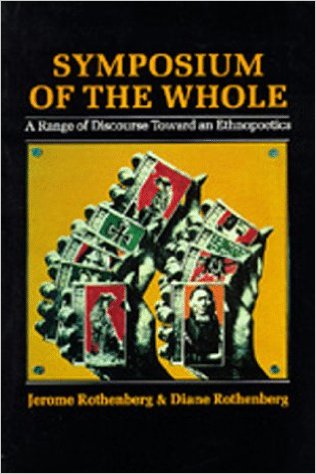
Weltpoesie on this scale radically decentres and contextualizes literate, Eurocentric poetics. Disputes over “meter” are revealed to be only one small conversation within a wildly-diverse, species-wide symposium concerned with poetic technique. Questions about subject matter become laughable in view of everything that has inspired humankind to artfully shape language. Within such a Symposium of the Whole provincialisms that cause some to wince inspire little more than a bemused chuckle, a shake of the head, and a return to the real work.
Reznikoff’s Testimony redux
Filed under: The Brouillon | Tags: Charles Reznikoff, Objectivism
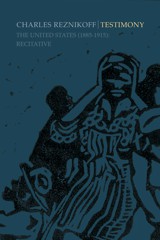
Leave a comment An index of the state of certain suburbs of American poetic culture is Charles Simic’s reading Charles Reznikoff’s monumental work Testimony “for the first time” (!) on the occasion of Black Sparrow’s reissuing it in one volume. However belated, his praise is testimony itself to his acuity and the work’s enduring power.
Black Sparrow is to be lauded for making Reznikoff’s Objectivist epic poem-including-history available again. Order it direct from the publisher by clicking on the cover:
The First Deep State Revolt Against the White House
Filed under: The Brouillon | Tags: deep history, deep politics, Peter Dale Scott
Leave a comment Peter Dale Scott is a poet of singular accomplishment, engaging the political poetically in, among other works, his magisterial Seculum trilogy. He is, as well, a tireless scholar and perspicacious political and social thinker of the American Left, who as good as coined the terms “deep state” and “deep politics” for the Western mind. Now, in advance of a forthcoming book on politics and poetics, appears his latest investigative analysis of the Kennedy assassination Dallas ’63: The First Deep State Revolt Against the White House. Click on the cover for more information!

Yíngēlìshī
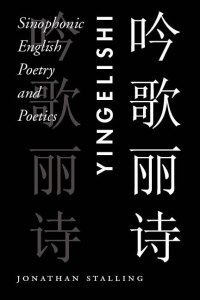
Languages, the wild things they are, have always mixed it up, as the parentage and biography of that mongrel tongue, English, attests. And the literati, too, such as James Joyce or Russell Hoban (among many others) have reimagined and reconfigured the vulgar tongue. Now, to this list, Jonathan C Stalling must be added, with his Sinophonic poetry and poetics of Yíngēlìshī.
Click on the cover of Stalling’s new book for an introduction at Jerome Rothenberg’s inimitable Poetry and Poetics site.
Symposium of the Whole to be reissued!
Filed under: The Brouillon | Tags: ethnopoetics, Jerome Rothenberg, Symposium of the Whole, Technicians of the Sacred
Comments (1) I’ve often said I have a hard time discussing poetry seriously with anyone unacquainted with Jerome Rothenberg’s groundbreaking assemblage Technicians of the Sacred. Though it is still available, for too long the companion volume of poetics, Symposium of the Whole, has been out of print, and now happy word comes that these two volumes will soon be reissued in updated form.
Read Rothenberg’s original Pre-face and announcement of reissue here.
Symposium of the Whole cover
When religion grows up art’s trellis
Filed under: The Brouillon | Tags: Jazz, John Coltrane, New Religious Movements, Religion
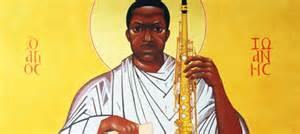
Leave a comment When Christianity began to collapse in Europe in the Nineteenth Century, cultural critics such as Matthew Arnold looked to art to reorient society. Given that religions arguably originate in the experience and attendant creativity around shamanism, Arnold’s notion, knowingly or not, goes back to archaic roots. Here’s a contemporary example of the art spirit inspiring religion, again, the Church of St. John Coltrane.
Two (more) solitudes
Filed under: The Brouillon | Tags: avant-garde, Canadian poetry, Cinema of the Present, experimental poetry, Lisa Robertson, poetry, poetry reviews
Leave a comment Anyone acquainted with English-language Canadian poetry will know that it’s divided into a variety of mutually uncomprehending schools, a staid-of-affairs most recently borne out in a discussion thread concerning a recent review of Lisa Robertson’s Cinema of the the Present in the National Post.
The thread’s originator first took up three strands, more-or-less: the review is “jargon crusted”, often nonsensical and stylistically repulsive. The review, however, employs little jargon: “identity formation,” “deixis,” and “deictic shifters” are the only offenders, and the last two are explained, if a little clumsily; the accusation of nonsense, meanwhile, was quickly downgraded to the charge that the review’s style would fail to excite the “intelligent yet non-specialist reader” to rush out and buy the book.
What strikes me as more curious though is what the review’s “style” indicates about the reception of avant-garde poetry. As one acute interlocutor observed “a poem whose second line is ‘You move into the distributive texture of an experimental protocol’ might be asking for this sort of review,” a remark that might be taken to mean that “experimental” poetry demands a particular response, in this case, one couched in the discourse developed over the past century precisely in answer to new art forms for which no existing critical vocabulary seemed fit. Indeed, ‘shifter’ is a most appropriate term in this respect, introduced by Otto Jespersen in 1923, taken up by Roman Jakobson in 1956 and, most tellingly, by Emile Benveniste, a linguist whose work deeply informs Robertson’s.
In one respect, then, the review might be said to possess a pedagogical purpose, attempting to orient the “ordinary reader” to be better able to approach a work that might otherwise seem outlandish and perplexing. Regardless of its purpose, however, the review’s “content” and “form” should be less disconcerting than its spontaneously possessing a ready fluency to articulate and appreciate an “experimental” work. How “experimental” can a work be, after all, when it is composed and readily appreciated within an already existing set of institutional, artistic-critical conventions? It would seem “experimental” only to those offended by there being more things in the heaven and earth of poetry than they read in their English classes. The review and discussion thread, then, are less indices of the alienation of the “specialist” from the “non-specialist” than of the fractious relativity of two equally well-established schools.
A number of curious implications unfold from this reconfiguration of the issue. Those defenders of the “intelligent yet non-specialist reader” come to appear disingenuous: the criticism of poetry, already a very specific concern, is never merely a matter of intelligence, Eliot’s famous dictum notwithstanding, but is inescapably rooted in education. As Paul de Man observed (in his essay “The Resistance to Theory”): “even the most intuitive, empirical and theoretically low key writers on literature [make] use of a minimal set of concepts (tone, organic form, allusion, tradition, historical situation, etc. ) of at least some general import.” To pretend that the understanding and appreciation of poetry is not enabled and cultured by a particular schooling hides the social specificity of the language(s) of criticism, which is to pretend the language of one group is that common to all, which is to assume a commonality whose universality is merely a repression of difference. The specialized, literary critical vocabulary that sticks out as it does, however, ironically gambles an initial, potentially-alienating difference in the hopes of cashing in on the winnings of a wider understanding, all for the sake of rendering the unfamiliar familiar.
Where it appears perverse to restrict poetry reviewing to a non-technical language (even when it is explained in “layman’s terms”), while terms such as “lipids,” “stem cells,” or even “molecule” for that matter can be found in the same newspaper as the review in question, it seems equally, ironically counterproductive to anaesthetize what is uniquely lively in a work. The criticism that restricts itself to recognizable formulae reinforces the illusion that all is already right with the world and that there is nothing new under the sun that would require an effort at cognition, as true for the resolutely plain-spoken journalist-critic as for the reviewer in question, for whom Robertson’s book can hold no surprises nor upend his critico-theoretical status quo, understanding the work as he does in advance thanks to the conceptual schemata that enable his understanding and appreciation in the first place.
Robertson’s—anyone’s—poetry is surely better served by a—dare I say—”dialectical” criticism, that introduces the work without interrupting the ensuing, hopefully unending and open-ended, conversation that is the life of art and of the mind.
Freeman Ng interviews Peter Dale Scott on his latest work The American Deep State: Wall Street, Big Oil, and the Attack on U.S. Democracy
Filed under: The Brouillon | Tags: deep politics, Peter Dale Scott, The American Deep State
Leave a comment Peter Dale Scott, poet and political thinker and researcher has just published his latest work The American Deep State: Wall Street, Big Oil, and the Attack on U.S. Democracy. Here, Freeman Ng explores Scott’s latest work with the author.
Robert Sheppard: Objectivism and John Seed: Reznikoff, Shelley and the Peterloo Massacre
Filed under: The Brouillon | Tags: Charles Reznikoff, John Seed, Objectivism, Peterloo Massacre
Comments (1) 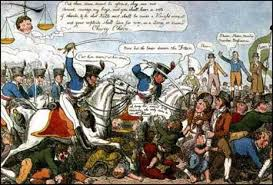 A very interesting (and hefty!) post on Objectivist poetic practice in England, here John Seed’s poem on The Peterloo Massacre composed from tesserae of existing documents. Read it here.
MARTINA PFEILER ON POETRY FILM
Filed under: The Brouillon | Tags: Dave Bonta, Martina Pfeiler, poetry, poetry film, ZEBRA Poetry Film Festival
Leave a comment What happens when poetry meets the moving image, when poetry goes “intermedia”? Here’s an interview with American Studies and Intermedia scholar Dr Martina Pfeiler on poetry film conducted during the Zebra Poetry Film Festival this October in Berlin. As the interviewer Dave Bonta says: “The conversation [is] wide-ranging… covering such topics as how poetry film fits into the larger context of poets’ use of technology, how poetry films may be used in the classroom to introduce students to poetry as a whole, and how the ZEBRA Poetry Film Festival has changed (or not changed) over the years.”

 Poeta Doctus