Archive for the ‘The Brouillon’ Category
Welcome, Kim Hyesoon!
A pithy, short introduction to the poetry of Hyesoon:
“We carve on our body what society teaches us and continue this task, not knowing the identity they force us to have. This identity is carved on our faces and our skins. Not knowing our bodies have become “the paper made of human meat,” we stuff our bodies and make them a theater where cultural symbols or suppressed symbols play. It is not possible to explain women’s poetry until you sympathize with how women painfully go through the experience of having these tattoos carved on their bodies. At this point, women’s language is the butcher’s language who sells his or her body. It is grotesque and miserable.”

Kim Hyesoon’s viscerally charged poetry channels the violence of South Korea and global capitalism. She writes out of illness and ecstasy. Instead of standing aside and criticizing global capitalism, she moves through its sick movement with grotesque humor: In “I’m OK, I’m Pig”, she becomes the mass-slaughtered pigs. The result is funny and horrifying:
 Kim Hyesoon PHOTO: Private
“We return as hot pigs
We return for our final act
The act in which our fingers rot
even before we lie down in our coffins.”
(from Marilyn Monroe, translated by Don Mee Choi)
This is not poetry for those readers who want to be uplifted or who want to be given an easy political stance. Kim writes not out of an enlightened state but out of a state saturated with illness and violence.
When asked why she started to write, Kim replies that she was introduced to poetry when she…
View original post 337 more words
The Dance of the Syllables: some remarks on prosody
Filed under: The Brouillon | Tags: melopoiea, poetics, poetry, poetry criticism, prosody
 Leave a comment
  Recently, a friend shared a link to an interview with Australian poet Robert Adamson citing this remark on craft as a teaser: “Poetry is song, every word in every line must work, each word transcribed like a note, each line connected to a breath.”
Whatever the merits of Adamson’s poetry, this observation on the art of poetry is just plain hokey. The identification of poetry with song is threadbare and, in a sense, disingenuous, unless he really is setting words to music. Likewise, that “every word in every line must work” (though clearly intended prescriptively) states little more than the principle of parsimony, an element of literary competence, the assumption that no element of a work of art is nonfunctional. When he goes on to equate words with notes in a song, he departs from the identification or metaphor he starts with (or, more charitably, develops it along his own lines for his own purposes) as songs notate, more or less, the syllables of their words. And to “connect” each line to a breath is belated at best, questionably phonocentric at worst. Sadly, such homespun poetics appear more the rule than the exception.
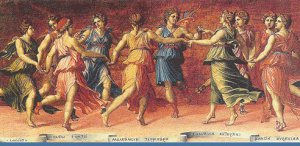
Instead of equating poetry with song one could as easily characterize the recitation of a poem as a dance, not of the whole 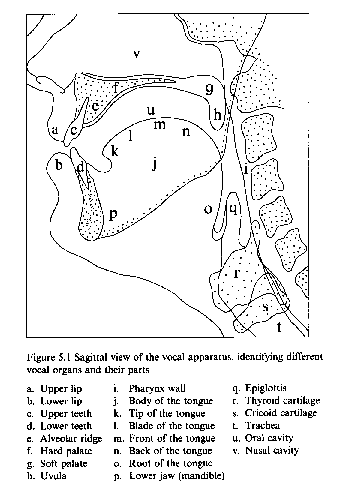 body but, at a minimum, the vocal apparatus. After all, reciting a poem demands the articulation of the phonemes that constitute its utterance by means of the complex but no less describable movement of the vocal organs and their parts. The written text of a poem imagined this way is not a musical score but a choreography. Of course, reciting a poem demands more than just speaking its words: posture (standing or sitting, for example), facial expression, and gesture, all bodily movements, are included, all aspects of the poem’s performance here conceived as dance.
The connection between poetry and dance is at least as time-honoured as that of poetry with song. The traditional manner of describing a poem’s prosody is scansion, the analysis of the line into its constituent feet and their stresses. The study of scansion is inherited from the days when education included the parsing of Greek and Latin verses both in terms of their grammar and their meter. The study of poetry in school finds an important precursor in the memorization of the Homeric epics in antique Athens, where schoolboys would learn the poems through a combination of stamping their feet and gesturing. This seated dance mimicked the more recognizable one of the tragic chorus whose dance steps were timed to its chanted lines, a performance descended from the ritualistic origins of classical drama. Those imitators of Greek culture, the Romans, not only adopted the pedagogical practices of their models, but also integrated it into their military training, wherein the legionnaires, wielding weapons and wearing armour twice the weight of the usual, drilled chanting and stepping in time, a performance in line with the diction of The Iliad that describes the fighting of its heroes as a war dance. This relation of scansion to archaic rite doubtless prompted Ezra Pound’s observation that “Music begins to atrophy when it departs too far from the dance… poetry begins to atrophy when it gets too far from music.”
However illuminating these reflections on the poetic foot may be, that scansion past and present pupils sweated through and rolled their eyes over was already outmoded in the 1920s when the Russian Formalists began to apply the powerfully precise methods of modern linguistic analysis to the meter and rhythm of poetry, rising to the challenges of establishing a “science” of literary study and of finding a way to appreciate and meaningfully discuss the radically novel Zaum poetry their friends the Futurist poets had just started composing. Anyone with even a passing acquaintance with an introductory linguistics textbook or the application of linguistic methodology to the acoustics of poetry will likely wince at well-meaning but ponderously quaint pronouncements on the poetic art, such as that by Adamson.
But even “scientifically” precise descriptions of a poem’s sound can never escape the abstractness that lends them their power of articulation. What opened my ears to poetic meter was hearing Yeats recite “The Lake Isle of Innisfree.” Regardless of the merits of Yeats’ performance, one can’t help but discern the “tune” (as Yeats called it) that orchestrates his recitation. Metrical systems are only the faintly waling ghosts of the melody a poem is sung to. When one combines this understanding with Carlyle’s observation that “all speech, even the commonest speech, has something of song in it: not a parish in the world but has its parish-accent;—the rhythm or tune to which the people there sing what they have to say” then by a constant, arduous practice of “close listening” the music of poetry and even everyday speech fills the ear and refines and quickens the appreciation of poetry. As Pound admonishes in his Treatise on Metre: “LISTEN to the sound it makes.”
(An application of the notions sketched here can be read in my appreciation of the sound of a short poem by Elaine Equi.)
Why “you can’t teach writing”
Filed under: The Brouillon | Tags: creative writing, literary criticism, literary theory, poetry, poetry criticism
Leave a comment “We never hear that music cannot be taught, painting cannot be taught, filmmaking cannot be taught. Writing is fraught with more industrial insecurities, I fear, than some of the other disciplines.”
Paul Vermeersch writes these two sentences in a passing response to “The Persistence of the Resistance to Theory”. The distinction that troubles him between “writing [and] some of the other disciplines” may be accounted for by some arts being more mediate than writing. Music, painting, filmmaking, photography, and sculpture, for that matter, all demand acquaintance with an instrument: obviously in the case of music; brush, pigments, palette and other implements in the case of painting; and so on. Writing, however, appears to the layperson to require only literacy or in the case of oral language arts even only the voice. It might be objected singing and dancing are as immediate as the voice and body, but both seem special occasions of each, speaking and writing more basic, as thinking, the dialogue of the soul with itself or what one attempts to merely attend in meditation, appears to intimate. Of course the writer and writing teacher beg to differ: the poem or story are not just thinking or talking; creative writing is an art or craft where language is the medium worked. No matter how spontaneous or plain spoken a poem, say, may appear—and even if it is in fact spontaneous or improvised—its language is organized in an artificial manner.
The very words “creative writing workshop” imply—and its practice is premised upon the assumption—that creative writing is a teachable, learnable craft. If the master is to teach the apprentice, they must share a metalanguage, a discourse that articulates the materials and practices of that art and that expresses value judgments. This discourse may be called a “poetics”, not of the theoretical kind typified by Aristotle’s Poetics—a description, analysis, and evaluation of the art by a non-practitioner—but more akin to Horace’s Ars Poetica, practical guidance of an acknowledged master offered to an aspiring neophyte. Ironically, while creative writing teachers will vehemently defend the artificiality of literary language, too often (in my experience, at least) they assume the language of their poetics is somehow natural and its value system intuitive. Worse, too often, precisely because the terms of their poetics is assumed to be natural, they assume it is as unproblematically shared with the apprentice.
Despite the distinction between theoretical and practical poetics, the practical language of the workshop is heavily indebted to the theoretical language of the English class, i.e., literary criticism. Of course, the corollary is also true: the language of the master informs that of the teacher: the poetics of Horace, Wordsworth, Coleridge, or Henry James are fed back in to the merely scholarly study of literature. But creators learn their terms in the classroom. Neither scholarly nor creative discourse can claim priority; they are mixed at the source, because the art of writing assumes what the ancients called grammar, literacy, and one’s taught reading and writing in school. Not only are the languages of criticism and creation impossible to disentwine, they are also diverse and relative. The notion of poetry as craft was energetically applied by the Russian Futurists before the Great War, for example, with their doctrine of “the self-sufficient word” and their emulation of the factory worker or craftsman, an approach summed up neatly by the painter Dmitriev: “the artist is now simply a constructor and technician.” Their poetic, as articulated by their scholarly co-workers the Russian Formalist critics, spoke of “materials” and “devices” with a dispassionate, scientific technicality and precision that makes the terminology of most criticism or poetics seem quaint. This approach to the craft of poetry finds analogues in anglophone poetics, in the “bald statement” William Carlos Williams makes in his introduction to The Wedge (1944), “A poem is a small (or large) machine made of words,” and in creative writing pedagogy where the Russian Formalist concepts of “defamiliarization” and “device” are used alongside exercises in proceduralist composition in the manner of the OULIPO or present-day Conceptualism. That such poetics also find inspiration and conceptual resources in literary theory should not go unremarked.
Regardless of the impossibility of a purely practical poetics, the knotiness of poetics, criticism, and theory being snarled together, or debates about the merits of competing creative writing pedagogies, doubts remain whether writing can be taught. Such skepticism cannot be dismissed as easily as pointing out it depends upon an outmoded, questionable notion of genius. Who can deny that the increasing plethora of creative writing programs results in an increasing homogenization of literary practice? My own experience is telling: every year I teach the latest Journey Prize Stories and invariably I find the creative-writing-school-trained jury members award first prize to the story worthy an A+ in a creative writing class while the edgy, lively work, worthy an A for Art, is overlooked, precisely because of the prejudices inculcated in the course of the jurors’ educations. What can be taught is technique, but technique without the natural gift of talent is merely mechanical or at best competent. The art of writing (or music, or painting, etc.) can be taught, but not what might make it Art.
On the Psychotherapeutics of Poetry: two questions on some remarks by Sean Haldane
Filed under: The Brouillon | Tags: Bruce Andrews, neuropsychology, Nick Piombino, poetry, poetry criticism, Sean Haldane
Leave a comment In an interview that resurfaced from the collective unconscious of the internet’s servers, Sean Haldane, poet and clinical  neuropsychologist, makes two remarks that raise some questions for me.
Reflecting on his lifelong psychotherapeutic practice, Haldane says he thinks “poetry has more capacity to change people than psychotherapy. If you read a poem and it gets to you, it can shift your perspective in quite a big way, and writing a poem, even more so.” Does this—can this—reflection hold for poetry that radically suspends reference or defamiliarizes the language? I can see it holding for Dante’s Commedia, but does it for Bruce Andrews‘ Lip Service or the work of Nick Piombino, a practising psychoanalyst associated with the L=A=N=G=U=A=G=E school? The aesthetic ideology that underwrites Haldane’s use of ‘perspective’ here is perhaps crucial in this matter.
Haldane sums up some of his findings on poetry’s workings on the brain thus: “Neuropsychology can help to explain poetry, to demystify the impulse. There has been work done on why poetry can send shivers down our spine. The poem activates the same parts of the brain that react when a child is separated from its mother. A deep sense of separation and longing.” Anyone engaged with Theory in the Twentieth Century must wonder what Freud or Lacan would have to say about that “deep sense of separation and longing” and its consequences for reading if not writing poetry!
I pose these questions as sincere—not merely rhetorical—questions: they open doors for speculation and research and perhaps even tentative conclusions I haven’t time to pursue here and now.
Baraka in 2010: a final interview
Filed under: The Brouillon | Tags: Amiri Baraka, Beat Poetry, L=A=N=G=U=A=G=E poetry, Marxism, poetry
Leave a comment 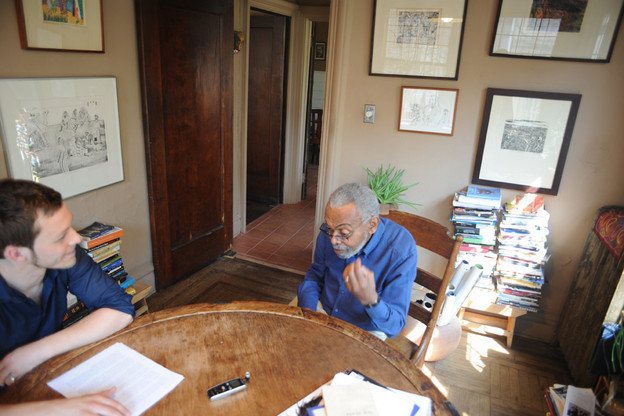 Dennis Büscher-Ulbricht, a crackerjack Amerikanistik scholar, interviews Amiri Baraka in an informed, engaged, and compelling way–a must-read for anyone concerned with “engaged” art. Read it, at Jacket2, here
Barbarian benefits
Filed under: The Brouillon | Tags: foreigness, Johannes Göransson, linguistics, Montevidayo blog, poetry, poetry criticism, Roman Jakobson, translation, Yoko Tawada
Leave a comment Those who know will know the English word barbarian comes from the ancient Greek for foreigner, barbaros, one who speaks a foreign tongue so other it resembles a dog’s barking, bar bar! Presently, I’m in Würzburg, Germany to participate in a workshop at an academic conference, and, although I do speak some German, my fluency places me outside the community of those for whom German and its local dialect(s) are their mother tongue, which (along with a taste of the local, famous vintage) gives rise to the fragmentary notes that follow on this experience of being a linguistic outsider.
1. A while back Johannes Göransson posted on Montevidayo a short quotation from Yoko Tawada that made me impatient, as it seemed to draw too neat a contrast between the reflexive transparency of the mother tongue and the relative opacities of a foreign language. Those of us who have ever had to take a “critical” or “hermeneutic” stance toward a poem in our mother tongue, or one informed by linguistics, know that such a stance distances, renders foreign or other, the mother tongue, such that its strangeness and materiality come into view. One need think only of Roman Jakobson’s (in)famous analysis of the linguistics and consequent aesthetics of “I like Ike” to understand that all discourse is always susceptible to a “defamiliarizing” gaze. However, it struck me as I ordered this evening’s dinner that when I speak German I hear my voice as if it were someone else’s, very differently from how I hear myself speak my mother tongue, which speaking I identify with my thinking, my stream-of-consciousness, and hence with myself. Though I can readily function in German, in a very pedestrian manner, when I speak in German I don’t exactly hear myself speaking German but another, “me-speaking-German.” This effect arises in part due to the relative opacity of the German I speak and hear: I may know (or believe I know) what I’m saying, but I still hear the sound of words more than their meanings, a kind of phonic residue that hangs in the air, the opposite of what happens when I speak English, where the sound of the words is muted by their meaning. Happily, there are moments of sufficient immersion, excitement or engagement, that are self-forgetful, when I do arrive at an immediate fluency, an identification. Of course, in such an instance, as the multilingual will know, when I speak German I am different from myself when I speak my mother-tongue. Fluent or not, the foreign tongue distances the speaker from (in this case) himself….
2. A tremendous benefit of abiding in a place alone where one is hardly fluent in the local dialect(s) is that one ends up talking to oneself, i.e., as Plato would have it at least, thinking, and, therefore, for a writer, in the best of all possible worlds, writing.
Comrade Kots: A Poem by Kirill Medvedev
Comrade Kots: A Poem by Kirill Medvedev
If you didn’t snag this link somewhere else on the web, here it is!
On the anniversary of massive protests in Moscow ahead of Vladimir Putin’s third presidential inauguration, the writer and labor activist Kirill Medvedev shares a poem whose title derives from a nickname he was given by Russia’s secret police agency, the FSB.
“the haven from sophistications and contentions”–a translation of George Slobodzian’s “Happy Hour”
Today, I read on Facebook a friend rightfully take to task a new anthology of Canadian poetry for its lack of translations. Later, I read how one poet tweeted squibs over a retrograde and self-indulgent column that riled a friend of the columnist to snark back via his own blog while everyone ignores the column’s sentiment was preemptively taken down by happy synchronicity days before. A poet-publisher laments the roadblocks to conversation and posits turning his back on the futility of finding the like-minded to work it all out in private in his journal instead. Meanwhile, the work goes on, here, a translation, from English to French, of a fine, understated lyric, “Happy Hour”.
Amy King’s Third Way
Stein may not be your tray of brownies like she is for Amy King, but in the course of her guest post over at the Poetry Foundation King makes a sweet observation, not without pertinence to the Canadian situation:
Most of us, I think, are exposed to smalls swaths cut from the vastness of poetry, focused on our own shores, but that is a betrayal created by a myopic education system and the mentality of “best of” lists and ranking systems we’re expected to fight through for recognition. When I see “Best of” in a title, I ask, “Best for what?” On the surface, ours is a misguided view of what poetry can be, what it can do. There is an American poetry spectrum that seems to be pinned on either end by notions of “accessibility” and “obscurity” or “mainstream” and “avant-garde.” Even our two major critics, Helen Vendler and Marjorie Perloff, are considered coach-advocates for those camps. Such western concepts mislead with their dichotomous proclivities and really only serve the business end of poetry relegated to the creation of anthologies, book promotion and sales, distribution of reading funds and platforms, academic job descriptions and canon-making syllabi. They obscure what poetry does in the world, to and for people, and how poetry broadens and deepens perspectives as lenses we are born to, craft from, and process through.
Publisher of the Month: BookThug : Small Press Distribution
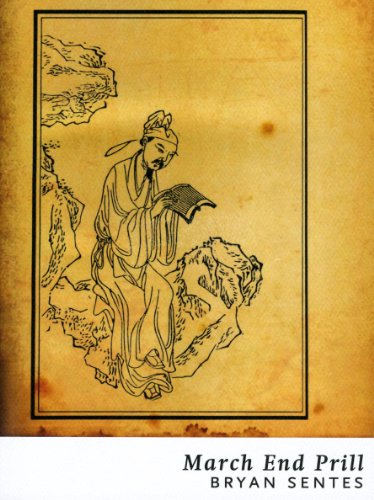
March End Prill
If you didn’t get your copy of March End Prill when it came out, here’s your chance to get it at nearly half price, as BookThug is Publisher of the Month at Small Press Distribution. BookThug is one eclectic publisher, so a quick browse of its list is likely to turn up other valuable discoveries, never mind the mindboggling offerings at SPD.

 Poeta Doctus